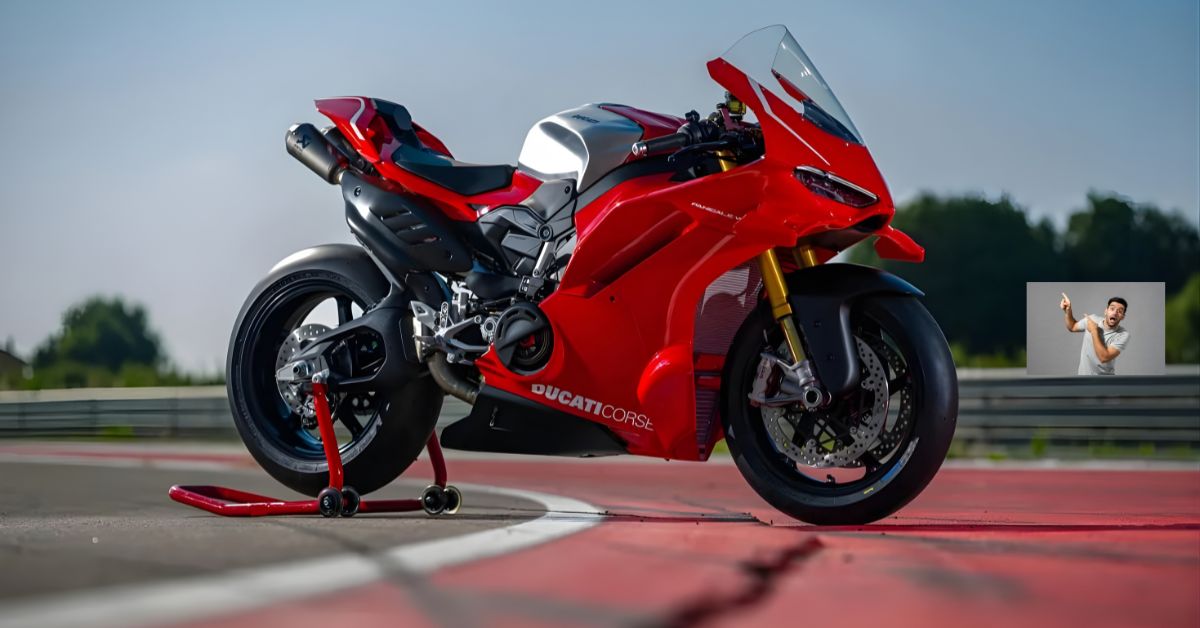
The Panigale S1000RR Review is a title that encapsulates the ultimate rivalry in modern motorcycling, bringing together the two definitive machines that rule the open-class superbike segment: the passionate, torque-rich Italian dominance of the Ducati Panigale V4 S and the ruthless, electronic precision of the German engineering masterpiece, the BMW S 1000 RR. These motorcycles are not simply transport; they are highly specialized, street-legal missiles, direct descendants of MotoGP and World Superbike racing programs, offering their riders over $200\text{ horsepower}$ in a package weighing less than $200\text{ kilograms}$. Analyzing this dual benchmark requires a deep dive into the conflicting philosophies of their engines, the advanced processing power of their electronic brains, and the immense financial commitment required to experience this level of two-wheeled performance in India. This extensive, expert analysis defines the features, dissects the benefits, and concludes the ultimate verdict on the performance war waged by the bikes that together embody the spirit of the Panigale S1000RR Review class.
The Heart of Performance: V4 vs. Inline-Four Power Delivery Philosophies
The core difference and the most compelling aspect of the Panigale S1000RR Review rivalry lie in the opposing philosophies of their engines, which define their unique performance characters and exhaust notes.
The Ducati Desmosedici Stradale V4
The Panigale V4 S utilizes Ducati’s ferocious $1103\text{cc}$ Desmosedici Stradale V4 engine, a unit engineered directly from MotoGP racing experience. This engine is a masterpiece of compact design, featuring a counter-rotating crankshaft—a unique racing element that counteracts the gyroscopic forces of the wheels, enhancing agility and reducing the effort required to initiate a lean into a corner. Its V4 configuration, with its wider bore and shorter stroke than the BMW, provides an intoxicating character, delivering a searing peak power output often exceeding $219\text{ horsepower}$ at $13,500\text{ rpm}$ and a higher peak torque of $120.9\text{ Nm}$ that arrives earlier in the mid-range. This power delivery is aggressive, torque-laden, and accompanied by a unique, thunderous V4 sound that is guttural at low speeds and transitions into a thrilling, rapid snarl under full acceleration. The Panigale specializes in raw, explosive, high-torque performance that makes every ride feel like a special event.
The BMW Inline-Four and ShiftCam Technology
The BMW S 1000 RR adheres to the traditional Japanese superbike formula with its $999\text{cc}$ water/oil-cooled in-line four-cylinder engine, but elevates it with advanced German precision and technology. This engine, optimized for the liter-class racing category, delivers a powerful $\sim 209\text{ horsepower}$ at an even higher $13,750\text{ rpm}$ and $113\text{ Nm}$ of torque. The S 1000 RR’s defining mechanical feature is BMW’s ShiftCam technology, a sophisticated system that varies the valve timing and valve lift on the intake side. This allows the engine to offer two distinct operating profiles: a smooth, refined, torque-rich delivery necessary for comfortable road riding at lower RPMs, and a massive, aggressive power spike for maximum attack on the track at high RPMs. The result is a more manageable and linear engine that builds power smoothly, contrasting with the immediate aggression of the V4, yet still achieving a blistering top speed often exceeding $300\text{ km/h}$. The inline-four produces a signature, turbine-like mechanical wail at high revs, characterized by its mechanical smoothness and rapid accumulation of speed.
The Digital Battlefield: Electronics and Rider Aids
In the hyper-performance class defined by the Panigale S1000RR Review, the true limit is no longer the engine’s power, but the electronic brain’s ability to manage it. Both bikes are equipped with state-of-the-art electronic suites governed by a highly sensitive Six-Axis Inertial Measurement Unit (IMU), which monitors the bike’s pitch, roll, and yaw in real-time.
Ducati’s Track-Focused Precision
The Panigale V4 S specializes in track electronics, designed to make the rider faster and safer on a closed circuit. Its system includes sophisticated features such as Ducati Slide Control (DSC), which allows the skilled rider to control controlled power slides out of corners; Engine Brake Control (EBC), which optimizes deceleration under heavy braking; and multiple levels of Ducati Wheelie Control (DWC) and Ducati Traction Control (DTC) that are all seamlessly integrated with the high-performance Cornering ABS EVO. This suite gives the rider a precise, surgical level of control over the bike’s dynamics, making it feel less frantic and more composed at the very limit of adhesion.
BMW’s Seamless Safety and Road Integration
The BMW S 1000 RR offers equally advanced electronics but emphasizes safety and real-world commuting ease. Its system includes Dynamic Damping Control (DDC), which electronically and automatically adjusts the semi-active suspension based on the riding mode and surface conditions, providing optimal comfort on the road and firm damping on the track. BMW’s ABS Pro system offers superior calibration for braking while leaned over, a feature critical for road safety. A unique and practical feature is standard Cruise Control and Hill Start Control, acknowledging that even a superbike must occasionally navigate traffic or highways, making the S 1000 RR comparatively more comfortable and user-friendly for daily duties than its Italian counterpart. Both utilize the advanced Shift Assist Pro (quickshifter) for clutchless upshifts and downshifts, a technology crucial for maintaining momentum and minimizing lap times.
Chassis Mastery: Handling, Weight, and Aerodynamics
The chassis and suspension systems showcase another divergence in engineering philosophy between the two contenders in the Panigale S1000RR Review class.
Ducati’s Lightweight Monocoque
The Panigale V4 S utilizes an Aluminium Alloy Front Frame (Monocoque) structure, where the engine itself is a stressed member of the chassis. This design drastically saves weight and improves stiffness, contributing to its extremely low kerb weight of approximately $191\text{ kg}$. The V4 S features fully adjustable Öhlins electronic suspension (NPX25/30 fork and TTX36 rear shock), which provides ultimate damping control and performance specifically optimized for track attack. The bike’s razor-sharp handling, coupled with the standard fitment of aerodynamic winglets that generate significant downforce (up to $30\text{ kg}$ at $270\text{ km/h}$), ensures the Panigale remains firmly planted and stable under extreme acceleration and heavy braking.
BMW’s Bridge Frame and Agility
The BMW S 1000 RR employs a traditional Bridge-type Frame utilizing cast aluminum, with the engine acting as a co-supporting element. Despite this traditional frame, the BMW is astonishingly light, with a kerb weight around $197\text{ kg}$. The BMW specializes in effortless agility, often cited by riders as requiring less effort in rapid side-to-side transitions due to its lightweight construction and narrower chassis. The S 1000 RR features its own signature aerodynamic winglets which generate up to $23.1\text{ kg}$ of downforce at $300\text{ km/h}$, preventing front-wheel lift and improving braking stability. Suspension utilizes the Dynamic Damping Control (DDC) system, an electronically adjustable setup that continuously monitors damping levels, providing a highly adaptive and compliant ride tailored to the chosen riding mode.
Pros, Cons, and the Track vs. Road Verdict
The assessment of the Panigale S1000RR Review rivalry comes down to a clear choice between committed, exotic aggression and refined, high-speed engineering.
Ducati Panigale V4 S: Pros and Cons
Pros: Unmatched emotional appeal and prestige; the sensational, high-torque V4 engine sound; specialized track electronics (DSC, EBC); superior componentry (Öhlins, Brembo); and low kerb weight.
Cons: Very aggressive and committed riding posture, making long road rides demanding; significantly higher acquisition cost; known for generating considerable heat directed towards the rider; and higher long-term maintenance costs associated with Desmodromic valves.
Read More: Dodge Viper 2026
BMW S 1000 RR: Pros and Cons
Pros: Supreme high-speed stability and agile handling; rider-friendly technology (Cruise Control, DDC suspension); lower acquisition and maintenance costs compared to the Ducati; and the sophisticated ShiftCam engine that offers smooth power delivery across all RPMs.
Cons: The inline-four engine, while fast, can lack the raw character and sound of the V4; and the electronic intervention, though excellent, can feel more clinical than the Ducati’s raw feel.
Price in India and Long-Term Value
The price disparity is the final and most significant factor differentiating the two bikes in the Panigale S1000RR Review class. The BMW S 1000 RR is positioned as the more accessible German superbike, with the Standard variant starting around $\text{₹}22.76\text{ Lakh}$ (ex-showroom) and the top-tier Pro M Sport variant reaching up to $\text{₹}27.84\text{ Lakh}$. This pricing offers phenomenal performance for the money and is backed by BMW’s more comprehensive service network.
Conversely, the Ducati Panigale V4 S carries the premium associated with Italian exotic engineering and superior componentry. The V4 S variant is priced significantly higher, starting around $\text{₹}39.0\text{ Lakh}$ (ex-showroom), a financial commitment that is nearly $\text{₹}12\text{ Lakh}$ higher than the top BMW model. While the Ducati offers slightly more power and higher specification components, this price premium reflects its exclusivity, brand prestige, and the cost of its specialized V4 engine technology. Both motorcycles, however, offer superior long-term value in the used market due to their status as segment benchmarks, maintaining high resale value driven by the enduring demand for flagship performance.
The search results reveal several key trends defining the 2026 motorcycle landscape:
- Royal Enfield’s 650cc Expansion: New models using the proven 648cc twin.
- Affordable Premium Adventure: New localized models from BMW (in partnership with TVS) and a stronger push from Hero.
- Mid-Capacity Twins/Quads: New 400cc to 500cc twins/singles from international brands (CFMoto, Brixton, Honda).
- Electrification: New EV models are expected in the mid-range performance segment (Ultraviolette, Ola, RE Himalayan Electric).
I will structure the article around these trends.
The Two-Wheeled Transformation: Key Motorcycle Launches Defining the Indian Market in 2026
The year 2026 is poised to be a period of significant evolution for the Indian motorcycle market, characterized by an unprecedented influx of new models across crucial segments, ranging from accessible adventure tourers built through global manufacturing partnerships to the expansion of premium, powerful offerings and a serious push into electrification. The overall trend showcases manufacturers aggressively localizing production and filling previously existing gaps in the 300cc to 500cc space, providing consumers with sophisticated technology and refined performance at increasingly competitive prices, fundamentally reshaping the buying decision for the next generation of riders.
The Royal Enfield 650cc and 450cc Offensive
Royal Enfield, maintaining its position as the segment leader in the mid-capacity space, is strategically expanding its already successful twin-cylinder platform while simultaneously solidifying its all-new 450cc offerings. The highly anticipated Royal Enfield Bullet 650 is slated for launch in early 2026, integrating the renowned 648cc parallel-twin engine, known for its smooth power delivery and highway manners, into the iconic, traditional silhouette of the Bullet. This combination will appeal directly to the massive traditionalist audience who demand the classic Bullet aesthetic but desire the modern, vibration-free performance and higher output necessary for reliable long-distance touring. Complementing this is the expected 2026 Royal Enfield Super Meteor 650 update, focusing on subtle refinements and feature enhancements to maintain its premium cruiser appeal, including potential comfort upgrades and minor aesthetic tweaks. Beyond the twins, Royal Enfield is also building upon the success of its Himalayan 450 platform with the launch of the Royal Enfield Continental GT 450, a sportier café racer that will utilize the high-performance Sherpa 450cc engine, promising a lighter, more agile, and spirited riding experience than its 650cc counterpart, appealing to the younger, performance-conscious retro segment.
The Rise of Affordable Premium Adventure and Touring
A major trend defining the 2026 launches is the proliferation of high-specification adventure touring motorcycles made accessible through localization and strategic partnerships. The BMW F 450 GS stands out as the most crucial launch in this category, set to replace the outgoing G 310 GS as the new entry point into BMW Motorrad’s adventure lineup. This machine, developed in partnership with TVS Motor Company and manufactured in India, features a new 420cc parallel-twin engine delivering around 48 hp of power, coupled with advanced features like a 6.5-inch TFT display and cornering ABS, positioning it to compete directly with the Royal Enfield Himalayan 450 and the KTM 390 Adventure but with the added prestige and expected quality assurance of the BMW badge. Similarly, the long-awaited Honda CB500X is confirmed for an India launch, bringing its renowned reliability, refined 471cc twin-cylinder engine, and comfortable road-biased adventure credentials to the market. This segment is further enhanced by models like the TVS Apache RTX 300, an indigenous adventure tourer utilizing the 312cc platform co-developed with BMW, and the arrival of international brands like Brixton with the Crossfire 500 Storr, which adds a distinctive, rugged European styling and a 486cc parallel-twin engine to the growing competition.
Performance and Niche Segment Additions
The performance motorcycle segment, particularly in the 300cc to 500cc bracket, is seeing crucial updates that maintain rider interest and provide accessible track-focused options. KTM is expected to refresh its lineup with the KTM RC 390 and potentially introduce the KTM RC 160, bringing its aggressive styling and track-focused performance down to new price points. Yamaha is also making a concerted effort to strengthen its premium performance portfolio with the anticipated launch of the New Generation Yamaha R3 and the aggressively styled Yamaha MT-03, both of which utilize the company’s parallel-twin 321cc engine, ensuring they remain compelling alternatives for sportbike and naked street enthusiasts. Furthermore, Hero MotoCorp is expected to elevate its adventure game with the Hero Xpulse 421, utilizing a larger 400cc liquid-cooled engine designed for better highway performance and off-road capability than its smaller siblings, targeting the enthusiast who seeks an affordable, high-performance homegrown ADV. On the electric front, the Ola Electric Diamondhead and models from Ultraviolette, such as the X44 and Tesseract, promise to bring high-performance, digitally connected electric mobility to the market, challenging the dominance of traditional ICE sports bikes with instantaneous torque and futuristic design concepts. These launches collectively ensure that 2026 will offer a machine for every rider, from the committed adventure enthusiast to the daily commuter seeking unparalleled performance and efficiency.