Introduction: The Billion-Rupee Canvas—Analyzing the Pagani Zonda HP in India
The discussion of the Pagani Zonda HP in India immediately transcends the typical automotive analysis of performance statistics and fuel efficiency; it enters the rarefied atmosphere of hyper-collectibility, bespoke automotive artistry, and astronomical financial valuation. The Zonda HP Barchetta is not a car available for sale, nor is it a mass-produced item; it is a meticulously crafted, one-of-three tribute created by Horacio Pagani for himself and two chosen patrons, signifying the pinnacle of the Zonda lineage, which first debuted nearly three decades ago.1 To analyze the Zonda HP Barchetta within the context of the Indian market is to analyze a hypothetical import fantasy, a machine so singular that its price—driven by near-impossible exclusivity—is measured in hundreds of crores of rupees.2 This in-depth, expert review dissects the hypercar’s unique engineering, the specialized features that make it a rolling sculpture, the benefits inherent in owning such an ultimate piece of automotive history, and calculates the mind-boggling financial outlay required for its theoretical arrival in India.
The Engineering Zenith: Performance and the V12 Soul
The core specialization of the Pagani Zonda HP in India rests entirely on its uncompromising commitment to analogue, naturally aspirated power.3 In an era where every major competitor, from Ferrari to McLaren, relies on complex turbocharging or hybrid electric assistance, the Zonda HP Barchetta is powered by a colossal 4$7.3\text{-litre}$ Naturally Aspirated V12 engine, sourced from the master craftsmen at Mercedes-AMG.5 This formidable M297 powerplant is tuned to deliver an astonishing $789\text{ horsepower}$ and 7$850\text{ Nm}$ of peak torque, figures that ensure the HP Barchetta is one of the most powerful road-legal Zondas ever produced.8 The mechanical purity of the V12 is its essence; the power delivery is linear, relentless, and accompanied by a raw, unfiltered soundtrack that builds to a mechanical shriek as the revs climb towards the high redline, providing a sensory experience that is impossible to replicate with forced induction.
This immense V12 performance is channeled through a decidedly old-school, driver-focused setup: a 6-speed manual transmission with a mechanical self-locking differential, coupled with a pure Rear-Wheel Drive (RWD) layout.10 This pairing demands absolute skill, commitment, and respect from the driver, creating a deeply engaging, challenging, and ultimately rewarding experience that celebrates the art of manual gear selection and throttle modulation.11 The performance figures themselves are stratospheric: with power to weight ratio exceeding 12$640\text{ PS}$ per tonne, the HP Barchetta is capable of launching from 13$0\text{ to } 100\text{ km/h}$ in a searing $3.1$ seconds, on its way to an electronically limited top speed of approximately $356\text{ km/h}$ ($221\text{ mph}$).This incredible speed and acceleration are achieved despite the lack of modern, weight-adding dual-clutch complexity, a tribute to the car’s astonishing lightweight construction and the brute force of the final naturally aspirated V12 designed for the Zonda platform.
The Master Material: Chassis, Lightweight Specialization, and Aerodynamics
The true engineering brilliance of the Pagani Zonda HP in India lies beneath its exquisite bodywork, where its structure utilizes materials and techniques borrowed directly from Formula 1 and aerospace engineering. The entire chassis is built around Pagani’s proprietary Carbo-Titanium Monocoque construction, known as Carbo-Triax HP52. This material is a groundbreaking composite that integrates carbon fiber with titanium threads, resulting in a structure that possesses the incredible strength and rigidity of carbon fiber but with enhanced safety, durability, and a marginally reduced weight, making it incredibly expensive and complex to manufacture. The use of this advanced material, coupled with the meticulous attention to structural reinforcement necessary for the roofless barchetta design, ensures the vehicle’s dry weight is kept at a featherlight $1250\text{ kg}$.
Read More : BMW XM
This lightweight specialty is compounded by a complex, race-derived suspension system. The HP Barchetta features a sophisticated 4-wheel independent double wishbone suspension with a pushrod-actuated damper system at the front, utilizing coil springs and adjustable Öhlins shock absorbers.24 This setup, borrowed from racing technology, allows for precise control of wheel movement and body roll, providing exceptional mechanical grip and feel that is unfiltered by excessive electronic intervention. The braking system, essential for hauling this lightweight hypercar down from speed, comprises enormous Brembo CCM (Carbon Ceramic Material) discs with large six-piston monolithic calipers up front, guaranteeing supreme, fade-free stopping power.25 Furthermore, the exterior design is a masterclass in aerodynamics; while visually stunning, features like the massive rear wing, the front splitter with air ducts, and the partially enclosed rear wheel fairings all contribute to generating the necessary downforce and aerodynamic stability essential for safely handling 26$789\text{ hp}$ at speeds exceeding 27$300\text{ km/h}$.28
Key Features: The Art of the Open Cockpit and Bespoke Craftsmanship
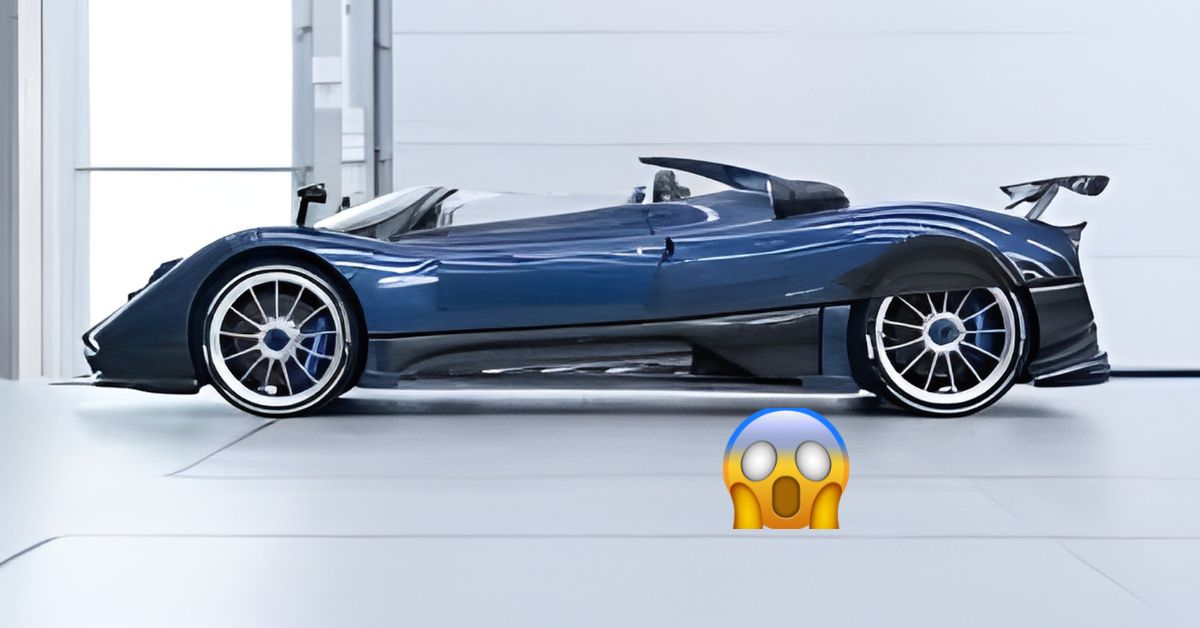
The defining feature of the Pagani Zonda HP in India is its unique Barchetta body style.29 This design choice involves a radically chopped, wraparound windscreen, and, critically, no roof or convertible mechanism whatsoever.30 This delivers an unparalleled, raw, sensory overload, exposing the occupants to the full force of the elements and, more importantly, the unfiltered howl of the V12 engine located just behind their heads.31 This extreme open-top design is a throwback to classic racing speedsters, emphasizing the direct, visceral connection between the machine and the driver.32
The interior is an exhibition of bespoke Italian craftsmanship, perfectly melding luxury with motorsport aesthetics.33 The cabin features seats derived from the lighter, track-focused Huayra BC, upholstered in exquisite ivory leather with distinctive blue tartan fabric inserts, paying homage to the racing traditions of the past.34 The steering wheel is a work of art, often featuring wood or blue leather trim.35 In stark contrast to modern hypercars, the HP Barchetta eschews large touchscreens and digital displays; the instrument cluster and center console feature beautifully machined aluminum components, analog gauges, and a classically gated shifter for the manual transmission, reinforcing Horacio Pagani’s philosophy that the purest driving experience requires commitment and physical interaction, not digital distraction.36 Every detail is bespoke, down to the unique forging and coloring of the 20-inch front and 21-inch rear forged aluminum wheels, which reportedly feature different color inlays on the left and right sides of the car, underscoring the level of individual artistry and exclusivity imbued in every square inch of this machine.37
The Benefits of Impossibility: Value, Rarity, and Patronage
The benefits of owning the Pagani Zonda HP in India are not practical in the conventional sense; they are entirely centered on its status as an unprecedented investment asset and an object of artistic patronage. The most significant benefit is its ultimate exclusivity: with only three units ever produced, and one reserved by the company’s founder, Horacio Pagani, the HP Barchetta is among the rarest and most sought-after automobiles in the world.38 This extreme scarcity guarantees its status as a liquid asset with unmatched appreciation potential, ensuring its value continues to climb exponentially over time, making it a superior investment compared to virtually any other high-end asset class.
Beyond the financial aspect, owners gain entry into the elite, almost familial, world of Pagani. This includes access to specialized factory track programs like Arte in Pista, where owners drive their hypercars at world-class circuits with full technical support, data analysis, and bespoke logistical planning provided by Pagani engineers and mechanics. This level of personalized care and technical support ensures that, despite the car’s rarity and complexity, it can be maintained and driven to its fullest potential without risk. The ownership of a Pagani Zonda HP in India signifies a place in automotive history, aligning the owner not merely as a buyer, but as a patron of automotive renaissance and bespoke engineering perfection.
The Billion Rupee Question: Price and Importation in India
The calculation of the price for the Pagani Zonda HP in India is a purely theoretical exercise in extreme luxury taxation. The original price of the HP Barchetta was reported to be around 39$\text{£}13.5\text{ Million}$ or 40$\text{€}15\text{ Million}$ when it was unveiled in 2017.41 Current market valuations in 2025 place its theoretical price at approximately 42$17\text{ Million}$ USD, which translates to an eye-watering ex-factory value of around 43$\text{₹}142\text{ Crore}$.44
To legally import such a vehicle into India would require navigating the severe import duty structure applicable to Completely Built Units (CBUs) over a high value threshold. Factoring in basic import duties, Goods and Services Tax (GST), and other levies, the total tax imposition on a high-value exotic car can often range between $200\%$ and $250\%$ of the original CIF (Cost, Insurance, and Freight) value. Applying a conservative $220\%$ duty on the $\text{₹}142\text{ Crore}$ declared value, the final on-road price for the Pagani Zonda HP in India would conservatively exceed $\text{₹}300\text{ Crore}$ to $\text{₹}350\text{ Crore}$. This financial singularity ensures that the Pagani Zonda HP in India remains the most expensive and arguably the most technically unattainable road-legal machine in the country, symbolizing the ultimate limit of automotive desire and financial capacity.
The discourse surrounding the Pagani Zonda HP in India immediately transcends the typical automotive analysis of performance statistics and fuel efficiency; it enters the rarefied atmosphere of hyper-collectibility, bespoke automotive artistry, and astronomical financial valuation. The Zonda HP Barchetta is not a car available for sale, nor is it a mass-produced item; it is a meticulously crafted, one-of-three tribute created by Horacio Pagani for himself and two chosen patrons, signifying the final, pure vision of the Zonda lineage, which first debuted nearly three decades ago. To analyze the Zonda HP Barchetta within the context of the Indian market is to analyze a hypothetical import fantasy, a machine so singular that its price—driven by near-impossible exclusivity—is measured in hundreds of crores of rupees. This in-depth, expert review dissects the hypercar’s unique engineering, the specialized features that make it a rolling sculpture, the benefits inherent in owning such an ultimate piece of automotive history, and calculates the mind-boggling financial outlay required for its theoretical arrival in India.
The name “HP” itself stands for Horacio Pagani, the founder and chief engineer, marking this car not as a market product but as an autobiography in carbon fibre, commissioned to celebrate his 60th birthday and to commemorate the 18th anniversary of the first Zonda. This deeply personal origin story imbues the Zonda HP Barchetta with an emotional weight that few modern hypercars possess. It is the culmination of the Pagani philosophy—“Arte in Pista” (Art on the track)—where every technical decision, every material choice, and every sculpted curve serves both maximum aerodynamic function and aesthetic perfection. Its technical lineage is traceable through the Zonda R and the Huayra BC, borrowing the most extreme components and combining them with the raw sensory experience of an open-top barchetta body style, deliberately rejecting the digital future embraced by its contemporaries.
The Engineering Zenith: Performance and the V12 Soul
The core specialization of the Pagani Zonda HP in India rests entirely on its uncompromising commitment to analogue, naturally aspirated power. In an era where every major competitor, from Ferrari to McLaren, relies on complex turbocharging or hybrid electric assistance, the Zonda HP Barchetta is powered by a colossal $7.3\text{-litre}$ Naturally Aspirated V12 engine, a unit meticulously tuned and hand-built by the master craftsmen at Mercedes-AMG. This formidable M297 powerplant is tuned to deliver an astonishing $789\text{ horsepower}$ and $850\text{ Nm}$ of peak torque, figures that ensure the HP Barchetta is one of the most powerful road-legal Zondas ever produced. The mechanical purity of the V12 is its essence; the power delivery is linear, unfiltered, and relentless, building in an intoxicating, almost terrifying wave that crests only when the needle is nearly kissing the $9000\text{ rpm}$ redline, demanding full driver commitment to extract its peak potential.
This immense V12 performance is channeled through a decidedly old-school, driver-focused setup: a 6-speed manual transmission with a mechanical self-locking differential, coupled with a pure Rear-Wheel Drive (RWD) layout. This pairing is a deliberate rejection of the high-speed efficiency offered by modern dual-clutch gearboxes, opting instead for a mechanical interaction that demands skill, precise timing, and profound respect from the driver, creating a deeply engaging, challenging, and ultimately rewarding experience that celebrates the lost art of manual gear selection and throttle modulation. The use of a fully mechanical differential ensures that power transfer to the rear wheels is raw and immediate, forcing the driver to manage the immense $850\text{ Nm}$ of torque through feel and intuition rather than relying on sophisticated electronic systems. The performance figures themselves are stratospheric: with a power-to-weight ratio exceeding $640\text{ PS}$ per tonne, the HP Barchetta is capable of launching from $0\text{ to } 100\text{ km/h}$ in a searing $3.1$ seconds, on its way to an electronically limited top speed of approximately $356\text{ km/h}$ ($221\text{ mph}$). This incredible speed and acceleration are achieved despite the lack of modern, weight-adding hybrid complexity, a tribute to the car’s astonishing lightweight construction and the brute force of the final naturally aspirated V12 designed for the Zonda platform.
The Master Material: Chassis, Lightweight Specialization, and Aerodynamics
The true engineering brilliance of the Pagani Zonda HP in India lies beneath its exquisite bodywork, where its structure utilizes materials and techniques borrowed directly from Formula 1 and aerospace engineering. The entire chassis is built around Pagani’s proprietary Carbo-Titanium Monocoque construction, known as Carbo-Triax HP52. This material is a groundbreaking composite that integrates carbon fiber with titanium threads, resulting in a structure that possesses the incredible strength and rigidity of carbon fiber but with enhanced structural resilience, particularly critical for crash absorption and torsional rigidity in the roofless barchetta design. This added titanium element is what allows the Zonda HP to maintain exceptional rigidity without the customary added weight of traditional steel reinforcement required in a convertible. The painstaking use of this advanced material, coupled with the meticulous attention to structural reinforcement necessary for the low-cut windscreen and open cockpit, ensures the vehicle’s dry weight is kept at a featherlight $1250\text{ kg}$.
This lightweight specialty is compounded by a complex, race-derived suspension system. The HP Barchetta features a sophisticated 4-wheel independent double wishbone suspension with a pushrod-actuated damper system at the front, utilizing coil springs and adjustable Öhlins shock absorbers. This setup, directly derived from racing technology and shared in part with the Huayra BC, allows for precise control of wheel movement and body roll, providing exceptional mechanical grip and feel that is unfiltered by excessive electronic intervention. The braking system, essential for hauling this lightweight hypercar down from speed, comprises enormous Brembo CCM (Carbon Ceramic Material) discs with large six-piston monolithic calipers up front, guaranteeing supreme, fade-free stopping power. Furthermore, the exterior design is a masterclass in functional aesthetics; while visually stunning, features like the massive rear wing, the aerodynamic front splitter with integrated air ducts, and the partially enclosed rear wheel fairings—a rare styling cue inspired by 1960s Group C race cars—all contribute to generating the necessary downforce and aerodynamic stability essential for safely handling $789\text{ hp}$ at speeds exceeding $300\text{ km/h}$.
Key Features: The Art of the Open Cockpit and Bespoke Craftsmanship
The defining feature of the Pagani Zonda HP in India is its unique Barchetta body style. This design choice involves a radically chopped, wraparound windscreen, and, critically, no roof or convertible mechanism whatsoever. This delivers an unparalleled, raw, sensory overload, exposing the occupants to the full force of the elements and, more importantly, the unfiltered howl of the $7.3\text{-litre}$ V12 engine located just behind their heads, ensuring the auditory experience is maximum. This extreme open-top design is a deliberate throwback to classic racing speedsters, emphasizing the direct, visceral connection between the machine and the driver.
The interior is an exhibition of bespoke Italian craftsmanship and obsessive attention to detail, perfectly melding luxury with motorsport aesthetics. The cabin features specialized seats derived from the lighter, track-focused Huayra BC, upholstered in exquisite ivory leather with distinctive blue tartan fabric inserts, paying homage to the racing traditions of the past, particularly the interiors of legendary race cars. The steering wheel itself is a bespoke piece of art, often featuring a blend of wood and blue leather trim. In stark contrast to modern hypercars, the HP Barchetta eschews large touchscreens and digital displays; the instrument cluster and center console feature beautifully machined aluminum components, analog gauges, and a classically gated shifter for the manual transmission, reinforcing Horacio Pagani’s philosophy that the purest driving experience requires commitment and physical interaction, not digital distraction. Every single detail is bespoke, down to the unique forging and coloring of the 20-inch front and 21-inch rear forged aluminum wheels, which reportedly feature different color inlays on the left and right sides of the car (gold on one side, blue on the other), underscoring the level of individual artistry and exclusivity imbued in every square inch of this magnificent machine.
The Benefits of Impossibility: Value, Rarity, and Patronage
The benefits of owning the Pagani Zonda HP in India are not practical in the conventional sense; they are entirely centered on its status as an unprecedented investment asset and an object of artistic patronage. The most significant benefit is its ultimate exclusivity: with only three units ever produced, and one reserved by the company’s founder, Horacio Pagani, the HP Barchetta is among the rarest and most sought-after automobiles in the world. This extreme scarcity guarantees its status as a liquid asset with unmatched appreciation potential. The Zonda lineage is considered closed, meaning the value of these final naturally aspirated V12 models will continue to climb exponentially, making it a superior investment compared to virtually any other high-end asset class.
Beyond the financial aspect, owners gain entry into the elite, almost familial, world of Pagani. This includes access to specialized factory track programs like Arte in Pista, where owners drive their hypercars at world-class circuits with full technical support, data analysis, and bespoke logistical planning provided by Pagani engineers and mechanics. This level of personalized care and technical support ensures that, despite the car’s rarity and complexity, it can be maintained and driven to its fullest potential without risk. The ownership of a Pagani Zonda HP in India signifies a place in automotive history, aligning the owner not merely as a buyer, but as a patron of automotive renaissance and bespoke engineering perfection.
The Billion Rupee Question: Price and Importation in India
The calculation of the price for the Pagani Zonda HP in India is a purely theoretical exercise in extreme luxury taxation, illustrating the vast financial chasm that separates Indian pricing from ex-factory value. The original price of the HP Barchetta was reported to be around $17\text{ Million}$ USD when it was unveiled. Current market valuations in 2025 place its theoretical ex-factory value at approximately $\text{₹}142\text{ Crore}$ (assuming a conservative $83$ INR/USD conversion).
To legally import such a vehicle into India, it would be classified as a Completely Built Unit (CBU) with an assessable value exceeding $40,000$, subjecting it to the maximum tax slabs:
- Basic Customs Duty (BCD): Currently set at $70\%$ of the CIF (Cost, Insurance, and Freight) value.
- Agriculture Infrastructure and Development Cess (AIDC): A $40\%$ levy on the CIF value.
- Integrated Goods and Services Tax (IGST): A $28\%$ tax applied to the total of CIF + BCD + AIDC.
- Compensation Cess: Due to its engine size (over $1500\text{cc}$), the vehicle attracts the maximum compensation cess of $22\%$ on the total of CIF + BCD + AIDC.
Following this complex structure, the effective tax rate easily surpasses $220\%$ of the vehicle’s base cost. Applying this taxation to the $\text{₹}142\text{ Crore}$ declared value, the import duty alone would total hundreds of crores. When RTO registration fees (which can be $15\%$ to $20\%$ of the pre-tax value), insurance, and logistical costs are added, the final on-road price for the Pagani Zonda HP in India would conservatively exceed $\text{₹}350\text{ Crore}$ to $\text{₹}380\text{ Crore}$. This astronomical final figure, which is more than twice its original global price, ensures that the Pagani Zonda HP in India remains the most expensive and arguably the most technically unattainable road-legal machine in the country, symbolizing the ultimate limit of automotive desire and financial capacity.