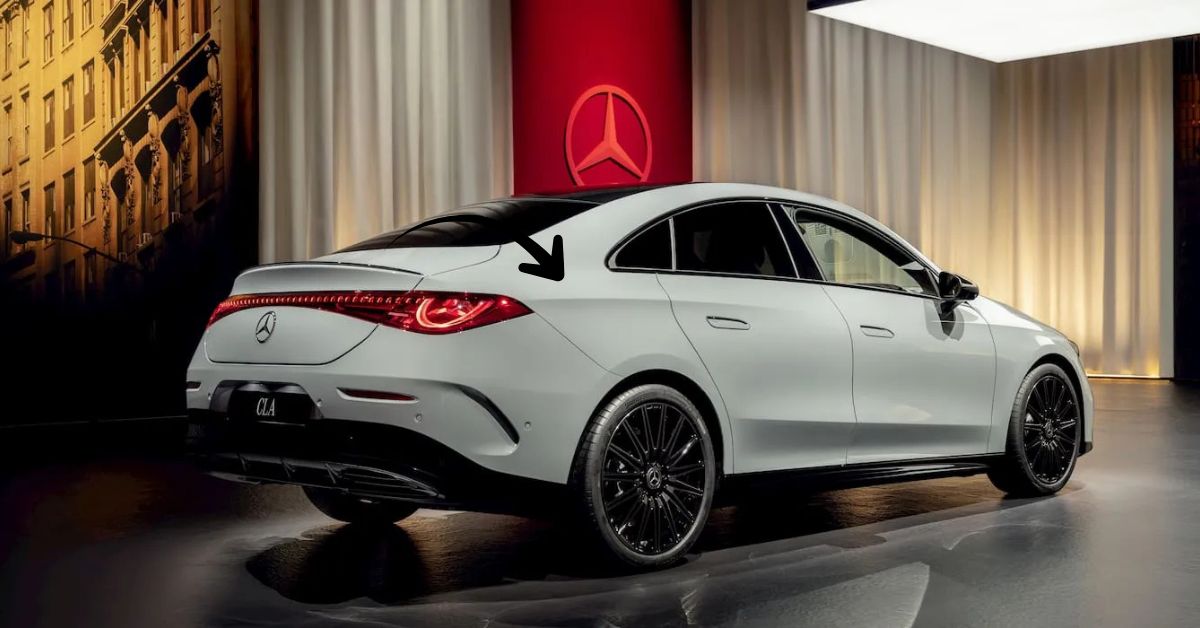
For years, the electric vehicle (EV) conversation has started and ended with one name: Tesla Model 3. Legacy automakers have tried to catch up, often producing cars that were either too expensive, had poor range, or felt like compromised adaptations of gas cars.
Enter the 2026 Mercedes-Benz CLA Electric.
This isn’t just another electric car thrown into the market to meet a quota. It is the first vehicle built on the brand-new Mercedes-Benz Modular Architecture (MMA)—a “skateboard” designed primarily for EVs. Mercedes calls it the “one-litre car of the electric age,” a nod to extreme efficiency. With a promised range that creates “range anxiety” for other cars and charging speeds that rival a coffee break, the new CLA is positioning itself as the first true luxury entry-level EV.+1
Whether you are a first-time EV buyer or a petrolhead considering the switch, this guide will break down everything you need to know about the electric CLA—from its groundbreaking 800-volt technology to why it might just be the smartest purchase you make in 2026.
1. Design & Platform: What is the “MMA” Architecture?
To understand why the new CLA is special, you have to ignore the “EQ” branding of the past. Mercedes is moving away from the “EQS” or “EQE” jelly-bean shapes. The new CLA looks like a car—a sleek, sexy four-door coupe that happens to be electric.
The Skateboard Design
The MMA platform is what experts call “Electric First.” Unlike the previous EQA or EQB, which were gas cars modified to hold batteries, the CLA was designed around the battery. This means:
- Flat Floor: More legroom for rear passengers.
- Frunk (Front Trunk): Yes, it finally has one! A dedicated 101-liter space for charging cables or small bags.
- Aerodynamics: It has a “shark nose” front end and a smooth underbody, allowing it to slice through the air with minimal resistance.
Real-Life Example: Imagine trying to fit a square peg in a round hole—that was the old approach of retrofitting gas cars with batteries. The MMA platform is like building a custom glove for a hand; everything fits perfectly, saving weight and space.
2. Range & Efficiency: The “Hypermiler” Explained
This is the headline feature. Mercedes engineers obsessed over efficiency (how far you go on 1 kWh of energy) rather than just stuffing a massive battery into the car.
The Numbers That Matter
- Maximum Range: Up to 792 km (WLTP). In real-world highway driving, expect comfortably over 400-450 miles.
- Battery Size: An 85 kWh usable battery pack (NMC chemistry with silicon oxide).
- Efficiency Rating: 12 kWh per 100 km (5.2 miles/kWh).
To put this in perspective, most modern EVs achieve 3.5 to 4.0 miles per kWh. The CLA achieving 5.2 is like a gas car getting 100 mpg when everyone else is getting 60.
The “London to Munich” Test
Mercedes claims this car is a long-distance cruiser. With a range approaching 500 miles, you could technically drive from San Francisco to Los Angeles on a single charge with miles to spare. For UK readers, that’s London to Glasgow without stopping.
3. Charging Speed: The 800-Volt Advantage
If range is the king, charging speed is the queen. This is where the CLA separates itself from competitors like the Tesla Model 3 (which uses older 400-volt tech) and the BMW i4.
What is 800-Volt Architecture?
Think of electricity like water flowing through a hose.
- 400V (Standard EVs): A standard garden hose. It fills the bucket, but it takes time.
- 800V (Mercedes CLA, Porsche Taycan): A firefighter’s hose. The pressure is doubled, filling the bucket twice as fast.
Charging Stats
- Max Charging Speed: 320 kW.
- 10% to 80% Time: 22 minutes.
- The “Splash and Dash”: You can add 300 km (186 miles) of range in just 10 minutes.
Pro Tip: To get these speeds, you must use a “HPC” (High Power Charger) rated at 350kW, like those from Ionity (Europe) or Electrify America (US). If you plug into a standard 50kW city charger, the 800V tech won’t speed things up.
4. Performance & The 2-Speed Transmission
Most EVs have a single-speed transmission—like a bicycle with only one gear. It’s great for acceleration but inefficient at high highway speeds.
The CLA Electric introduces a 2-speed transmission:
- First Gear: Short ratio for that instant “push-back-in-your-seat” acceleration when the traffic light turns green.
- Second Gear: Long ratio for highway cruising. This keeps the electric motor spinning slower at 70-80 mph, which saves battery and reduces noise.
Power Specs (Estimated):
- CLA 250+ (RWD): ~272 hp (200 kW). 0-60 mph in approx 6.5 seconds.
- CLA 350 4MATIC (AWD): ~350+ hp. 0-60 mph in under 5 seconds.
- AMG Version: Rumored to be over 500 hp, coming later.
5. Interior & Technology: The MBUX Superscreen
Mercedes is declaring war on minimalism. While Tesla gives you one center screen, the CLA offers the MBUX Superscreen.
The Dashboard
It features three distinct displays under one continuous glass surface spanning the entire dashboard:
- Driver Cluster: Speed, range, and navigation.
- Center Infotainment: Media, climate, and vehicle settings.
- Passenger Screen: Allows the co-pilot to watch movies or stream videos. Note: This screen has a privacy filter so the driver cannot see it and get distracted.
MB.OS and AI
The car runs on the new MB.OS (Mercedes-Benz Operating System). It uses AI to learn your habits.
- Example: If you always call your spouse at 5:30 PM on your way home, the car will eventually ask, “Would you like to call home?” at 5:30 PM automatically.
- 3D Navigation: The maps use game-engine graphics (Unity) to show realistic 3D buildings and lanes.
6. Safety Features (ADAS)
Mercedes-Benz has historically been a pioneer in safety (they invented ABS and crumple zones). The CLA carries this torch.
- Level 2+ Autonomy: The car can handle steering, braking, and lane changes on highways, though you must keep your eyes on the road.
- Child Presence Detection: Uses sensitive radar to detect breathing. If you accidentally lock a child or pet in the car, it will sound alarms and send messages to your phone.
- 360-Degree Guard: The cameras act as a dashcam and sentry mode, recording if someone bumps your car while it’s parked.
7. Pros and Cons
No car is perfect. Here is an honest look at the CLA Electric.
| Pros | Cons |
| Class-Leading Range: 750km+ WLTP is a game changer. | Price: Will likely start higher than a Tesla Model 3 or Hyundai Ioniq 6. |
| 800V Charging: Future-proofs the car for the next decade. | Touch Controls: Physical buttons are mostly gone, replaced by screens. |
| Luxury Interior: Materials feel premium (sustainable fabric, bamboo). | Rear Headroom: The sloping “coupe” roofline cuts into headspace for tall passengers. |
| Efficiency: 2-speed gearbox ensures highway economy. | Options Cost: Mercedes is famous for expensive add-on packages. |
8. Comparison: CLA Electric vs. Tesla Model 3 (Highland)
This is the question everyone asks.
- Drive Quality: The Model 3 is sporty and firm. The Mercedes CLA focuses on “waftability”—it absorbs bumps better and is quieter at speed.
- Tech: Tesla has better software integration (Netflix, games) and the Supercharger network (though Mercedes is gaining access to NACS). Mercedes has better screen quality and a more traditional “luxury” gauge cluster.
- Build Quality: The CLA will likely have superior paint, panel gaps, and interior materials compared to the mass-market Tesla.
Verdict: Buy the Tesla if you want the best bang-for-buck and software. Buy the Mercedes CLA if you want a true luxury car that happens to be electric, with range that finally matches gas cars.
9. Maintenance Tips for the Electric CLA
Owning an EV requires different care than a gas car.
- Tire Care is Critical: EVs are heavy and have instant torque. This wears tires out 20% faster. Rotate your tires every 6,000 miles to ensure even wear.
- Cabin Air Filter: With no engine noise, smells from outside are more noticeable. Change the HEPA cabin filter every 12 months.
- Brake Fluid: Even though you use regenerative braking, brake fluid absorbs moisture. Flush it every 2 years to prevent corrosion in the lines.
- Battery Health:
- Daily Use: Charge to 80%.
- Road Trips: Charge to 100%.
- Why? Sitting at 100% charge for days stresses the battery chemistry (NMC) and degrades long-term range.
Conclusion
The 2026 Mercedes-Benz CLA Electric is not just a refresh; it is a reinvention. For the first time, a legacy automaker has built a small luxury sedan that beats the specifications of the market leaders on paper—specifically in range and charging speed.
For the beginner, this car removes the two biggest hurdles of EV ownership: “Range Anxiety” (with its massive 450+ mile real-world capability) and “Charging Time Anxiety” (thanks to the 800V architecture).
Read More : Tata Tiago EV
If you are looking for an EV that retains the prestige, comfort, and build quality of a German luxury car, but possesses the heart and efficiency of a next-gen tech product, the new CLA is worth waiting for.
Your Next Step:
Would you like me to generate a comparison table pitting the CLA Electric against the BMW i4 and Hyundai Ioniq 6 to help you visualize the specs side-by-side?
10. FAQ: Common Questions
Q1: When will the Mercedes CLA Electric be released?
A: The production version is expected to debut in late 2025, with deliveries starting in early to mid-2026.
Q2: How much will the Mercedes CLA Electric cost?
A: Official pricing isn’t out, but estimates suggest a starting price around $50,000 – $55,000 (approx. £45,000 – £50,000).
Q3: Can I use Tesla Superchargers with the CLA?
A: Yes. Mercedes has announced it will adopt the NACS (North American Charging Standard) port for North American models, giving access to the Supercharger network.
Q4: Is there a gas version of the new CLA?
A: Yes. The MMA platform supports a “hybrid” setup. There will be a version with a highly efficient 4-cylinder engine designed to act as a generator or direct drive, but the focus is clearly on the EV.
Q5: What is the warranty?
A: Expect the standard Mercedes EV warranty: 4 years/50,000 miles for the vehicle and 10 years/155,000 miles (target capacity) for the battery pack.