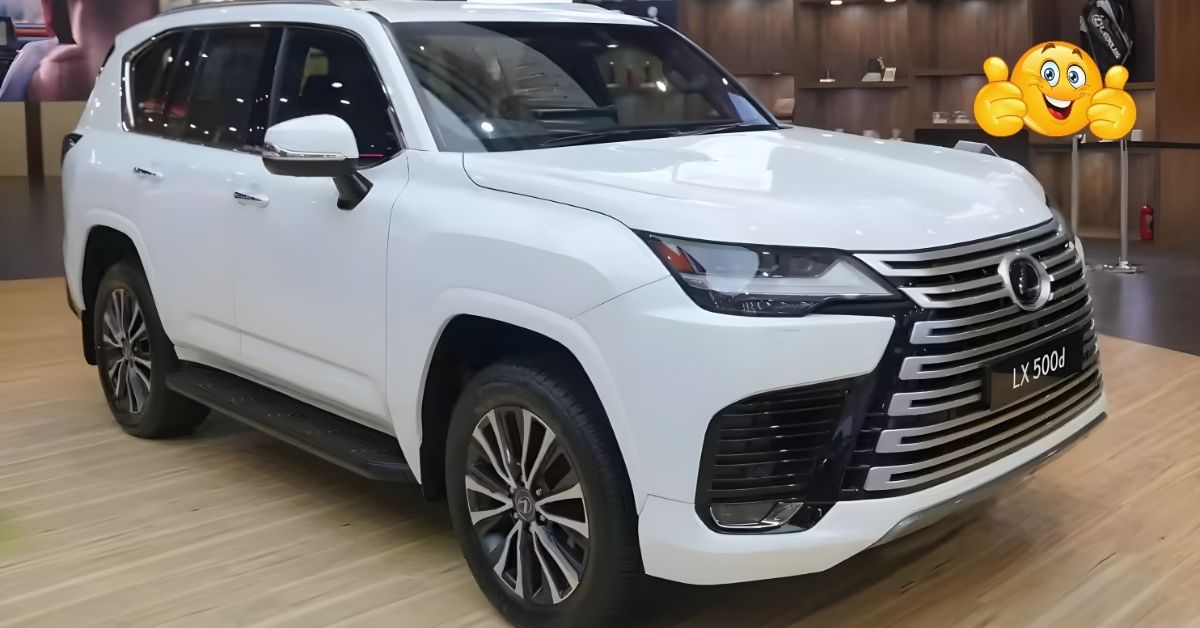
The Lexus LX 500d 2026 Ultra Luxury SUV stands at the absolute pinnacle of the full-size sport utility vehicle segment, representing a unique and powerful confluence of two seemingly contradictory design philosophies: the rugged, unbreakable, body-on-frame durability inherited from its Toyota Land Cruiser lineage, and the refined, impeccable luxury and technological precision that defines the Lexus marque. This flagship machine is not merely a mode of transport; it is a declaration of uncompromising prestige and capability, designed to offer an oasis of calm and advanced comfort whether navigating the congested avenues of a metropolis or tackling the most challenging, untamed terrains. The 2026 model, continuing the generation launched in the previous cycle and now enhanced with specialized trim options, solidifies the Lexus LX 500d 2026 Ultra Luxury SUV as the definitive choice for discerning Indian clientele who demand a vehicle that sacrifices nothing in terms of features, performance, or inherent toughness. This comprehensive review dissects the SUV’s powerful engineering, the sophisticated features defining its ultra-luxury status, its real-world performance metrics, its crucial mileage trade-off, and its commanding price positioning in the exclusive Indian market.
The Engineering Foundation: Full-Size 4×4 and Robust Performance
At the mechanical core of the Lexus LX 500d 2026 Ultra Luxury SUV lies a fundamental promise of reliability and relentless power. The current generation model, which will define the 2026 offering, is powered by a formidable $3.3\text{-litre}$ V6 Twin-Turbo Diesel engine, known internally by the designation F33A-FTV. This engine architecture marks a significant, deliberate shift from the previous generation’s naturally aspirated V8, signaling a focus on improved low-end torque delivery and thermal efficiency. The twin-turbocharged V6 delivers a commanding output of $304\text{ bhp}$ of power and a massive $700\text{ Nm}$ of peak torque, which is accessible across a broad and usable $1600\text{ rpm}$ to $2600\text{ rpm}$ band. This immense torque is crucial for both effortless highway cruising and aggressive off-road crawling, ensuring the large SUV never feels strained, even when fully loaded.
The transmission duties are handled by a slick, modern 10-speed Automatic Transmission (TC), which is instrumental in maximizing the efficiency and performance of the V6 diesel. This gearbox offers seamless, near-imperceptible shifts during relaxed driving and executes rapid, decisive downshifts when the driver engages the paddle shifters or selects the Sport mode, delivering optimal power when required. The result of this powertrain mastery is a claimed $0\text{ to } 100\text{ km/h}$ acceleration time of approximately $8.0$ seconds, a highly respectable figure for a vehicle weighing well over two tonnes and built on a sturdy ladder-frame chassis. This combination ensures that the Lexus LX 500d 2026 Ultra Luxury SUV provides performance that is both refined for daily use and robust enough for every conceivable challenge, cementing its reputation for powerful and dependable motion.
Mastery of the Terrain: The Unrivalled 4×4 and Chassis Technology
The true specialization of the Lexus LX 500d 2026 Ultra Luxury SUV, which separates it from the majority of luxury rivals built on softer, road-biased monocoque platforms, is its profound and authentic off-road capability. This 4×4 mastery is guaranteed by its close relationship with the legendary Toyota Land Cruiser 300, upon whose robust GA-F platform it is based. The LX utilizes a Full-Time 4WD system as standard, providing continuous traction and stability. This is integrated with a sophisticated chassis management system that allows the vehicle to adapt instantaneously to the terrain.
Core to its off-road prowess is the Active Four-Wheel Height Control (AHC) system, which allows the driver to electronically adjust the vehicle’s ride height—raising the chassis for maximum ground clearance when traversing rocky terrain and lowering it automatically for easy entry/exit or reduced drag at high speeds. This is complemented by the Adaptive Variable Suspension (AVS), which continuously adjusts the damping force at each wheel based on the driving conditions and the selected drive mode, ensuring the ride remains exceptionally comfortable on paved roads and highly controlled on challenging off-road trails. The Multi-Terrain Select (MTS) system offers up to six specialized modes, including Rock, Mud, and Deep Snow, optimizing the drivetrain, brakes, and suspension settings automatically. The inclusion of features like Crawl Control, which automatically manages throttle and braking on steep descents or difficult inclines, and the availability of electronically controlled front and rear locking differentials in the Overtrail variant, confirms that the Lexus LX 500d 2026 Ultra Luxury SUV is engineered for uncompromising, reliable off-road domination alongside its luxurious mandate.
The Luxury Sanctuary: Features Defining the Ultra Luxury Cabin
The cabin of the Lexus LX 500d 2026 Ultra Luxury SUV is a sanctuary meticulously crafted from the highest quality materials, designed to isolate its occupants from the chaos of the outside world. The concept of Ultra Luxury is realized through several key features that prioritize comfort, technology, and passenger experience. The seating is draped in Semi-Aniline leather with exquisite diamond-stitched quilting and refined wood trim, such as Ash Open Pore, setting a standard for tactile quality. For climate comfort, a sophisticated Four-Zone Independent Automatic Climate Control system provides personalized temperature settings for the front passengers and the two outboard rear passengers, a crucial facility for the varied Indian climate.
The in-cabin technology is a study in intuitive digitalization, centered around a unique dual-screen display setup on the center console. The main $12.3\text{-inch}$ high-resolution touchscreen handles navigation, media, and wireless connectivity for Apple CarPlay and wired Android Auto, while a secondary $7\text{-inch}$ lower display is dedicated to climate control settings, Multi-Terrain Select functions, and other vehicle parameters, ensuring the main screen remains uncluttered for essential information. Acoustic excellence is provided by the sublime 25-speaker Mark Levinson Reference Surround Sound System, which delivers a concert-hall experience with its immersive 3D audio quality. Furthermore, the Lexus LX 500d 2026 Ultra Luxury SUV includes essential security and convenience facilities such as Fingerprint Authentication Push-Button Start, ensuring the vehicle can only be started by authorized drivers, and an array of power outlets, USB ports, and a Cool Box integrated into the center console, underscoring its commitment to absolute comfort and technological leadership.
Economics of Supremacy: Mileage and Price in India
Given its immense power, $3.3\text{-litre}$ V6 displacement, $700\text{ Nm}$ of torque, and full-time 4WD system, the Lexus LX 500d 2026 Ultra Luxury SUV makes a necessary trade-off in fuel efficiency for its unparalleled capability and performance. The ARAI-certified mileage for the vehicle stands at approximately $6.9\text{ kmpl}$, with user-reported real-world figures typically hovering around $8\text{ kmpl}$ in mixed city and highway driving. While this figure is expectedly low compared to smaller passenger SUVs, it is highly competitive within the ultra-luxury, heavy-duty 4×4 segment, aligning closely with its main rival, the Mercedes-Benz G-Class. The vehicle’s enormous $80\text{-litre}$ fuel tank capacity ensures that, despite the lower mileage, the practical driving range remains substantial, minimizing the frequency of refueling during long journeys.
Read More : Audi R8 Spyder V10
The Lexus LX 500d 2026 Ultra Luxury SUV maintains its positioning as a high-end import with an aspirational price tag. The current ex-showroom price for the LX 500d Urban variant starts around $\text{₹}2.80\text{ Crore}$, while the specialized Overtrail edition is priced higher. Accounting for minor inflationary adjustments and the inclusion of the latest features for 2026, the ex-showroom price is expected to settle in the region of $\text{₹}2.90\text{ Crore}$ to $\text{₹}3.10\text{ Crore}$. The final On-Road Price in India, inclusive of import duties, high state taxes, RTO charges, and insurance, will confidently place the Lexus LX 500d 2026 Ultra Luxury SUV in the range of $\text{₹}3.4\text{ Crore}$ to $\text{₹}3.7\text{ Crore}$ in major metropolitan areas like Mumbai and Bengaluru. This price point reflects its segment rivals, the Land Rover Range Rover and the Mercedes-Benz G-Class, and is justified by its unique blend of Japanese reliability, structural robustness, and uncompromising Ultra Luxury features, securing its status as the most sophisticated and capable full-size 4×4 available for the elite Indian buyer.
The automobile of the future, beginning with the foundational models emerging in 2026, possesses a fundamental specialization that moves beyond horsepower and chassis dynamics: it is defined by its intelligence, its ability to evolve, and its seamless integration into the digital world. The era of the car as a simple mechanical device has ended, replaced by the reality of the Software-Defined Vehicle (SDV), where the user experience, performance capabilities, and safety architecture are governed not by static hardware, but by dynamic, updateable code. This architectural shift is the single greatest specialty of the next generation of cars, enabling continuous refinement, personalized functionality, and radical energy efficiency that will redefine ownership value.
The Specialty of Intelligence: Software, Evolution, and the Digital Cockpit
The primary specialty of future cars is their capacity for evolution via Over-The-Air (OTA) updates, transforming the vehicle into a product that improves after purchase, much like a smartphone. This SDV specialty means that performance characteristics, infotainment features, and even the accuracy of safety systems can be refined or expanded remotely, ensuring the vehicle remains technologically current and highly relevant years after it leaves the showroom. This continuous updating supports the futuristic Digital Cockpit, which is no longer just a dashboard but a personalized third living space. The integration of high-resolution, often curved, multi-screen interfaces, biometric authentication for driver profiles, and Augmented Reality Head-Up Displays (AR-HUDs) that project navigation and safety alerts directly onto the road surface forms the core of this specialized user experience. The future car specializes in personalized interaction, learning driver habits and preferences to proactively manage climate, media, and even ride stiffness.
The Specialty of Safety: Autonomy, Assistance, and Energy Management
Safety is transitioning from passive protection to proactive, predictive autonomy, creating a profound new specialty in assisted driving. The current push towards Level 2 ADAS is quickly giving way to the development of Level 3 (L3) Autonomy, which allows the driver to legally disengage from the driving task under specific highway conditions, effectively turning over control to the vehicle’s sophisticated sensor array, Lidar, and computer vision systems. This specialization is built on reliable hardware and complex software that can predict traffic flows and react faster than human capability. Furthermore, the specialized approach to energy is paramount, with the Electrified Powertrain being the defining feature of the future. The EV’s specialties include instantaneous torque delivery for high performance, exceptionally low maintenance costs due to fewer moving parts, and, crucially, the Vehicle-to-Load (V2L) and Vehicle-to-Home (V2H) capabilities, which allow the car to act as a massive, mobile power source, lending it utility far beyond simple transportation. This unique ability to manage, store, and share energy makes the future car an integrated part of the owner’s sustainable domestic and commercial ecosystem.