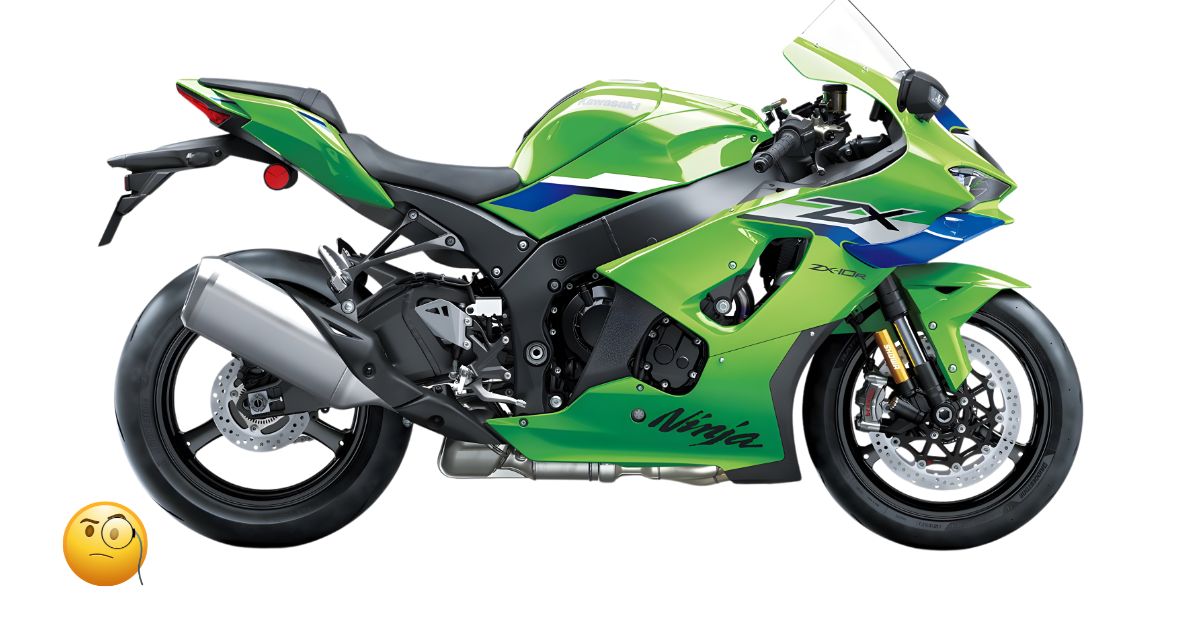
WorldSBK Domination: The Definitive Kawasaki Ninja ZX-10R Review—Performance, Track-Ready Features, Price in India, and Unbeatable Value
The Kawasaki Ninja ZX-10R Review is not merely an assessment of a flagship motorcycle; it is an examination of a machine designed, refined, and aggressively tuned to secure championships on the world stage. As the direct progeny of Kawasaki’s World Superbike (WorldSBK) efforts, which have yielded unprecedented dominance, the 2026 ZX-10R represents the apex of Japanese liter-class engineering, seamlessly blending mind-bending power with a sophisticated electronic safety net. This motorcycle is a definitive choice for the elite enthusiast in India—a rider who demands uncompromising track performance, razor-sharp handling, and proven mechanical reliability, all packaged at a price point that offers phenomenal value compared to its European rivals. This extensive, expert analysis delves into the brutal power metrics of its inline-four engine, details the specialized chassis and aerodynamic features, explains the depth of its IMU-enhanced electronics, and outlines the precise cost of ownership in the Indian market.
The Heart of the Champion: Unrelenting Performance and Inline-Four Power Delivery
The core of the Kawasaki Ninja ZX-10R Review is its relentless $998\text{cc}$ Liquid-Cooled, 4-Stroke In-Line Four-Cylinder engine. This DOHC engine is engineered not just for high peak power, but for sustained, accessible output throughout the high-RPM range, a necessary characteristic derived from the demands of circuit racing. In its standard road-going trim, the engine produces a monumental $203\text{ PS}$ (approximately $200\text{ bhp}$) at $13,200\text{ rpm}$, with a robust peak torque of $114.9\text{ Nm}$ at $11,400\text{ rpm}$. However, its true potential is unleashed at speed, where the Ram Air intake system pressurizes the airbox, increasing volumetric efficiency and boosting the power output to an astonishing $213\text{ PS}$ (over $210\text{ bhp}$), a power figure that firmly places the ZX-10R among the most potent production superbikes globally.
This enormous power translates directly into brutal acceleration, with the ZX-10R capable of launching from $0\text{ to } 100\text{ km/h}$ in approximately $3.0$ seconds. The power delivery is characterized by its linearity in the low and mid-range, transitioning into a ferocious, screaming surge past $8,000\text{ rpm}$ as the machine enters its track-focused zone. Power is managed through a precise 6-speed cassette-style transmission, a design borrowed from pure racing bikes that allows for quick gear ratio changes for circuit optimization. The final speed capability of the Kawasaki Ninja ZX-10R Review subject is electronically governed to a benchmark $299\text{ km/h}$, though its raw potential, especially with aftermarket tuning, is significantly higher, confirming its identity as a true speed machine.
The Aerodynamic Edge: Winglets and Chassis Geometry
The 2026 Kawasaki Ninja ZX-10R Review highlights an increased focus on aerodynamic efficiency, a critical element transferred directly from the demands of WorldSBK racing where fractions of a second decide victory. The redesigned front cowl and fairings now feature integrated winglets, subtle but highly effective aerodynamic devices that generate significant downforce. These winglets are meticulously shaped to provide up to a $25\%$ increase in downforce compared to previous generations, a specialization that significantly benefits the rider by physically pushing the front wheel down onto the tarmac at high speeds. This increased downforce achieves three crucial performance gains: it reduces the tendency for the front wheel to lift under the bike’s massive acceleration, it improves stability when braking hard before a corner, and it enhances the rider’s front-end feel during aggressive cornering, providing immense confidence at lean.
Complementing this aerodynamic refinement, Kawasaki engineers also implemented subtle but effective chassis geometry tweaks. The position of the swingarm pivot and the steering head angle were finely adjusted to match the effect of the new winglets, collectively contributing to improved rear-wheel traction and a lighter, more responsive handling profile. This ensures that the ZX-10R is not just stable in a straight line, but is exceptionally agile in the rapid side-to-side transitions and high-speed cornering scenarios that define modern circuit riding. The chassis itself is a rigid twin-spar cast aluminium frame, providing the robust foundation necessary to withstand the enormous forces exerted by the $200\text{ horsepower}$ engine and the specialized suspension system.
Digital Control: The IMU-Enhanced Electronics Suite
The true key to unlocking the raw power of the Kawasaki Ninja ZX-10R Review subject safely lies within its state-of-the-art electronic management package, which is heavily influenced by feedback from the Kawasaki Racing Team. This system is centered around a precise Bosch Inertial Measurement Unit (IMU), a sophisticated device that measures the bike’s motion across five or six axes, continuously feeding data on lean angle, acceleration, and pitch to the electronic control unit (ECU).
This data powers the complex array of rider aids that collectively form the bike’s safety and performance net:
- S-KTRC (Sport-Kawasaki TRaction Control): Unlike basic traction control, S-KTRC constantly monitors the difference in speed between the front and rear wheels, analyzing the lean angle from the IMU to modulate power delivery, allowing the rider to maintain maximum drive out of corners without losing control, offering multiple levels of intervention.
- KCMF (Kawasaki Cornering Management Function): This is a key IMU-based feature that continuously manages engine power and braking force (via KIBS) to ensure the bike’s chassis attitude is maintained throughout a corner, preventing the machine from standing up or sliding when the rider is leaned over and applying the brakes.
- KQS (Kawasaki Quick Shifter): This bi-directional system allows for seamless, clutchless gear changes both up and down, a vital feature for minimizing track lap times and enhancing the smoothness of acceleration and deceleration during sport riding.
- KIBS (Kawasaki Intelligent Anti-Lock Brake System): This is a high-precision, track-focused ABS system that works in conjunction with the Brembo brakes and the IMU, providing supreme stopping power that resists fade and maintains stability even under the most aggressive track braking scenarios.
- KLCM (Kawasaki Launch Control Mode): This specialized mode helps the rider achieve the fastest possible start from a standing position by managing power output to prevent wheel spin and maintain optimal lift during the initial surge of acceleration, a direct benefit for amateur racers.
Hardware and Usability: Suspension, Brakes, and Daily Features
The physical hardware of the Kawasaki Ninja ZX-10R Review subject is equally high-grade. Suspension duties are handled by specialized, race-derived Showa components: the Balance Free Front Fork (BFF) and the Balance Free Rear Cushion (BFRC lite) monoshock. These components are fully adjustable and utilize WorldSBK technology to provide independent damping and compression control, ensuring the suspension reacts precisely to the demands of the circuit while still offering a degree of controlled compliance for road use. Braking is entrusted to a powerful system featuring dual large $330\text{ mm}$ semi-floating discs at the front, gripped by high-specification Brembo M50 monobloc radial calipers—the same calipers used on many Italian exotics—providing fierce, consistent stopping force.
For enhanced street usability, the 2026 ZX-10R integrates several modern, practical features. The cockpit features a full-colour TFT instrumentation display that offers Bluetooth smartphone connectivity, providing riders with essential functions like call alerts and turn-by-turn navigation assist, making long-distance road trips feasible. Furthermore, the inclusion of Electronic Cruise Control reduces rider fatigue during lengthy highway stints, demonstrating that the machine, while primarily built for the track, is also capable of serving as a capable, if aggressively ergonomic, road-going superbike.
Read More : Aprilia RSV4 Review
The Investment Verdict: Price in India and Unbeatable Value
The Kawasaki Ninja ZX-10R Review culminates in its most persuasive argument: its price-to-performance ratio. Despite its pure WorldSBK heritage and its $213\text{ horsepower}$ output, the ZX-10R remains the most accessible liter-class superbike in the market. Following recent price adjustments for the 2026 model, the ex-showroom price for the standard variant starts around $\text{₹}18.50\text{ Lakh}$ to $\text{₹}20.79\text{ Lakh}$ depending on the specific state and tax structure. This places it significantly below its direct European rivals, such as the top-spec BMW S 1000 RR and the Ducati Panigale V4, which typically start $\text{₹}4\text{ Lakh}$ to $\text{₹}15\text{ Lakh}$ higher, respectively.
The final On-Road Price in India for the Kawasaki Ninja ZX-10R Review subject ranges from approximately $\text{₹}23.6\text{ Lakh}$ to $\text{₹}25.7\text{ Lakh}$ across major cities. This price point offers an unparalleled value proposition: the buyer receives a machine with WorldSBK-proven chassis components, $200\text{ horsepower}$ of refined inline-four power, and a full suite of IMU-enhanced electronics, all backed by Kawasaki’s renowned Japanese mechanical reliability. The ownership benefits include lower long-term parts costs compared to Italian exotics and a powerful sense of command over a machine that is inherently built for victory. The Kawasaki Ninja ZX-10R Review concludes that for the experienced rider seeking the ultimate track weapon that can also handle road duty, the ZX-10R is, unequivocally, the best value proposition in the superbike world.
The Two-Wheeled Transformation: Key Motorcycle Launches and Technological Shifts Defining the Indian Market in 2026
The year 2026 is poised to be a period of significant evolution for the Indian motorcycle market, characterized by an unprecedented influx of new models across crucial segments, ranging from accessible adventure tourers built through global manufacturing partnerships to the expansion of premium, powerful offerings and a serious push into electrification. The overall trend showcases manufacturers aggressively localizing production and filling previously existing gaps in the 300cc to 500cc space, providing consumers with sophisticated technology and refined performance at increasingly competitive prices, fundamentally reshaping the buying decision for the next generation of riders.
The Rise of Premium Mid-Capacity and Adventure Tourers
The most aggressive growth in 2026 is expected within the 400cc to 800cc segments, where both domestic and international manufacturers are launching highly refined, technologically advanced machines. KTM is set to be a major disruptor with the highly anticipated Duke 490, a new street monster built on an all-new platform developed jointly with Bajaj. This parallel-twin machine will finally bridge the significant power gap between the single-cylinder Duke 390 and the larger 790, promising raw power, aggressive styling, and competitive pricing around ₹3 Lakh ex-showroom. Similarly, Suzuki is expected to introduce the GSX-8R and GSX-8T, leveraging a smooth 776cc parallel-twin engine to bring modern performance to the supersport touring and naked segments, positioning themselves against the Yamaha MT-07 and its rivals.
In the adventure touring segment, the focus is on superior capability and high-end features. BMW is readying the F 450 GS, a highly relevant launch that upgrades their entry-level ADV offering with a new parallel-twin engine, improved suspension, and better electronics, directly capitalizing on the expertise gained from their partnership with TVS. The Honda CB500X is also set for a 2026 update, expected to maintain its reputation for reliability and comfort while integrating new features like a TFT instrument cluster and traction control, appealing strongly to riders planning long, dependable tours across India’s diverse terrains. This strategic localization ensures that premium European and Japanese performance, traditionally priced out of reach for many, becomes accessible to a much broader market.
Royal Enfield’s Flagship Expansion and Electrification
Royal Enfield, the segment leader in the mid-capacity space, is undertaking a crucial strategic maneuver with the expansion of its platform architecture. The biggest headlines are reserved for the new 750cc platform, which is set to debut with the Himalayan 750 and the Continental GT 750 in late 2026. This new, powerful parallel-twin engine is designed to deliver refined highway performance, greater torque, and cruising comfort necessary to compete with global heavyweights and move Royal Enfield definitively into a higher performance bracket.
Equally transformative is Royal Enfield’s official entry into the electric vehicle (EV) market. The company has confirmed the global rollout of its first e-bike range, launched under the historic “Flying Flea” brand name, slated to begin in 2026. Models like the Flying Flea C6 are intended to establish a strong foothold in the premium electric motorcycle space, leveraging the brand’s legacy design but driven by zero-emission technology. This move, which includes a rapid follow-up launch in India shortly after the European debut, signifies a commitment to creating and growing the electric performance category rather than merely chasing existing sales volumes, assuring Royal Enfield’s relevance in the future of mobility.
Defining Technological Advancements in 2026 Motorcycles
The specialty of the 2026 motorcycle fleet lies in the democratization of advanced technology, shifting the emphasis from raw power to intelligent control and rider convenience. Honda is leading a significant technological trend with the introduction of the E-Clutch system on models like the 2026 CBR650R. This innovative feature utilizes an electronically actuated clutch mechanism to automate clutch control during gear shifts, allowing riders to shift gears seamlessly without engaging the clutch lever. This technology not only drastically reduces hand fatigue in stop-and-go traffic but also simplifies gear transitions for new riders while still providing the flexibility for experienced riders to use the clutch manually when desired.
Furthermore, the influence of the Software-Defined Vehicle (SDV) concept, primarily seen in cars, is rapidly migrating to premium motorcycles. This involves integrating digital display systems, sophisticated onboard cameras, and connected features powered by advanced processors. Companies like KTM (with the enhanced 8.8-inch TFT dashboard on the 990 DUKE R) and Pioneer (with its “Ride Connect” solutions) are pioneering the use of AI-aided rider safety systems and intuitive Human-Machine Interfaces (HMI) for enhanced riding comfort and entertainment. These advancements ensure the 2026 motorcycles are not just faster, but significantly safer, smarter, and more convenient than any generation before them.