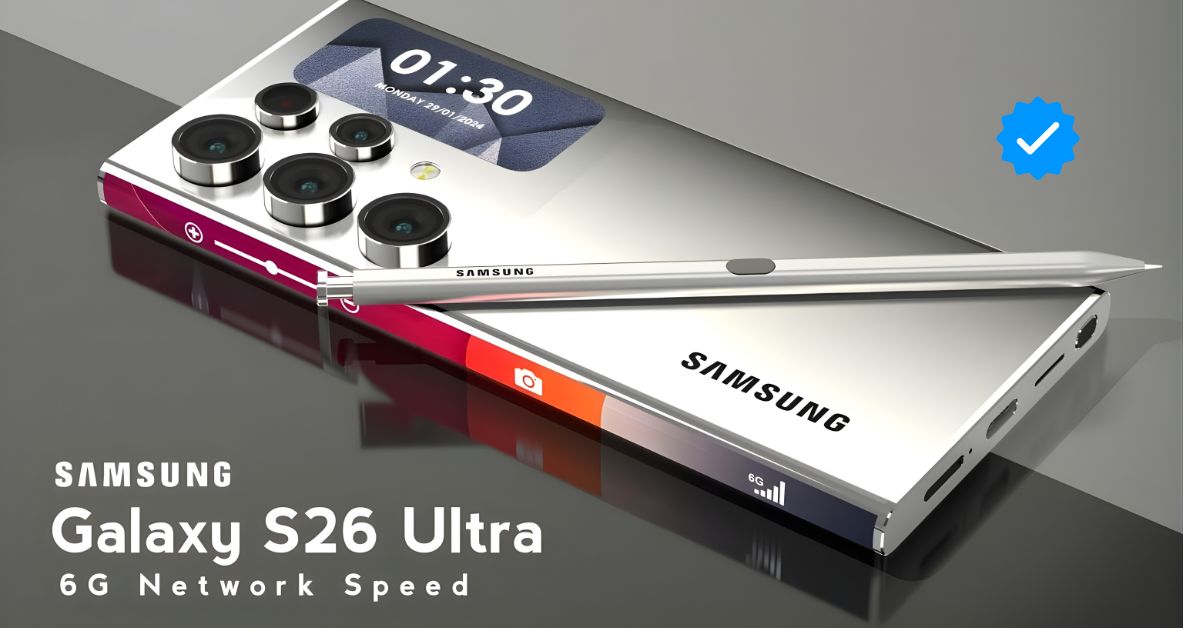
The Samsung Galaxy S26 Ultra 5G Review 2025 is an examination of the device engineered to be the ultimate technological convergence—a machine that establishes the absolute benchmark for mobile computing, professional imaging, and generative Artificial Intelligence. This phone represents the pinnacle of Samsung’s commitment to the Ultra philosophy, prioritizing cutting-edge hardware specifications and a seamless, feature-rich software experience that elevates the smartphone beyond a simple communication tool. Anticipated for an early 2026 launch, the S26 Ultra is the most significant Android release of the year, destined to become the definitive choice for professionals, creators, and power users who demand zero compromise in performance and capability. This extensive analysis dissects the custom-tuned processor, rigorously evaluates the multi-sensor camera system and its AI-driven capabilities, details the brilliance of its new generation display, and confirms the highly exclusive price positioning for the Indian market.
Performance and Processor: The Snapdragon 8 Elite Gen 5 Advantage
The uncompromising power of the Samsung Galaxy S26 Ultra 5G Review 2025 subject is delivered by the next-generation flagship processor, the Qualcomm Snapdragon 8 Elite Gen 5 for Galaxy. Built on the advanced $3\text{ nm}$ manufacturing process, this chipset is not merely a speed upgrade but a foundation for sophisticated, on-device AI. The “for Galaxy” specialization denotes a version that is custom-tuned and overclocked, featuring a prime Oryon V3 core that reaches speeds up to $4.6\text{ GHz}$, ensuring performance remains dominant even under the heaviest loads. This high-frequency core is paired with an enhanced Adreno 840 GPU, delivering massive gains in graphics rendering and Ray Tracing capabilities—a crucial feature for console-quality mobile gaming.
AI Specialization and Memory
The true specialization of the Snapdragon 8 Elite Gen 5 lies in its dedicated Neural Processing Unit (NPU), which is significantly faster than its predecessors. This NPU powers the expanded Galaxy AI suite, enabling complex features like real-time Generative Video Editing, instantaneous Live Translate 2.0 for phone calls, and highly personalized system optimization, all processed locally on the device for superior speed and security. The processor is supported by a large pool of memory, with the S26 Ultra expected to ship with a baseline of $12\text{ GB}$ of LPDDR5X RAM and the highest tier offering a massive $16\text{ GB}$ of LPDDR5X RAM, ensuring the system can fluidly manage concurrent AI models, extensive multitasking, and graphics-intensive applications. Storage uses the latest UFS $4.0$ standard, providing lightning-fast data read and write speeds, which drastically improves app installation times and 8K video processing speed.
Camera Test: 200MP Quad-Sensor Array and Telephoto Mastery
The camera system of the Samsung Galaxy S26 Ultra 5G Review 2025 subject continues Samsung’s pursuit of unparalleled versatility, relying on a complex quad-sensor array that masters both immense detail and extreme zoom.
Sensor Hardware and Detail Capture
The primary camera utilizes a refined, second-generation $200\text{ MP}$ wide-angle sensor with an optimized aperture (rumored to be $f/1.7$) and multi-directional Phase Detection Autofocus (PDAF). While retaining the high megapixel count, the sensor likely features a physical size increase, improving its light-gathering capabilities and overall image quality in all lighting conditions. The camera leverages advanced pixel-binning technology to condense data into brilliant $12.5\text{ MP}$ or $50\text{ MP}$ final images, achieving superior detail and dynamic range. The main sensor is supported by powerful Optical Image Stabilization (OIS), ensuring both stills and video are sharp and blur-free.
Read More : Infinix Note 40 Pro
Dual Telephoto and AI Nightography
The S26 Ultra retains its signature Dual Telephoto system, a key specialization that provides unmatched optical versatility: a dedicated $10\text{ MP}$ $3\times$ optical zoom lens (ideal for portraiture) and a high-resolution $50\text{ MP}$ periscope telephoto lens offering $5\times$ optical zoom. The combination enables the famous $100\times$ Space Zoom, which relies on advanced computational stabilization and AI algorithms to produce surprisingly usable images at extreme distances. Video capabilities are pushed further, supporting $8\text{K}$ video recording at $30\text{ fps}$ and super-smooth $4\text{K}$ video at $60\text{ fps}$ across multiple lenses. The camera system benefits heavily from the new NPU, enabling AI-Enhanced Nightography for clearer, noise-reduced low-light video and Generative Photo Editing tools that use AI to seamlessly reposition or remove objects from a photo.
AMOLED Display Quality: 144Hz Fluidity and Visual Density
The visual experience on the Samsung Galaxy S26 Ultra 5G Review 2025 subject is delivered by the largest, brightest, and most fluid display in the Galaxy lineup: a $6.9\text{-inch}$ Dynamic LTPO AMOLED 2X display. The screen features a crystal-clear resolution, delivering exceptional pixel density.
Brightness and Fluidity
The S26 Ultra is tipped to increase its refresh rate to a fluid $144\text{ Hz}$ for specific high-performance applications and gaming, while utilizing the efficient LTPO 4.0 technology to dynamically scale the refresh rate down to $1\text{ Hz}$ to maximize battery efficiency. The panel’s specialization is its sheer brightness, with a rumored peak brightness level reaching $2,600\text{ nits}$ or higher. This guarantees perfect visibility even under the harshest direct sunlight and ensures HDR content renders with breathtaking clarity and contrast. The display is protected by the latest generation of Corning Gorilla Armor 2 glass, offering superior scratch resistance and a specialized anti-reflective coating that significantly reduces glare.
Gaming FPS and Battery Life: Sustained Power and 60W Charging
The gaming and battery endurance of the Samsung Galaxy S26 Ultra 5G Review 2025 subject are engineered for sustained, high-fidelity performance, addressing the power demands of the elite Snapdragon processor.
Sustained Gaming Performance
The Snapdragon 8 Elite Gen 5 and its enhanced Adreno 840 GPU are designed to run the most demanding AAA mobile games, such as those leveraging the Unreal Engine 5 platform, at stable frame rates. The S26 Ultra is expected to support native $144\text{ FPS}$ in optimized titles and sustained $60\text{ FPS}$ in graphically intensive games with advanced hardware-accelerated Ray Tracing enabled. To manage the immense heat from the overclocked chip, the phone includes a highly advanced Vapor Chamber cooling system, which is larger and more efficient than previous models, ensuring thermal throttling is minimized and peak performance is maintained for longer gaming sessions.
Battery and Charging Advancement
Battery capacity is a critical focus, with the S26 Ultra expected to feature a larger $5,200\text{ mAh}$ or $5,500\text{ mAh}$ battery, a necessary increase to support the powerful chipset and expansive display. Charging speed sees a significant official upgrade, moving from the previous generation’s $45\text{ W}$ to $60\text{ W}$ wired fast charging. This allows the large battery to reach $80\%$ charge in approximately 30 minutes, drastically reducing downtime. Wireless charging is also set to improve, with support for $15\text{ W}$ to $25\text{ W}$ Qi2 Ready wireless charging, enhancing charging convenience.
Pros, Cons, and Expected Price in India
The Samsung Galaxy S26 Ultra 5G Review 2025 confirms its position as the ultimate Android powerhouse, though its technological supremacy comes with unavoidable trade-offs.
Pros (Advantages)
The key advantages are the unmatched power and efficiency of the custom Snapdragon 8 Elite Gen 5, the versatile $200\text{ MP}$ quad-camera system with powerful $5\times$ optical zoom, the massive $144\text{ Hz}$ LTPO AMOLED display, the inclusion of the integrated S Pen stylus for productivity, and the guaranteed seven years of software and security updates. The advanced Galaxy AI features cement its technological lead.
Cons (Drawbacks)
The major drawbacks are its colossal physical size and weight (making one-handed use challenging), its high thermal output during peak performance demanding a sophisticated cooling system, and its high initial purchase price which places it out of reach for most consumers.
Expected Price in India
The pricing of the Samsung Galaxy S26 Ultra 5G reflects its status as the top-tier flagship globally. The starting price for the base $12\text{ GB}$ RAM and $256\text{ GB}$ storage variant is expected to be around $\text{₹}1,59,999$ to $\text{₹}1,65,999$ in India. The top-tier $1\text{ TB}$ storage model with $16\text{ GB}$ RAM will likely command a price exceeding $\text{₹}1,95,000$. The final On-Road Price in India for the fully loaded variants, factoring in GST and local taxes, is estimated to reach $\text{₹}1.9\text{ Lakh}$ to $\text{₹}2.2\text{ Lakh}$, confirming its status as the premium investment in mobile technology.
The iPhone 18 Pro Max Review is an examination of Apple’s flagship philosophy for 2026, a device that is anticipated to be the ultimate convergence of advanced computational power, revolutionary photographic capability, and seamless digital integration. The entire 2026 iPhone lineup, including the standard Pro models and the highly rumored iPhone Fold, represents a profound strategic pivot, moving beyond mere annual hardware upgrades to building a sophisticated ecosystem defined by on-device Artificial Intelligence (AI) and structural refinement. This extensive analysis synthesizes the expected technological leaps of the iPhone 18 Pro Max, details the specialized features of the rumored iPhone Fold, and outlines the significant expected price points for these devices in the premium Indian market.
Performance and Processor: The A20 Pro Chip and Integrated AI
The computational core of the iPhone 18 Pro Max Review subject is the highly anticipated Apple A20 Pro chip, fabricated on a next-generation process, potentially moving to the $2\text{-nanometer}$ architecture. This specialized silicon is engineered not just for raw speed but for massive increases in power efficiency and dedicated Neural Engine performance. The A20 Pro is rumored to introduce architectural changes, possibly integrating RAM directly onto the same wafer as the CPU and GPU. This specialized integration is expected to yield up to $30\text{ percent}$ better efficiency and $15\text{ percent}$ faster overall performance compared to the preceding A19 chip, ensuring the device can handle complex, continuous AI workloads without overheating or draining the battery.
AI and System Integration
The enhanced Neural Engine within the A20 Pro is the foundation for Apple’s continued expansion of its proprietary AI suite. This power will be used to enhance core iOS functions, making the operating system more context-aware and proactive. AI is expected to revolutionize processes from real-time language translation to highly advanced, predictive user interfaces that anticipate actions. This deep integration means the phone will be able to run larger, more complex AI models locally on the device, ensuring superior speed, security, and responsiveness for features like advanced photo editing and personalized content generation.
Camera Technology: Variable Aperture and Sensor Stacking
The photographic capabilities of the iPhone 18 Pro Max Review subject are expected to undergo one of the most significant mechanical and sensor overhauls in years, pushing the device into genuine professional-grade territory.
Variable Aperture and Sensor Size
A key feature strongly rumored for the iPhone 18 Pro and Pro Max is the introduction of a variable aperture lens on the main camera. This specialization allows the phone to mechanically adjust the opening of the lens, enabling better control over depth-of-field for portraiture and superior light management in extremely bright or dark conditions—a critical tool for serious photographers. Furthermore, Apple is rumored to be testing a new three-layer stacked sensor technology developed by Samsung. This advanced sensor structure is designed to significantly improve the sensor’s dynamic range and reduce image noise, particularly in challenging low-light environments, ensuring the 18 Pro Max delivers superior clarity and detail. The rear optics will maintain the versatile telephoto capabilities, likely including the periscope zoom lens introduced in earlier Pro Max models.
Front Camera and Display Integration
The display technology is directly influencing the front camera. The iPhone 18 Pro Max is expected to test and potentially implement under-display Face ID technology, aiming to shrink the Dynamic Island cutout or replace it entirely with a simple hole-punch for the front-facing camera. This specialization would maximize the usable screen space and improve the display’s aesthetic purity. The front camera itself is expected to receive an upgrade, potentially moving to an $18\text{ MP}$ sensor with support for features like Center Stage, enhancing video calls and selfies.
Display Quality and Charging Speeds
The visual and power systems of the iPhone 18 Pro Max Review subject are designed to support its demanding processing capabilities and maximize user experience. The display remains a large $6.9\text{-inch}$ OLED panel utilizing ProMotion technology. The Pro models are rumored to increase the screen’s maximum refresh rate from $120\text{ Hz}$ to an ultra-fluid $144\text{ Hz}$ or $165\text{ Hz}$ for specialized gaming and high-performance applications, providing superior motion rendering.
In terms of power, the Pro Max is expected to feature a robust $5,000\text{ mAh}$ battery—a high-density design made possible by advancements in battery technology. Charging speeds are also set for an upgrade, with rumors suggesting the device will support $80\text{ W}$ fast wired charging, significantly reducing the time required to fully replenish the large battery capacity. Wireless charging is expected to be enhanced with the adoption of the latest Qi2 wireless charging standard, improving speed and efficiency over MagSafe.
The iPhone Fold: The Ultimate Unfolding of the Ecosystem
The most revolutionary aspect of the 2026 Apple lineup is the highly anticipated iPhone Fold. This device represents Apple’s bold entry into the advanced foldable market, carrying its own set of unique specializations.
Design and Form Factor
The iPhone Fold is tipped to be a book-style foldable, similar to the Samsung Galaxy Z Fold series, featuring a $7.8\text{-inch}$ foldable inner display and a smaller $5.5\text{-inch}$ cover screen. Apple is rumored to be focusing intensely on eliminating the display crease, aiming for a near-seamless experience when the inner screen is unfolded. The device is expected to be incredibly thin, potentially rivaling the thinnest foldables on the market.
Connectivity and Camera Compromise
The iPhone Fold is rumored to utilize the next-generation A20 Pro chipset and may be the first iPhone to abandon the physical SIM tray entirely, relying solely on eSIM technology worldwide. This is a bold connectivity specialization. The camera system, however, may prioritize thinness over full performance, with rumors suggesting a dual $48\text{ MP}$ rear setup (main and ultrawide) without the extreme telephoto zoom found on the Pro Max, reflecting the necessary design compromises of the foldable form factor. The estimated starting price for the iPhone Fold is projected to be around $\text{₹}2,15,000$ to $\text{₹}2,30,000$ in India, positioning it as the most expensive and exclusive device in Apple’s portfolio.
Price and Investment Verdict
The iPhone 18 Pro Max Review confirms its status as the most exclusive and technologically advanced investment in the mobile world. The price reflects the premium silicon, advanced camera engineering, and guaranteed software longevity (typically seven years of updates). The estimated price in India for the base iPhone 18 Pro Max is projected to start around $\text{₹}1,49,900$ to $\text{₹}1,69,990$, with the top-tier variants reaching well over $\text{₹}1,90,000$. This high price is justified by the device’s technological supremacy, unparalleled ecosystem integration, and its commitment to defining the cutting edge of mobile computing for years to come.