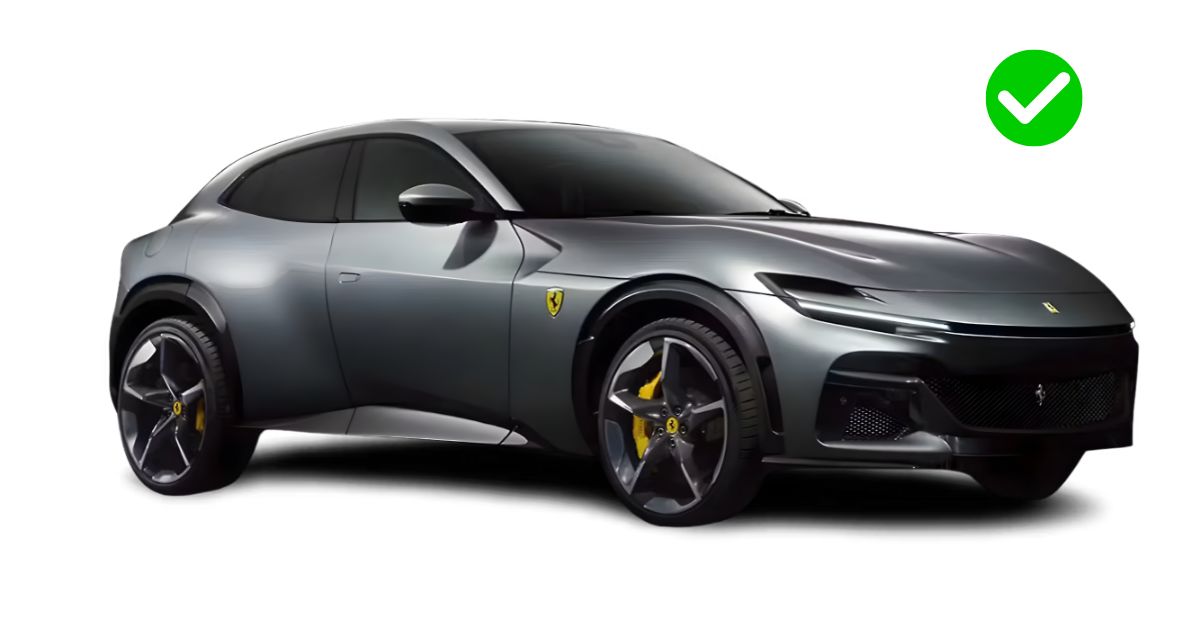
The Ferrari Purosangue 2025 Review is an exhaustive examination of the most controversial and significant vehicle in the modern history of the Prancing Horse—a four-door, four-seater high-riding machine that masterfully fuses supercar DNA with genuine luxury SUV utility. While Ferrari vehemently denies calling it an SUV, referring to it instead as an FUV (Ferrari Utility Vehicle), the Purosangue is engineered to conquer a new segment, challenging rivals like the Lamborghini Urus and Aston Martin DBX with a specialization that is uniquely Ferrari: a naturally aspirated V12 engine and a revolutionary active suspension system. This vehicle is more than just a model; it is a statement of capability, structural innovation, and uncompromising speed. This comprehensive analysis dissects the monumental V12 performance, details the groundbreaking active chassis technology, explores the unique luxury experience of its specialized cabin, and confirms the stratospheric price of ownership for the highly exclusive Indian market.
V12 Performance: The Naturally Aspirated Heart and Unmistakable Sound
The core identity and specialization of the Ferrari Purosangue 2025 Review subject is its engine: the formidable $6.5\text{-litre}$ F140IA Naturally Aspirated V12. In a world increasingly dominated by turbochargers and hybrid systems, Ferrari made the singular decision to fit the Purosangue with its most revered engine architecture, ensuring the vehicle provides an auditory and throttle response experience that is unmatched in the luxury SUV segment.
Raw Output and Torque Delivery
The large $6.5\text{-litre}$ V12, positioned mid-front, generates a colossal $725\text{ PS}$ (715 horsepower) and $716\text{ Newton-metres}$ of torque, making it one of the most powerful conventionally-powered SUVs ever produced. The engineering focus on natural aspiration ensures a razor-sharp throttle response and a linear build-up of power that screams to a peak at $7,750\text{ rpm}$ before hitting its rev limit. This high-revving nature is key to the Ferrari experience. Crucially for daily driving, 80 percent of the maximum torque is available as early as $2,100\text{ rpm}$, ensuring the vehicle feels powerful and responsive even in urban traffic, while retaining its signature dramatic performance at high speeds.
This monumental power is channeled through a high-performance 8-speed oil-bath dual-clutch transmission (DCT). The DCT is designed for seamless, lightning-fast upshifts that maintain the engine’s momentum and rev-matching downshifts that amplify the V12’s distinctive roar. The car utilizes a sophisticated 4RM-S all-wheel drive system, a variant of the complex system found in the GTC4Lusso, which is primarily rear-wheel drive but engages the front axle when slip is detected or when maximum traction is required. This ensures the Purosangue maintains the balanced, engaging dynamic of a true Ferrari sports car. Acceleration is blistering, with the Purosangue launching from $0\text{ to } 100\text{ km/h}$ in a mere $3.3\text{ seconds}$, with a top speed exceeding $310\text{ km/h}$ ($192\text{ mph}$).
Active Chassis Technology: Cheating Physics with FAST
The most revolutionary technological specialization of the Ferrari Purosangue 2025 Review subject is its suspension system, known as F.A.S.T. (Ferrari Active Suspension Technology). This system is genuinely active, a radical departure from the adaptive or semi-active suspensions used by competitors.
Read More: Toyota Harrier 2025
True Active Spool Valve (TASV) Dampers
The FAST system utilizes specialized Multimatic True Active Spool Valve (TASV) Dampers at all four corners, a world-first technology for a production vehicle. Unlike conventional dampers, which only react to road input, the TASV dampers integrate a 48-volt electric motor connected to a ball screw and gearbox assembly within the damper body. This motor can actively push and pull the car’s body, independent of what the wheels are doing. The system effectively controls all body motions—pitch, dive, heave, and, most crucially, body roll—in real-time and at high frequencies.
This specialization means that when the car enters a corner aggressively, the system can instantly exert a counter-force, keeping the massive vehicle virtually flat and maintaining optimal load on each tire. The result is a ride quality that is both supremely comfortable on rough roads (by pulling the wheel down into potholes) and dramatically controlled during high-speed maneuvers, allowing the Purosangue to handle like a much smaller, lighter sports car despite its substantial $2,033\text{ kg}$ kerb weight and higher ground clearance of $185\text{ mm}$. The FAST system entirely eliminates the need for conventional anti-roll bars, further demonstrating its engineering superiority.
Luxury SUV Experience: Dual-Cockpit and Coach Doors
The interior of the Ferrari Purosangue 2025 Review subject is engineered as a true four-seater luxury lounge, breaking with Ferrari’s historical tradition of 2+2 setups.
Dual-Cockpit Architecture and Four Seating
The cabin’s most significant specialization is its four separate, highly adjustable, and independently heated seats. The front passenger is deeply involved in the driving experience through the “Dual Cockpit” architecture, which includes a dedicated $10.25\text{-inch}$ touchscreen display on the passenger side that provides navigation, speed, and media controls. The driver’s interface is fully digital, utilizing the latest generation of Ferrari’s integrated digital interface. The rear passengers enjoy the same level of luxury and comfort as the front, with their own dedicated climate controls and optional rear entertainment screens, defining the Purosangue as a genuine four-place grand tourer.
Rear-Hinged Coach Doors
Access to this meticulously designed interior is facilitated by the unique rear-hinged coach doors (often called “suicide doors”). These doors open wide, providing exceptional ingress and egress for the rear passengers while maintaining the vehicle’s structural rigidity and compact profile. The luggage compartment is generous by Ferrari standards, offering $473\text{ litres}$ of boot space, which is expandable when the rear seats are folded forward, adding a level of practicality previously unseen in a Maranello product. The materials used throughout the cabin are bespoke, including specialized carbon fiber weaves, hand-stitched leather, and high-quality Alcantara, ensuring a visually elegant and tactile experience.
Mileage, Pros & Cons, and Price in India
The ownership experience of the Ferrari Purosangue 2025 Review subject is defined by its engineering brilliance, extreme exclusivity, and high operational costs.
Fuel Economy and Running Costs
The inevitable trade-off for the glory of the naturally aspirated V12 is fuel economy. The Purosangue has an official mileage rating of only $5.78\text{ kmpl}$ (as per global test cycles). In rigorous Indian city driving, owners can expect this figure to drop to the single digits. Running costs are exceptionally high, requiring premium high-octane fuel, specialized maintenance only available through authorized Ferrari service centers, and high insurance premiums befitting a vehicle of this performance and value.
Pros and Cons Summary
The major advantages (Pros) are the unmatched sound and responsiveness of the $6.5\text{L}$ Naturally Aspirated V12, the revolutionary F.A.S.T. active suspension technology that eliminates body roll, the genuine four-seater cabin with coach doors, and sublime performance coupled with everyday usability. The major drawbacks (Cons) are the extremely poor fuel economy, limited overall ground clearance for an SUV (which can be actively raised but is not designed for serious off-roading), the astronomical CBU import price, and the high cost and complexity of maintenance.
Expected Price in India
The Ferrari Purosangue is highly exclusive, and its initial price is compounded by India’s high CBU (Completely Built Unit) import duties, placing it in an elite financial category. The global MSRP starts around $\$428,000$. The official starting Ex-Showroom Price in India for the Ferrari Purosangue is approximately $\text{₹}10.5\text{ Crore}$ to $\text{₹}10.75\text{ Crore}$. The final On-Road Price in India for a well-optioned Purosangue, factoring in RTO registration, insurance, and taxes (which can amount to over $\text{₹}1.7$ Crore in taxes alone), falls into the range of $\text{₹}12.0\text{ Crore}$ to $\text{₹}12.5\text{ Crore}$ in major metropolitan areas, confirming its status as the most exclusive and technologically advanced ultra-luxury utility vehicle available in the country.
The Hyundai Creta N Line 2025 Review is an examination of the compact SUV segment’s most aggressive and performance-focused offering, a vehicle that strategically fuses the immense popularity and feature-rich cabin of the standard Creta with the specialized styling and dynamic enhancements of Hyundai’s N performance division. The N Line is not simply a cosmetic package; it is an executive-level variant specifically tuned to provide a sharper, more engaging driving experience, directly appealing to the enthusiast who demands both daily practicality and thrilling performance. Its structural and aesthetic specializations set it apart from its rivals, offering a unique blend of sporty visual dominance and high-tech cabin amenities. This comprehensive analysis dissects its powerful turbocharged engine, evaluates the impact of its specialized handling setup, details its advanced feature list, and confirms its highly aspirational price positioning in the Indian market.
Engine Specs and Specialized Performance: The 1.5L Turbo GDi Core
The performance of the Hyundai Creta N Line 2025 Review subject is powered by a refined and muscular engine that forms the bedrock of its sporty character.
The 1.5L Turbo GDi Engine
The N Line version is exclusively powered by the $1.5\text{-litre}$ Turbo GDi Petrol engine. This four-cylinder turbocharged unit generates a robust 160 PS (158 bhp) of maximum power at $5,500\text{ rpm}$ and a peak torque of 253 Newton-metres delivered consistently across a wide band from $1,500\text{ rpm}$ to $3,500\text{ rpm}$. This strong torque delivery ensures the N Line feels responsive and powerful across the city and highway, minimizing turbo lag and providing effortless overtaking capability.
The engine offers a crucial choice of transmissions that cater to driving preferences: a 6-speed manual transmission (MT) for the enthusiast who prefers maximum control and engagement, and a highly efficient 7-speed Dual Clutch Transmission (DCT). The DCT, in particular, offers lightning-fast shifts that contribute significantly to the car’s sporty character and smooth, uninterrupted acceleration, making it the preferred choice for maximizing daily driving performance.
Dynamic Tuning and Handling Specialization
The N Line’s specialization is its dynamic tuning. Unlike the standard Creta, the N Line receives a slightly stiffer suspension setup and a quicker steering rack. This subtle but important calibration minimizes body roll during hard cornering, improves feedback to the driver, and makes the vehicle feel more agile and planted on winding roads. Complementing this is the inclusion of a sporty twin-tip exhaust, which provides a deeper, more aggressive note under acceleration, enhancing the overall sensory engagement that is central to the N Line philosophy.
Features and Cabin Technology: The All-Black Digital Cockpit
The interior of the Hyundai Creta N Line 2025 Review subject elevates the standard model’s feature-rich cabin with a specialized, aggressive aesthetic and advanced digital integration.
N Line Aesthetics and Comfort
The cabin adopts an exclusive all-black sporty theme, contrasted by striking red inserts and ambient lighting throughout the dashboard, door panels, and stitching. The driver interface is specialized with an N Line-specific three-spoke steering wheel and gear knob, both adorned with the iconic ‘N’ badging and wrapped in premium leatherette with red stitching. Comfort remains uncompromised, with the inclusion of ventilated front seats (a crucial feature for the Indian climate), an 8-way powered driver seat with memory functions, and dual-zone automatic temperature control (DATC), allowing the driver and front passenger to set separate climate preferences.
Digital Integration and ADAS
The digital cockpit features a seamless integration of dual $10.25\text{-inch}$ curvilinear displays, one serving as the HD infotainment screen and the other as the fully digital driver cluster. The infotainment system is highly responsive, featuring over 70 Bluelink connected car features, including remote start/stop, safety alerts, and personalized profiles. The safety specialization is significant: the Creta N Line is equipped with a suite of Level 2 ADAS (Advanced Driver Assistance Systems), including Smart Cruise Control, Lane Keeping Assist, and Forward Collision Warning. This is supplemented by over 40 standard safety features, including 6 airbags, Electronic Stability Control (ESC), and a highly useful 360-degree camera with guidelines for parking.
Mileage, Pros & Cons, and Price in India
The ownership experience of the Hyundai Creta N Line 2025 Review subject is defined by its excellent performance efficiency and its competitive, yet premium, pricing.
Fuel Efficiency and Running Costs
The $1.5\text{L}$ Turbo GDi engine is remarkably efficient despite its performance focus. The claimed ARAI fuel efficiency figures are around $18.2\text{ kmpl}$ for the DCT variant and $18.0\text{ kmpl}$ for the manual transmission. Real-world city mileage tends to hover around $12\text{ kmpl}$ to $14\text{ kmpl}$, which is highly respectable for a turbocharged petrol SUV. Running costs are manageable, benefiting from Hyundai’s extensive service network and competitive maintenance costs.
Pros and Cons Summary
The major advantages (Pros) are the powerful $160\text{ PS}$ turbocharged engine, the engaging driving dynamics due to the stiffer suspension and quick steering, the aggressive and unique N Line design aesthetics, the feature-loaded interior (ventilated seats, dual screens, panoramic sunroof), and the advanced Level 2 ADAS safety suite. The primary disadvantages (Cons) are the absence of a diesel engine option (limiting choice for high-mileage users) and the firm ride quality at low speeds, which is a necessary trade-off for the improved handling.
Expected Price in India
The pricing of the Hyundai Creta N Line 2025 is positioned strategically to appeal to the performance segment while remaining accessible to the mass market. The estimated Ex-Showroom Price in India for the base N8 DCT variant is approximately $\text{₹}18.0\text{ Lakh}$, with the fully loaded N10 DCT Dual Tone variant reaching up to $\text{₹}20.2\text{ Lakh}$. The final On-Road Price in India for the top variant is estimated to fall between $\text{₹}22\text{ Lakh}$ and $\text{₹}24\text{ Lakh}$, confirming the Creta N Line as the premium, sport-focused choice in the compact SUV segment.