1. INTRODUCTION (The Hook)
Let’s get the real truth out of the way first. The iconic, fire-breathing, V8-powered Dodge Challenger that we knew and loved—the one that defined American brute force—is gone. Finished. Replaced.
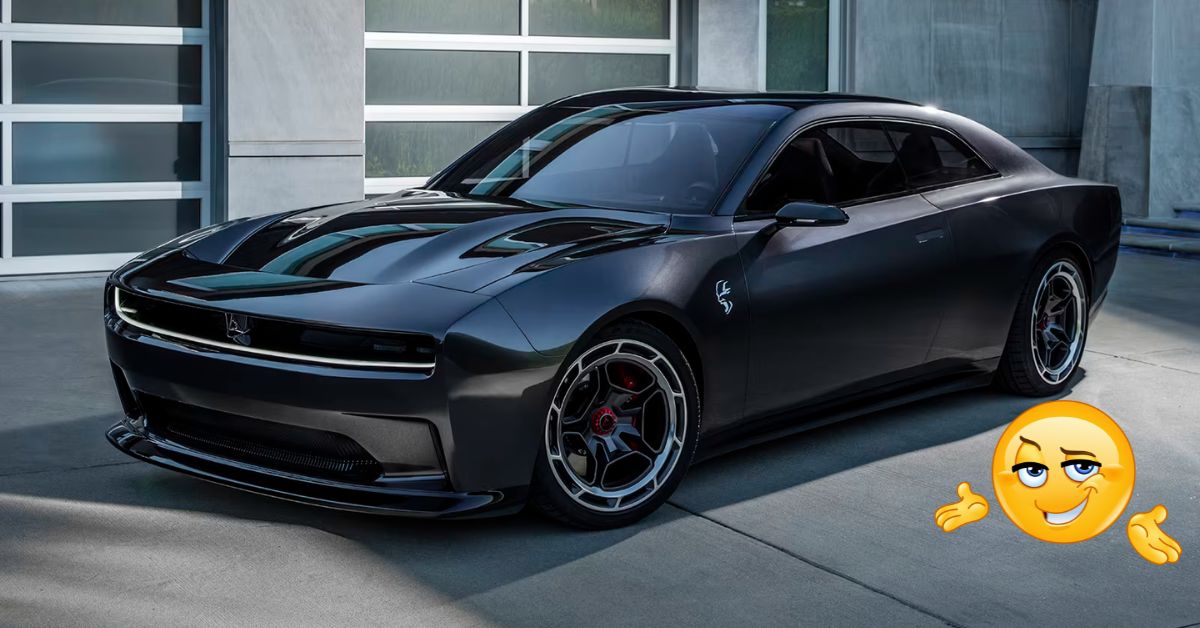
The Dodge Challenger 2025 doesn’t exist. It has been absorbed into the revolutionary, all-electric (for now) Dodge Charger Daytona 2025.
This is not just a new model; it’s a monumental shift for the entire muscle car segment. For the first time, the roar of the V8 is being replaced by the whine of electric motors—albeit one artificially engineered to sound like a beast (more on the “Fratzonic Chambered Exhaust” later).
The hype around the Charger Daytona Scat Pack—with its brutal $670 \text{ horsepower}$ and sub-$3.5$ second $0-100 \text{ km/h}$ time—is deafening. But can an electric car truly capture the soul of a muscle car? For an Indian buyer looking to import a slice of pure Americana, the question isn’t about nostalgia; it’s about practicality, range, and whether this new-age electric performance justifies the inevitable $₹1.5 \text{ Crore+}$ price tag (after duties and taxes).
We’ve dissected the tech, analyzed the specs, and figured out if this new electric monster is a legitimate spiritual successor or just a powerful, heavy EV wearing a muscle car costume.
2. QUICK SPECS TABLE
The focus for performance enthusiasts is on the all-electric Daytona Scat Pack, which sets the benchmark for the new era of Dodge muscle.
| Specification | Charger Daytona R/T (EV) | Charger Daytona Scat Pack (EV) |
| Powertrain | Dual Electric Motors (AWD) | Dual Electric Motors (AWD) |
| Max Power (Total) | $496 \text{ hp}$ | $670 \text{ hp}$ |
| Max Torque (Total) | $404 \text{ lb-ft}$ ($548 \text{ Nm}$) | $627 \text{ lb-ft}$ ($850 \text{ Nm}$) |
| 0-60 mph (Claimed) | $4.7 \text{ seconds}$ | $3.3 \text{ seconds}$ |
| Quarter-Mile (Claimed) | $12.6 \text{ seconds}$ | $11.5 \text{ seconds}$ |
| Battery Capacity (Usable) | $100.5 \text{ kWh}$ | $100.5 \text{ kWh}$ |
| Estimated Range (EPA) | $\sim 317 \text{ miles}$ ($\sim 510 \text{ km}$) | $\sim 260 \text{ miles}$ ($\sim 418 \text{ km}$) |
| Weight (Curb) | $\sim 5,600 \text{ lbs}$ ($\sim 2,540 \text{ kg}$) | $\sim 5,800 \text{ lbs}$ ($\sim 2,630 \text{ kg}$) |
| Seating Capacity | 5 | 5 |
| US MSRP (Est.) | $\sim \$ 59,595$ | $\sim \$ 73,190$ |
3. DESIGN & BUILD (Deep Dive)
The new Charger Daytona is a two-door coupe that replaces the Challenger, but crucially, it shares its platform and initial electric powertrain with the four-door Charger sedan. The design is where old-school muscle meets aggressive, functional futurism.
The Stance and Sheet Metal
The car is huge—even longer and wider than the outgoing Challenger.
- Length: $206.6 \text{ inches}$ ($5248 \text{ mm}$), making it a true American land yacht.
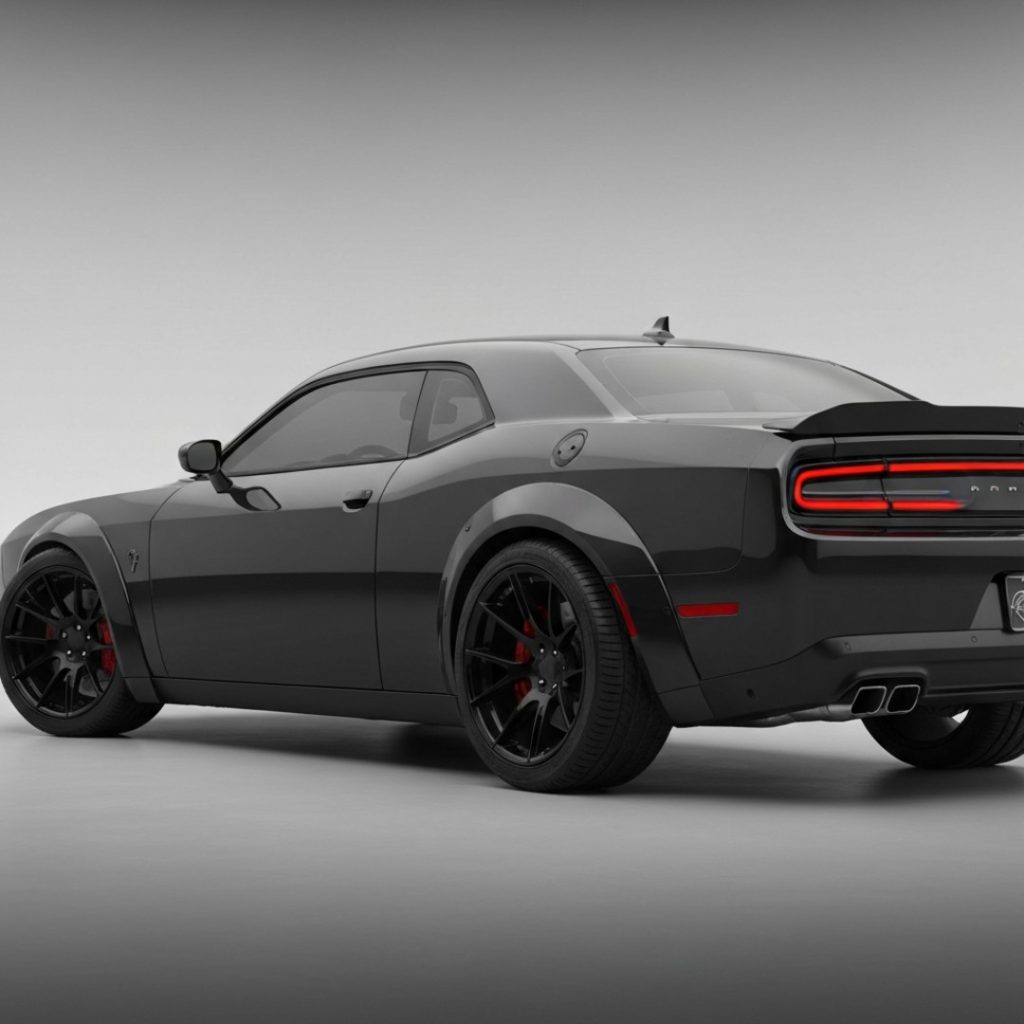
- Body: It features a standard Widebody design, pushing the wheels to the absolute corners and giving it a menacing stance.
- The R-Wing: This is the key aerodynamic trick. The front fascia incorporates a functional pass-through where the upper grille used to be, directing air over the bonnet to improve downforce. It’s an aggressive nod to the original Charger Daytona’s massive nose cone.
- Weight & Build Material: The curb weight of nearly $2,600 \text{ kg}$ (for the Scat Pack) is the elephant in the room. This immense weight, driven by the $100.5 \text{ kWh}$ battery pack, dictates every aspect of the car’s handling. The chassis utilizes galvanized steel and aluminum, but the sheer mass means this is a brute, not a nimble athlete.
The Interior Feel
The cabin is a dramatic step up from the utilitarian Challenger. It replaces cheap plastics with modern tech and performance-focused materials.
- Seating: New performance seats with heavy bolstering, often wrapped in simulated suede/leatherette, are a significant improvement. However, they lack the deep, track-ready support of the Challenger’s best seats.
- Practicality: The switch from the Challenger’s trunk to a rear liftback design (like a modern hatchback) is a massive win for practicality, offering $37.4 \text{ cubic feet}$ of cargo space—enough for serious luggage or track gear.
4. DISPLAY & VISUALS
Dodge has finally joined the 21st century. The cabin tech is unrecognizable compared to the old car.
The Digital Cockpit
The driver is presented with a large, customizable digital interface.
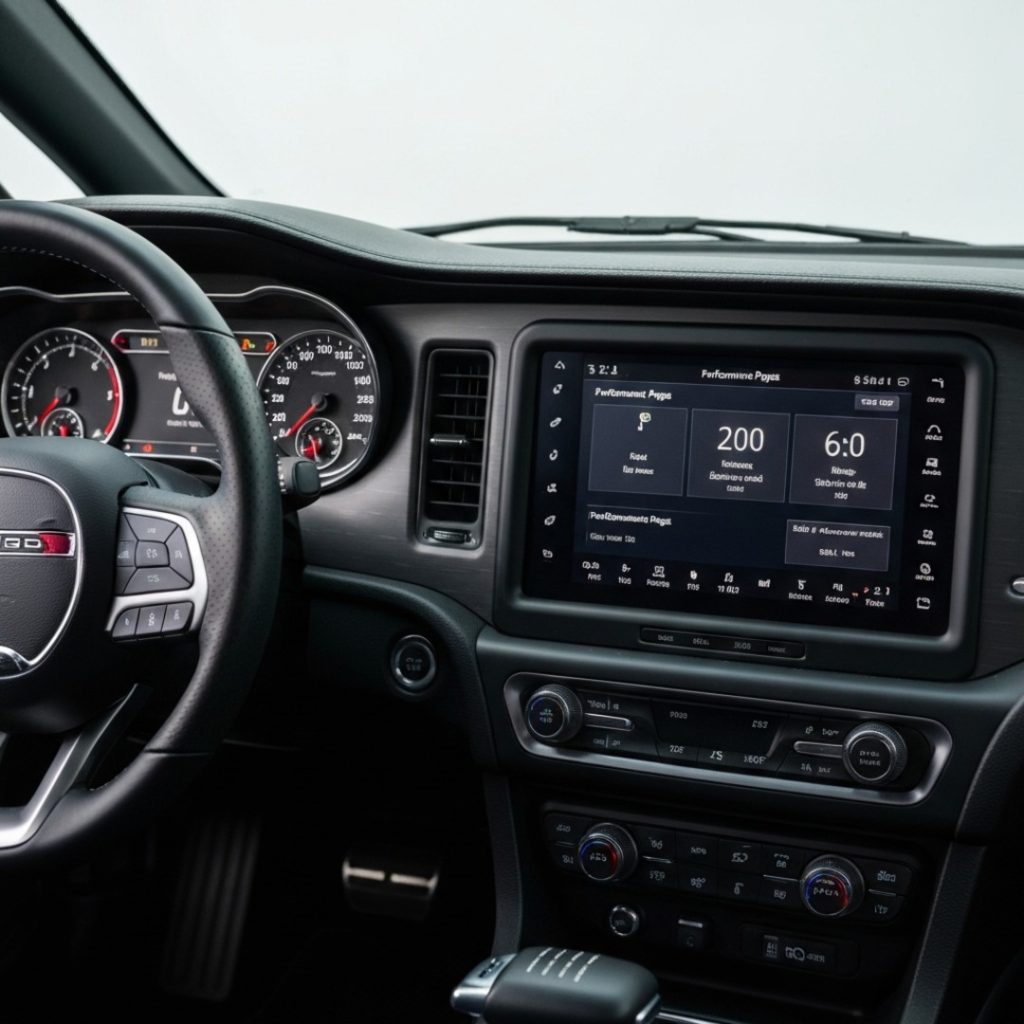
- Digital Cluster: A $10.25 \text{-inch}$ or optional $16.0 \text{-inch}$ digital cluster display (depending on trim) offers reconfigurable gauges, performance metrics, and a retro-style theme that pays homage to classic Dodge instrument panels.
- Infotainment: The centerpiece is a $12.3 \text{-inch}$ Freestanding Touchscreen Display running the Uconnect 5 system.
- Screen Quality & Visibility: The displays are high-resolution, sharp, and responsive. They handle bright sunlight well, crucial for Indian conditions. However, the real visual spectacle is the Performance Pages, which offer real-time power distribution, G-force readings, and a plethora of customizable driving settings.
One-Touch Performance Tech
The new flat-top and flat-bottom steering wheel features an ‘R-T’ button for the R/T or a ‘PowerShot’ button for the Scat Pack.
- PowerShot: This button provides an instant $40 \text{ hp}$ temporary boost of power. It’s a pure dopamine hit and a key visual element of the driving experience, immediately displayed on the digital cluster.
5. PERFORMANCE & DRIVING EXPERIENCE
This is the make-or-break section. The electric motors deliver blistering speed, but the experience is fundamentally different.
The Acceleration Reality
The $670 \text{ hp}$ and $850 \text{ Nm}$ of instant, electric torque from the Scat Pack model are simply devastating. The $0-60 \text{ mph}$ time of $3.3 \text{ seconds}$ is quicker than the outgoing, gas-powered Charger Hellcat Redeye.
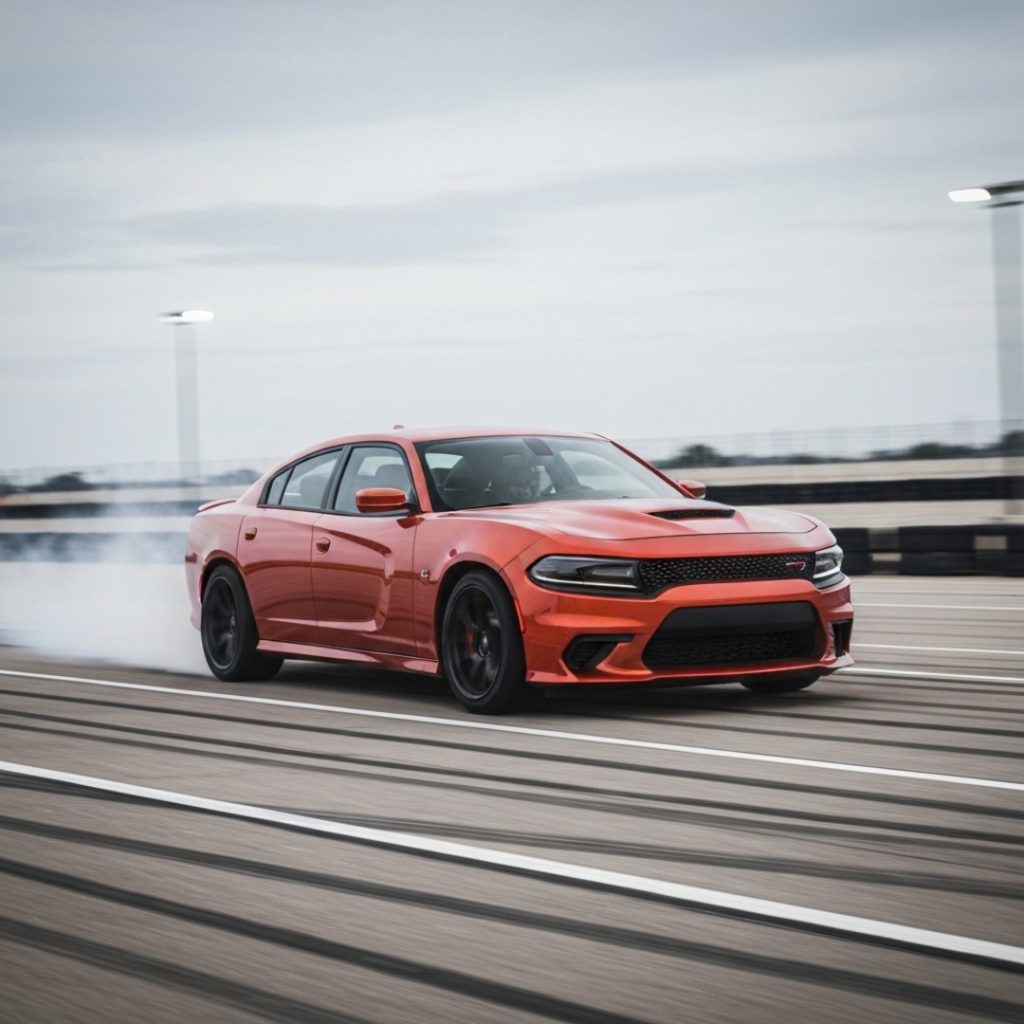
- Real-World Stress Test: Unlike a V8, which needs to spool up, the power is instant. It throws you back into the seat with a violence that only EVs can deliver. On a quick launch, the All-Wheel Drive (AWD) system (standard on the EV) ensures tire spin is minimal, unlike the tail-happy V8 Challengers.
- Handling: The Weight Problem: This is the ‘Don’t waste your money if…’ scenario. The real truth is, the $2,600 \text{ kg}$ curb weight is a liability. While the car is quick in a straight line, pushing it through corners reveals significant issues. Early reviews cite understeer and a general feeling of sloppiness when demanding quick changes of direction. This is a drag strip beast, not a canyon carver. If you’re looking for genuine corner-carving agility, this is not the right muscle car for you.
- Heating/Cooling: The $400 \text{ V}$ propulsion system is sophisticated. Like high-performance EVs, it features dedicated thermal management for the battery and motors, preventing the kind of “power fade” you might see in less-optimized systems.
6. ENGINE (Motors) & THE NOISE
The ‘Engine’ section is now about motors, batteries, and the crucial sound experience.
Electric Power Delivery
The Scat Pack utilizes a $400 \text{ V}$ architecture with dual electric motors—one on each axle, providing standard AWD. This not only aids acceleration but offers better wet-weather grip, a huge plus for monsoon season driving in India.
- Maximum Power: $670 \text{ hp}$ is delivered via a factory-installed Direct Connection Stage 2 Upgrade, standard on the Scat Pack.
- Transmission: A simple 1-speed direct drive system. No gears to shift, which might disappoint purists who enjoy the tactile nature of a manual or even the aggressive shifts of an 8-speed auto.
The Fratzonic Chambered Exhaust
Dodge knew they couldn’t just have silence. They developed the Fratzonic Chambered Exhaust—an external sound system designed to mimic the visceral rumble of the Hellcat V8.
- The Sound: It’s produced through two passive radiators located at the rear of the car, pumping out a synthetic noise that can reach up to $126 \text{ decibels}$ (matching a Hellcat).
- The Verdict: It’s an interesting workaround, but it lacks the organic, deep resonance of a proper, firing V8. It’s loud, aggressive, and certainly turns heads, but the real truth is, it sounds like an extreme video game, not a raw combustion engine.
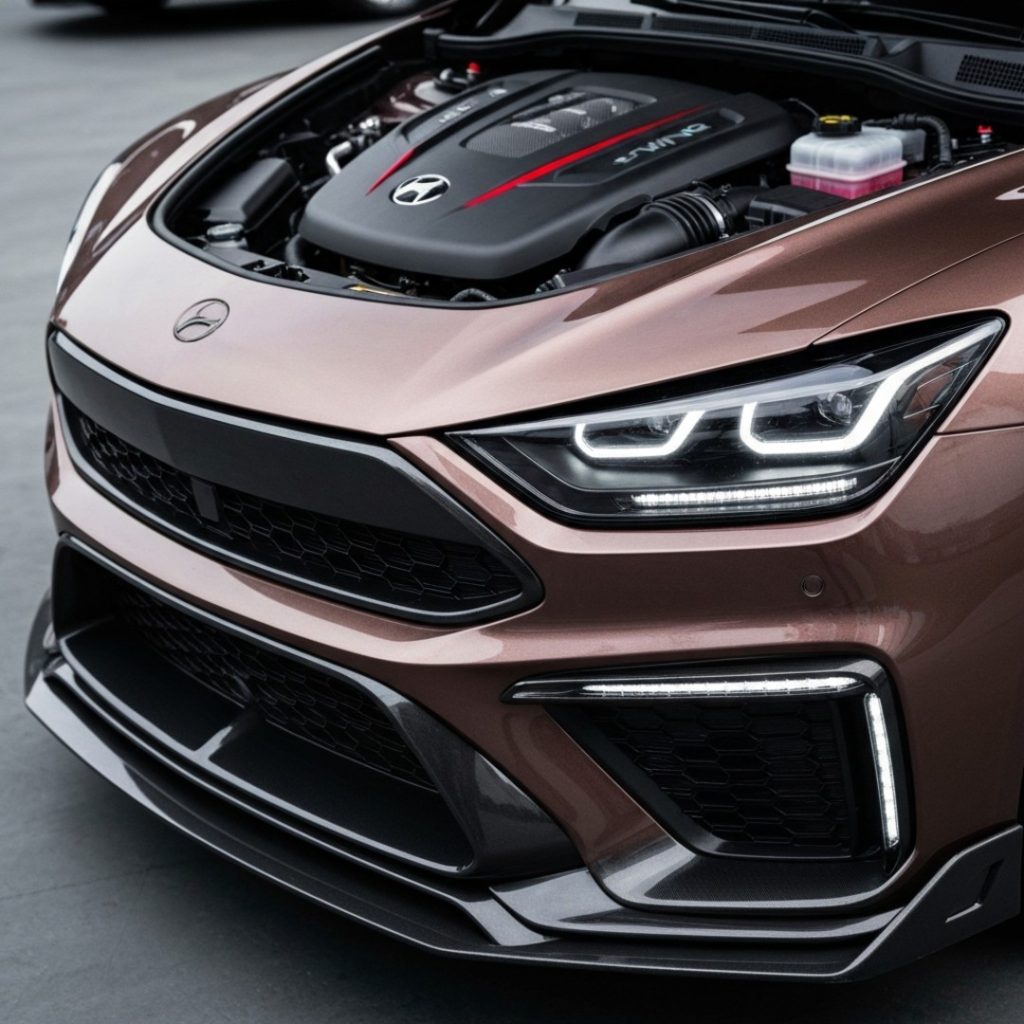
7. BATTERY & ENDURANCE
For the Scat Pack, range is the compromise for performance.
Charging and Efficiency Data
The Charger Daytona uses a high-voltage $400 \text{ V}$ system with a large $100.5 \text{ kWh}$ battery pack.
- DC Fast Charging: On a powerful $350 \text{ kW}$ DC fast charger, the car is expected to charge from $20 \text{% to } 80 \text{% in approximately } 28 \text{ minutes}$. This is competitive, but still slower than high-end $800 \text{ V}$ systems like the Porsche Taycan.
- Home Charging (Level 2): Using a typical $240 \text{ V}$ home charger, a full $0 \text{% to } 100 \text{%}$ charge will take around $9.9 \text{ hours}$.
- Real-World Range: The estimated EPA range of $\sim 260 \text{ miles}$ ($\sim 418 \text{ km}$) for the Scat Pack will drop significantly with enthusiastic driving. If you use the full $670 \text{ hp}$ frequently, expect the range to fall closer to $300 \text{ km}$—enough for a fun weekend drive but requiring careful planning for inter-city travel in India.
| Endurance Metric | Charger Daytona Scat Pack |
| EPA Estimated Range | $418 \text{ km}$ ($\sim 260 \text{ miles}$) |
| Real-World Hard Driving Range | $\sim 300 \text{ km}$ |
| DC Fast Charge (20-80%) | $\sim 28 \text{ minutes}$ |
| L2 Home Charge (0-100%) | $\sim 10 \text{ hours}$ |
8. THE COMPETITION (Auto-Selected Rivals)
The Dodge Charger Daytona 2025 finds itself in a newly created niche: high-performance electric coupe/sedans. Its two strongest competitors are the established EV performance leader and its traditional combustion rival’s electric cousin.
Read More : Toyota Century SUV
Dodge Charger Daytona 2025 vs Ford Mustang Mach-E GT vs Upcoming Dodge Charger Sixpack (Gas)
| Feature | Charger Daytona Scat Pack (EV) | Ford Mustang Mach-E GT (EV) | Charger Sixpack (Gas I6 Twin-Turbo) |
| Power/Torque | $670 \text{ hp} / 850 \text{ Nm}$ | $480 \text{ hp} / 860 \text{ Nm}$ | $550 \text{ hp} / 720 \text{ Nm}$ (Est.) |
| 0-60 mph | $3.3 \text{ seconds}$ | $3.5 \text{ seconds}$ | $3.9 \text{ seconds}$ (Est.) |
| Curb Weight (Approx.) | $\sim 2,630 \text{ kg}$ | $\sim 2,270 \text{ kg}$ | $\sim 2,100 \text{ kg}$ (Est.) |
| Body Style | 2-Door Coupe (or 4-Door Sedan) | 4-Door Crossover SUV | 2/4-Door Muscle Car |
| Sound Experience | Synthetic Fratzonic Exhaust | Silent/Minimal Noise | Twin-Turbo I6 Engine Note |
| Value Proposition | Ultimate straight-line acceleration and bold EV statement. | Everyday usability, better handling, established EV nameplate. | V6 Hemi-like sound, better handling dynamics due to lower weight. |
The Analysis & Winner
- If you want the quickest car: The Dodge Charger Daytona Scat Pack is the clear winner. The $3.3 \text{ seconds}$ sprint is undeniable performance bragging rights.
- If you want a more balanced driver’s car: The Mustang Mach-E GT, despite being a crossover, is reported to have superior handling dynamics and a significantly lower weight, making it a better all-rounder for spirited driving.
- If you hate EVs: Don’t waste your money on the EV. Wait for the gas-powered Dodge Charger Sixpack (coming in 2026). With a twin-turbo $3.0 \text{ L}$ straight-six engine expected to push $550 \text{ hp}$ in the high-output version, it promises to be much lighter, more engaging, and will likely deliver the sound and feel that traditional muscle car fans crave.
The Clear Winner for the Future of Muscle Car Performance is the Dodge Charger Daytona 2025. It is the most powerful and fastest out-of-the-box muscle car ever produced by Dodge, successfully achieving the shock and awe factor required to launch the next era.
9. FINAL VERDICT
The Dodge Charger Daytona 2025 is a revolution, a necessary pivot by a brand defined by tradition. It sacrifices the visceral rumble of the V8 for a new, silent brutality of acceleration. It’s a powerful, polarizing, and hugely impressive machine.
Buy it if:
- Brutal, instant acceleration is your only priority. The $3.3 \text{ second}$ sprint time is addictive.
- You want to own a piece of automotive history. This is the first electric muscle car from the brand, marking the end of the V8 era.
- You appreciate a massive technological leap in the cabin, replacing dated interiors with cutting-edge screens and software.
Skip it if:
- You define a muscle car by its V8 engine sound and feel. The Fratzonic exhaust is a gimmick, not a replacement.
- You prioritize handling and agility. The immense weight makes it a straight-line star, but a cornering compromise.
- You want a true budget muscle car. The Sixpack gas variant will offer a cheaper, lighter, and likely more traditional driving experience.
Rating: / 5 Stars. (A necessary, powerful leap, but the weight penalty costs it the fifth star.)
10. FAQs (People Also Ask)
Is the Dodge Challenger being discontinued for 2025?
Yes, the gasoline-powered Dodge Challenger (and Charger sedan) officially ended production in 2023. The nameplate has been succeeded by the new 2025 Dodge Charger, which, in its initial rollout, is all-electric (EV) in the Daytona R/T and Scat Pack trims.
Is the 2025 Dodge Charger available as a V8 (HEMI) model?
No. The 2025 Dodge Charger Daytona is strictly an all-electric vehicle. However, Dodge has confirmed that future models will include a gasoline-powered variant called the Charger Sixpack, which will utilize a high-output twin-turbo 3.0L inline-six-cylinder engine, not a V8.
How does the Dodge Charger Daytona Scat Pack get $670 \text{ horsepower}$?
The Charger Daytona Scat Pack’s $670 \text{ hp}$ figure is achieved through a standard, factory-installed Direct Connection Stage 2 Upgrade. This software enhancement pushes the dual electric motors to their peak output, delivering brutal acceleration and torque.
What is the ‘Fratzonic Chambered Exhaust’ system?
The Fratzonic Chambered Exhaust is Dodge’s unique solution to the lack of engine sound in an EV. It is an external sound amplifier that uses passive radiators and chambers to generate an aggressive, synthetic exhaust note, capable of reaching $126 \text{ dB}$, designed to mimic the roar of a traditional HEMI V8.
What is the $0-60 \text{ mph}$ time of the new electric Dodge Charger Daytona?
The 2025 Dodge Charger Daytona Scat Pack, with its $670 \text{ horsepower}$, is claimed by Dodge to achieve $0-60 \text{ mph}$ in a blistering $3.3 \text{ seconds}$. This makes it the quickest accelerating mass-produced muscle car Dodge has ever made, surpassing the outgoing Hellcat V8 models.