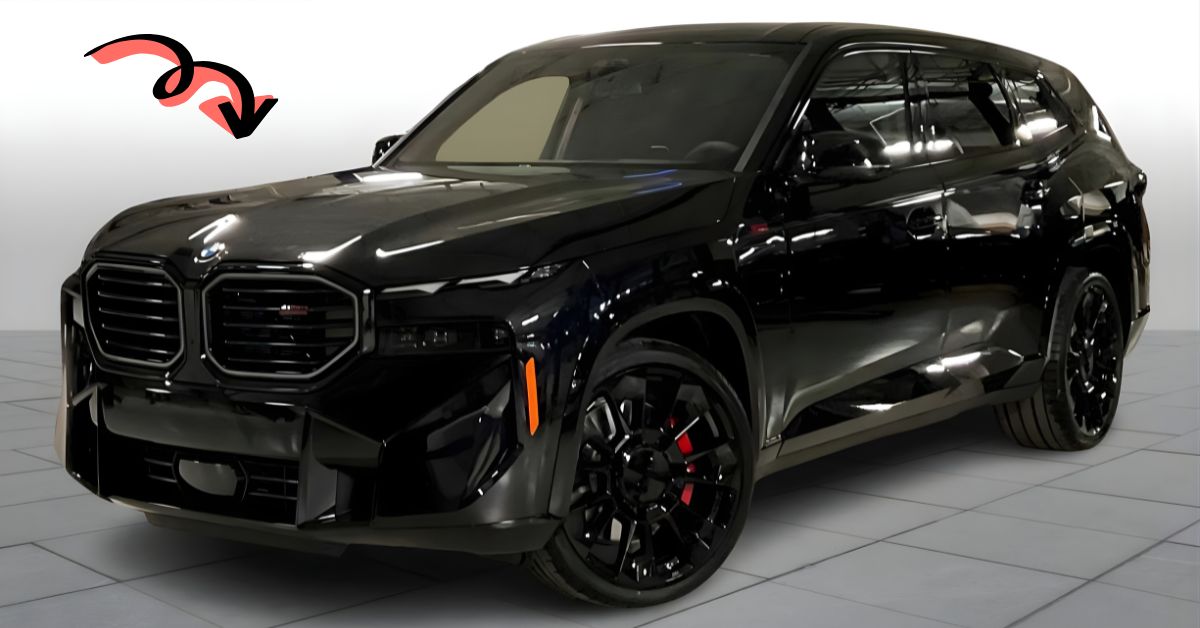
The BMW XM Review is less an assessment of a mere sports utility vehicle and more an examination of a statement—a colossal, defiant declaration of intent from the M division, positioning itself as the first standalone M model developed entirely in-house since the legendary M1. This monumental machine deliberately shatters conventions, fusing the brutal, unbridled performance of a V8 engine with the cutting-edge efficiency and silent capability of a sophisticated plug-in hybrid electric vehicle (PHEV) system. For the 2026 model year, BMW has streamlined the lineup, focusing attention squarely on the range-topping, high-output XM Label (previously known as Label Red), which elevates the SUV’s specifications into hyper-SUV territory. This extensive analysis explores the extreme power figures, dissects the complexity of its hybrid efficiency, details the exclusive features defining its ultra-luxury cabin, evaluates its critical pros and cons, and forecasts the substantial price point for the discerning buyer in the Indian market.
The M Hybrid Powerhouse: Unrivalled Performance and Engineering Excellence
The performance core of the BMW XM Review is defined by the extraordinary M Hybrid drive system in the 2026 XM Label. This system combines the power of BMW’s revered 4.4-litre M TwinPower Turbo V8 engine with a highly potent electric motor integrated directly into the 8-speed M Steptronic transmission. The V8 alone is a marvel, generating a ferocious $585\text{ bhp}$, but the synergy with the $197\text{ bhp}$ electric motor creates a staggering combined output of $748\text{ bhp}$ (horsepower) and a peak system torque of a monumental $1000\text{ Nm}$. This makes the XM Label the most powerful series production model ever manufactured by BMW M, a figure necessary to propel its considerable mass.
This immense surge of power is channeled through the sophisticated M xDrive all-wheel-drive system, ensuring maximum traction and control off the line. This meticulous engineering allows the gargantuan SUV to launch from $0\text{ to } 100\text{ km/h}$ in a blistering $3.8$ seconds, a figure that rivals dedicated sports cars and leaves most luxury SUVs in its wake. The M Steptronic transmission, featuring Launch Control and instantaneous shifting, maintains the V8’s characteristic aggression and soundtrack when the petrol engine is engaged. For those who opt for the M Driver’s Package, the electronically governed top speed is raised significantly from $250\text{ km/h}$ to a true high-performance speed of $290\text{ km/h}$, confirming the BMW XM Review subject is a machine built without compromise for both the road and the track.
The Mileage Conundrum: Understanding PHEV Efficiency and Daily Utility
The discussion surrounding the BMW XM Review and its mileage must be contextualized entirely within the parameters of its plug-in hybrid architecture. The officially quoted ARAI-certified mileage figure stands at a staggering $61.9\text{ kmpl}$, a number that, while technically accurate for regulatory calculation, is highly misleading for real-world V8 petrol consumption. This figure is achieved by factoring in the significant range of emission-free electric driving. The vehicle houses a substantial $25.7\text{ kWh}$ (net) high-voltage battery pack, which provides a pure electric driving range of approximately $76\text{ km}$ to $88\text{ km}$ (WLTP cycle).
Read More: Lexus LX 500d
This electric range is the XM’s true efficiency specialty: it allows the owner to execute virtually all daily city commutes, errands, and school runs in complete silence and with zero tailpipe emissions, effectively achieving several days of travel at an infinite mileage rate by relying solely on the charged battery. When the battery is depleted or the driver demands maximum acceleration, the V8 fires up instantly. In this V8-only mode, the fuel economy is typical of a high-performance $4.4\text{-litre}$ SUV, generally settling in the $7\text{ kmpl}$ to $10\text{ kmpl}$ range, reflecting the vehicle’s substantial $2.7$-ton curb weight. The 2026 model improves charging convenience by upgrading the onboard AC charging rate from $7.4\text{ kW}$ to $11\text{ kW}$, technically allowing for faster home and public AC charging and enhancing the usability of the electric-only mode for daily driving.
Chassis and Dynamics: The Weight vs. Agility Battle
The massive $2.7$-ton curb weight of the BMW XM Review subject—a direct consequence of its V8 engine, large body structure, and integrated battery pack—presents the greatest challenge to its M badging. BMW M engineers mitigate this mass using a sophisticated array of chassis technologies. The vehicle features Adaptive M Suspension Professional, incorporating electronically controlled shock absorbers and active anti-roll bars (48V active roll stabilization). Furthermore, the inclusion of Integral Active Steering, a four-wheel steering system, enhances agility at low speeds by turning the rear wheels in the opposite direction to the front, drastically reducing the effective turning circle and making the enormous SUV feel manageable in tight parking situations. At high speeds, the rear wheels turn in the same direction, improving stability and handling during aggressive maneuvers.
However, critics often point to the firm ride quality as a significant compromise. Despite the adaptive dampers, the suspension, built on steel springs, is tuned aggressively to counteract the vehicle’s weight during performance driving, resulting in a ride that can feel overly stiff and compromised on uneven Indian roads, detracting from the luxurious cruising experience expected of an SUV at this price point. This stiffness highlights the XM’s central dichotomy: it attempts to be both a supple luxury cruiser and a brutal track weapon, a duality that is not always resolved perfectly in real-world driving.
Luxury and Exclusivity: Features of the M Lounge Cabin
The BMW XM Review subject excels in exclusivity and interior opulence, with its cabin purposefully designed as a statement of luxury and high-tech integration. The exterior is defined by an illuminated BMW M kidney grille, twin LED headlamps, and massive 22-inch standard (or optional 23-inch) M light-alloy wheels, ensuring an unparalleled road presence. Inside, the centerpiece is the BMW Curved Display, which seamlessly integrates a $12.3\text{-inch}$ instrument panel and a $14.9\text{-inch}$ control display, running the latest iDrive 8.5 software. The technology is capped by the stunning Bowers & Wilkins Diamond Surround Sound System, featuring 20 speakers and a 1,475-watt amplifier, which provides an acoustic experience commensurate with the vehicle’s price.
The rear cabin, dubbed the M Lounge, is a unique selling proposition. It is characterized by three new interior themes for 2026, featuring Full Merino Leather upholstery with distinctive diamond quilting and high-quality comfort cushions. The roof is particularly special, featuring a geometric-patterned headliner with a dramatic fibre-optic lighting display that uses over 100 LEDs to create a three-dimensional effect, replacing the traditional panoramic sunroof. Comfort facilities include four-zone automatic climate control, M multifunction front seats with massage, heating, and ventilation functions, reinforcing the XM’s commitment to providing a luxurious, exclusive, and hyper-technological passenger experience.
Pros, Cons, and Price in India
Pros
The BMW XM Review yields several key advantages: Brutal, Unrivalled Power with $748\text{ bhp}$ and $1000\text{ Nm}$; Exclusivity as the first standalone M model in decades; PHEV Practicality offering silent, pure EV city commuting; and Luxurious M Lounge Interior with class-leading technology and comfort features.
Cons
The drawbacks are significant: Extreme Curb Weight of approximately $2.7$ tons, which dictates its handling characteristics; Polarizing Design that may alienate traditional BMW buyers; Stiff Ride Quality that compromises luxury comfort; and the High Maintenance Costs typical of complex plug-in hybrid V8 powertrains.
The price of the BMW XM Review subject reflects its exclusivity and performance. The standard model was previously priced at $\text{₹}2.55\text{ Crore}$ ex-showroom. The more powerful XM Label (748 bhp) was priced higher. Considering the streamlining of the 2026 lineup to focus on the Label, the estimated On-Road Price in India for the fully equipped BMW XM Label will range from $\text{₹}3.6\text{ Crore}$ to $\text{₹}3.8\text{ Crore}$ in major metropolitan areas, making it a high-end niche choice reserved for buyers who demand unparalleled power, technological innovation, and an uncompromising statement on the road.
The specialization of the BMW XM lies entirely within its unique and provocative mandate: it is engineered to be the ultimate statement of extravagant, uncompromising, and electrically-assisted high performance, a machine that refuses to adhere to the subtle conventions of the luxury SUV segment. Unlike its rivals which often prioritize either comfort or track performance, the XM is special because it violently attempts to master both extremes, all while embodying the most powerful Plug-in Hybrid (PHEV) powertrain ever produced by BMW M.
The Specialization of Electrified Extremism: The M Hybrid Core
The true technological specialty of the BMW XM centers on its M Hybrid system, which is a direct, race-derived application of the technology used in the BMW M Hybrid V8 endurance racer. This is not a simple mild-hybrid setup designed for marginal efficiency; it is an integrated, high-performance system where the electric motor is engineered to boost the massive output of the combustion engine. The V8 itself is a new generation 4.4-litre M TwinPower Turbo V8, but the specialty lies in the electric motor’s placement: it is integrated directly into the 8-speed M Steptronic transmission. This setup allows the electric motor to apply its instantaneous $197\text{ hp}$ and $280\text{ Nm}$ torque precisely and immediately before the V8’s power is fully realized, effectively eliminating any hint of turbo lag and ensuring a brutal, continuous surge of power. The result is a combined system output in the current XM Label of $748\text{ hp}$ and $1000\text{ Nm}$ of torque, making it the most powerful series-production road car in BMW’s history. This hybridization is special because it is designed not for efficiency but for maximum, instantaneous performance.
The Specialization of Architectural Defiance: Handling and Suspension
The XM’s engineering specialty is its battle against its own $2.7$-ton curb weight. To overcome this mass, BMW equipped the XM with the most advanced chassis technologies available, ensuring its high-performance handling defies its size. This includes the Adaptive M Suspension Professional, which incorporates electronically controlled active anti-roll bars (Active Roll Stabilization). These bars use powerful electric motors to instantly counteract body roll during aggressive cornering, keeping the massive vehicle remarkably flat and stable. Furthermore, the inclusion of Integral Active Steering (four-wheel steering) is a critical specialty. At low speeds, the rear wheels turn in the opposite direction to the front, drastically reducing the vehicle’s turning radius and making the large SUV surprisingly agile in city driving and parking. At high speeds, the rear wheels turn in the same direction, enhancing stability during quick lane changes and fast bends. This intricate ballet of active anti-roll, active steering, and sophisticated damping is the specialized solution required to deliver authentic M performance in a heavy PHEV SUV format.
The Specialization of Extravagant Design and The M Lounge
The design is perhaps the most obvious external specialty of the BMW XM. Its styling is aggressively polarizing, featuring a massive, illuminated M kidney grille and a bold, muscular silhouette that is purposefully designed to elicit a strong reaction and signal supreme exclusivity. This extravagant statement continues inside, where the M Lounge rear seating area is the ultimate cabin specialty. This is not merely a rear bench; it is a meticulously crafted space featuring high-quality, diamond-quilted Full Merino leather upholstery and a unique three-dimensional prism structure headliner. This roof section is intricately lined with over 100 optical fibers for ambient lighting, creating a dramatic, geometric lighting display that elevates the rear passenger experience into an art form, a feature unique to the XM and reinforcing its identity as a luxury flagship. The XM specializes in this blend of visual provocation externally and unparalleled, tech-infused luxury internally, making it a powerful and undeniable statement of wealth and performance.