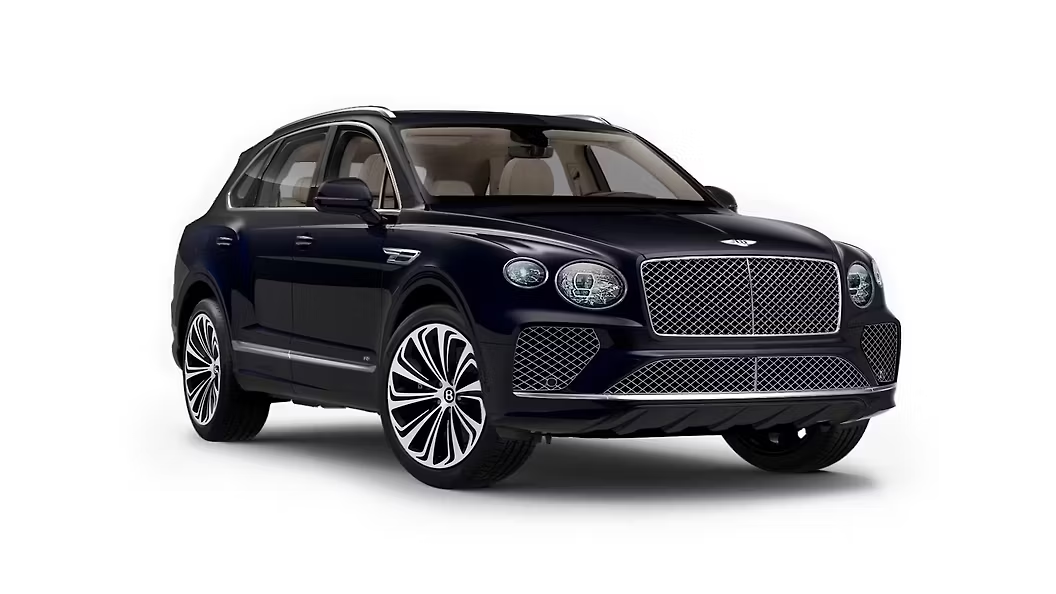
The Bentley Bentayga Review is an examination of the ultimate expression of the ultra-luxury SUV, a vehicle that transcends mere transportation to become a statement of immense wealth, refined taste, and uncompromising performance. Born from a legacy of grand touring excellence, the Bentayga set the benchmark for the modern ultra-luxury utility vehicle when it first arrived, and the 2026 iteration, honed by continuous refinement and technological integration, continues to assert its dominance. This machine is a study in purposeful contradiction, blending the meticulous, hand-stitched craftsmanship of a bespoke British saloon with the aggressive speed and sophisticated chassis management of a high-performance sports car. For the discerning elite in India, the Bentayga represents the finest convergence of power, personalization, and prestige, commanding a price that reflects its unique positioning at the very top of the automotive hierarchy. This comprehensive analysis dissects its powerful engine options, details the specialized systems that ensure its world-class ride and handling, explores the bespoke luxury of its cabin, and outlines the significant financial commitment required for its ownership in India.
Engine Performance: The Symphony of Power—V8, PHEV, and the Legacy of W12
The performance heart of the Bentley Bentayga Review subject is defined by a choice of powertrains that reflect both Bentley’s traditional pursuit of overwhelming power and its necessary pivot towards electrified efficiency.
The V8 Powerhouse and Performance
The core of the Bentayga lineup in 2026 is the refined $4.0\text{-litre}$ Twin-Turbo V8 engine. This potent unit, celebrated for its robust power delivery and satisfying exhaust growl, generates a formidable $542\text{ bhp}$ ($550\text{ PS}$) and $770\text{ Nm}$ of peak torque. This power is channeled through a precise 8-speed automatic transmission and Bentley’s permanent All-Wheel Drive (AWD) system, allowing the large SUV to accelerate from $0\text{ to } 100\text{ km/h}$ in a rapid $4.5$ seconds, with a top speed officially stated at $290\text{ km/h}$. The Bentayga V8 offers a sublime balance between daily usability and instantaneous performance, with its massive torque ensuring effortless, rapid acceleration in any gear, a crucial feature for quick overtaking maneuvers on Indian highways.
The Speed and the PHEV Future
While the iconic $6.0\text{-litre}$ Twin-Turbo W12 engine that once powered the Bentayga Speed is being phased out globally, its successor, the Bentayga Speed V8, maintains the performance mandate. The 2026 Speed variant is now equipped with a higher-output version of the V8, pushing power to over $641\text{ bhp}$ and $850\text{ Nm}$ of torque, capable of achieving the $0\text{ to } 100\text{ km/h}$ sprint in approximately $3.4$ seconds and a top speed of $310\text{ km/h}$. Complementing this raw power is the highly relevant $3.0\text{-litre}$ V6 Plug-in Hybrid (PHEV) powertrain, which provides around $456\text{ bhp}$ combined and an impressive $700\text{ Nm}$ of torque. Crucially, the hybrid offers a serene, electric-only driving range of approximately $40\text{ km}$ to $50\text{ km}$ on a single charge. This feature allows owners to complete city commutes and short trips in absolute silence, significantly reducing urban emissions and demonstrating Bentley’s commitment to sustainable luxury without compromising its performance heritage.
Read More: Tata Sierra
Chassis and Performance: Bentley Dynamic Ride and Physics Defiance
The exceptional handling and supreme ride comfort that define the Bentley Bentayga Review subject are made possible by a specialized, active chassis system that actively manages the vehicle’s immense $2.4\text{-ton}$ mass.
Bentley Dynamic Ride (BDR)
The key technology here is Bentley Dynamic Ride (BDR), a groundbreaking $48\text{V}$ electric active anti-roll system fitted to the higher-spec models. This system utilizes powerful electric motors on the anti-roll bars to monitor and instantly counteract body roll during cornering. When the car enters a corner, the motors stiffen the anti-roll bars, keeping the body virtually flat, which is critical for maximizing stability and delivering a sports car-like handling precision. Conversely, during straight-line cruising, the system relaxes its grip, allowing the wheels to articulate freely, effectively decoupling the left and right wheels to absorb bumps and imperfections, resulting in a “magic carpet ride” comfort that is virtually unmatched in the SUV segment.
All-Wheel Steering and All-Terrain Capability
The Bentayga further enhances its dynamic capability with All-Wheel Steering (AWS), particularly essential on the Extended Wheelbase (EWB) models. At low speeds, the rear wheels steer in the opposite direction to the front, drastically reducing the vehicle’s turning circle and making the enormous SUV feel agile and manageable in tight urban environments. At high speeds, the rear wheels steer in phase with the front, enhancing stability during quick lane changes. Combined with the Electronic Air Suspension, which offers four distinct ride heights and specialized Bentley drive modes, the Bentayga maintains genuine all-terrain capability, allowing it to confidently handle challenging road surfaces, deep snow, or sand, proving its status as a true luxury 4×4.
Interior Features: The Pinnacle of Bespoke Craftsmanship and Comfort
The cabin of the Bentley Bentayga Review subject is where its price is truly justified, representing the absolute pinnacle of luxury craftsmanship and comfort specialization. The interior is hand-finished, dominated by aromatic, exquisitely tanned leather hides, rare sustainable wood veneers, and polished metals.
Specialized Comfort and Technology
The Bentayga specializes in occupant comfort through unique features such as Postural Adjust and Seat Auto Climate—systems available on the EWB models. Seat Auto Climate actively monitors the temperature and humidity at the surface of the seat, automatically adjusting heating and ventilation to maintain an exact temperature balance. Postural Adjust subtly varies the pressure in individual air pockets within the seats, promoting blood flow and reducing fatigue during long journeys. The rear cabin experience is enhanced by the optional Bentley Rear Entertainment system, which features twin $10.1\text{-inch}$ high-definition touchscreens. The audio experience is handled by the astonishing Naim for Bentley Audio System, featuring $1,780\text{W}$ of power and 20 speakers, creating an acoustically sealed, concert-hall environment. The attention to detail extends to the famous Diamond Knurling on the control surfaces and the optional Bentley Rotating Display, which swaps the large touchscreen for three handcrafted analogue dials at the touch of a button, blending digital innovation with timeless mechanical artistry.
Safety, Benefits, and Price in India
Safety, while not crash-tested by agencies like Euro NCAP, is guaranteed by its substantial size, strong platform (shared with the Audi Q7/Lamborghini Urus), and comprehensive Touring Specification ADAS suite. This includes Adaptive Cruise Control with traffic sign recognition, Night Vision, Head-Up Display, and a $360$-degree camera system.
The primary benefit of owning the Bentley Bentayga Review subject is Unrivalled Customization and Exclusivity. Every vehicle is a bespoke commission, with the Mulliner division offering virtually limitless options for paint, veneer, leather color, and stitching, ensuring no two Bentaygas are exactly alike. Its sheer presence and the prestige of the Bentley badge are unmatched.
The price of the Bentley Bentayga Review subject firmly places it in the ultra-luxury stratum in India. The ex-showroom price for the V8 Petrol starts around $\text{₹}4.1\text{ Crore}$ to $\text{₹}5.0\text{ Crore}$. The highly desirable Extended Wheelbase (EWB) and Speed models reach far higher, often exceeding $\text{₹}6\text{ Crore}$ ex-showroom. The final On-Road Price in India for a customized Bentayga V8 is typically between $\text{₹}5.0\text{ Crore}$ and $\text{₹}5.75\text{ Crore}$, while fully personalized EWB or Speed variants can easily approach $\text{₹}7.0\text{ Crore}$, confirming its status as the most opulent, performance-capable luxury SUV on the market.
The automotive landscape in India for the 2026 model year is characterized by profound changes, driven by electrification, the democratization of high-end features, and the highly competitive entry of new global platforms. The market is rapidly shifting away from simple cost-effectiveness toward a demand for high-value propositions that successfully blend global technology with localized pricing, ensuring vehicles are future-proofed against evolving emission norms and consumer safety expectations. This comprehensive review analyzes the most anticipated launches across the mass-market, lifestyle, and premium segments, highlighting the features, performance benchmarks, and estimated price ranges that will define the choices for the Indian consumer in the coming year.
The Mass-Market Revolution: EVs, Hybrids, and Safety Benchmarks
The most transformative launches in 2026 will come from the market volume leaders, Maruti Suzuki and their joint venture partner Toyota, who are focusing on high-mileage hybrid technology and the necessary transition to dedicated electric vehicle (EV) platforms.
The Maruti Suzuki eVitara and Toyota Urban Cruiser EV: Electric Entry
The highly anticipated arrival of the Maruti Suzuki eVitara (and its platform sibling, the Toyota Urban Cruiser EV) marks the official, aggressive entry of India’s largest manufacturer into the dedicated electric SUV space. Built on a new scalable platform, the eVitara is expected to offer robust performance and substantial range, with the top-spec model targeting a significant $49\text{ kWh}$ to $61\text{ kWh}$ battery capacity. This large battery pack is projected to deliver an ARAI-certified range approaching $500\text{ km}$, a figure that immediately places it at the forefront of the mid-range EV segment. Positioned in the $\text{₹}17\text{ Lakh}$ to $\text{₹}22\text{ Lakh}$ ex-showroom segment, the eVitara will directly challenge the established dominance of the Tata Nexon EV and Mahindra XUV400. Its features are projected to be high-tech, including a large floating digital display, fast DC charging capability (0 to $80\%$ in under an hour), and superior cabin refinement, leveraging Maruti’s service network reliability with cutting-edge EV technology. The Maruti eVitara is also rumored to have achieved a 5-Star BNCAP safety rating, signaling a significant step up in structural integrity for the brand’s electric offerings.
New Era of Domestic Excellence: Mahindra XUV 7XO and Tata Sierra EV
Mahindra is set to continue its SUV dominance with the Mahindra XUV 7XO, the highly anticipated successor to the immensely popular XUV700. Set for an early 2026 debut, the XUV 7XO promises superior design, enhanced technology, and greater comfort. It is expected to retain the powerful $2.0\text{-litre}$ mStallion petrol and $2.2\text{-litre}$ mHawk diesel engines but will feature upgraded interiors, a revised digital cockpit, and enhanced Level 2 ADAS (Advanced Driver Assistance Systems) capabilities, further cementing its position as the premium technology flagship in the sub-$\text{₹}30\text{ Lakh}$ segment.
Equally important is the imminent launch of the Tata Sierra EV, set for early 2026. This model revives the legendary nameplate and is built on the advanced acti.ev platform. With an expected price range of $\text{₹}20\text{ Lakh}$ to $\text{₹}25\text{ Lakh}$, the Sierra EV promises a combination of nostalgic design (retaining the iconic silhouette) and future-proof power, targeting a practical EV range in excess of $400\text{ km}$, offering a robust and stylish alternative to existing electric SUVs.
Luxury and Technological Flagships: High-End Electrification and ADAS Supremacy
At the premium and luxury end of the market, 2026 is defined by the full-scale transition to specialized electric platforms and the introduction of next-generation driver assistance hardware, signaling a major leap in vehicle safety and connectivity.
The Mercedes-Benz CLA Electric: Range and $800\text{V}$ Architecture
The new generation Mercedes-Benz CLA Electric represents a fundamental shift in the luxury sedan segment. Built on the revolutionary MMA (Mercedes Modular Architecture) platform, the CLA EV is designed from the ground up to maximize electric efficiency. The specialization here is the use of an $800\text{V}$ electrical system, which enables ultra-fast DC charging—a key differentiator that significantly reduces charging times compared to current $400\text{V}$ systems. The headline feature is the vehicle’s projected WLTP claimed range of up to $750\text{ km}$, a benchmark figure that virtually eliminates range anxiety for luxury consumers. Priced in the estimated $\text{₹}60\text{ Lakh}$ to $\text{₹}75\text{ Lakh}$ range, the CLA EV will blend a highly aerodynamic, sleek design with the new MB.OS digital cockpit architecture, setting a new standard for electric luxury.
BMW iX3 and Audi Q6 e-tron: The EV SUV Arms Race
BMW and Audi are strategically targeting the high-volume luxury EV SUV segment. The next-generation BMW iX3, built on the all-new Neue Klasse platform, is expected to arrive with significant range and efficiency gains, potentially targeting a WLTP range approaching $800\text{ km}$ and supporting ultra-fast charging capability, directly challenging the dominance of the Tesla Model Y. Simultaneously, the Audi Q6 e-tron, built on the premium PPE (Premium Platform Electric) architecture co-developed with Porsche, will fill the crucial $\text{₹}1\text{ Crore}$ bracket. The Q6 e-tron specializes in sophisticated aerodynamics and high-fidelity digital displays, leveraging its platform for superior driving dynamics and rapid charging speeds, appealing to buyers who prioritize technology and understated luxury.
The Hybrid Supercar Wave
The high-performance segment is completing its transition to hybridization. The Lamborghini Huracán Successor is confirmed for a 2026 release, featuring a V8 Plug-in Hybrid powertrain. This blend of the classic exotic V8 sound with the instant electric torque of hybridization will redefine the entry-level supercar experience in India, providing higher overall performance and efficiency gains required by global standards. Similarly, the Bentley Continental GT Hybrid is set to combine Bentley’s traditional grand touring luxury and bespoke craftsmanship with a powerful V6 or V8 Plug-in Hybrid system, catering to the ultra-rich who demand uncompromising speed alongside a clear commitment to sustainable technology.
Niche Segments and Global Platforms: Duster, Tekton, and Pickup Trucks
The competitive mid-segment is being revitalized by global platform-sharing initiatives, bringing highly advanced architectures to India.
The Renault Duster and Nissan Tekton Comeback
The Renault Duster is making its highly anticipated return in early 2026, built on the versatile CMF-B platform. This new Duster is expected to feature bold, aggressive styling and advanced powertrains, including a $1.2\text{-litre}$ turbocharged petrol engine with strong hybrid options, promising segment-leading fuel efficiency in the $20\text{ kmpl}$ range. Its platform-sibling, the Nissan Tekton, will distinguish itself with a more rugged, Patrol-inspired design aesthetic, featuring connected LED DRLs and a high-tech feature set including Level 2 ADAS and a $360$-degree camera, challenging rivals in the $\text{₹}10\text{ Lakh}$ to $\text{₹}20\text{ Lakh}$ range.
The Mahindra Global Pik Up (Scorpio X)
Mahindra is pioneering the lifestyle pickup truck segment with the launch of the Global Pik Up (possibly named Scorpio X), based on the rugged Scorpio N platform. This vehicle aims to provide genuine off-road capability (with the $2.2\text{-litre}$ mHawk diesel and 4×4) combined with utility, directly competing with the Toyota Hilux. This launch signals the maturity of the Indian market’s appetite for specialized, high-utility adventure vehicles, positioning the Pik Up in the $\text{₹}16\text{ Lakh}$ to $\text{₹}25\text{ Lakh}$ segment.