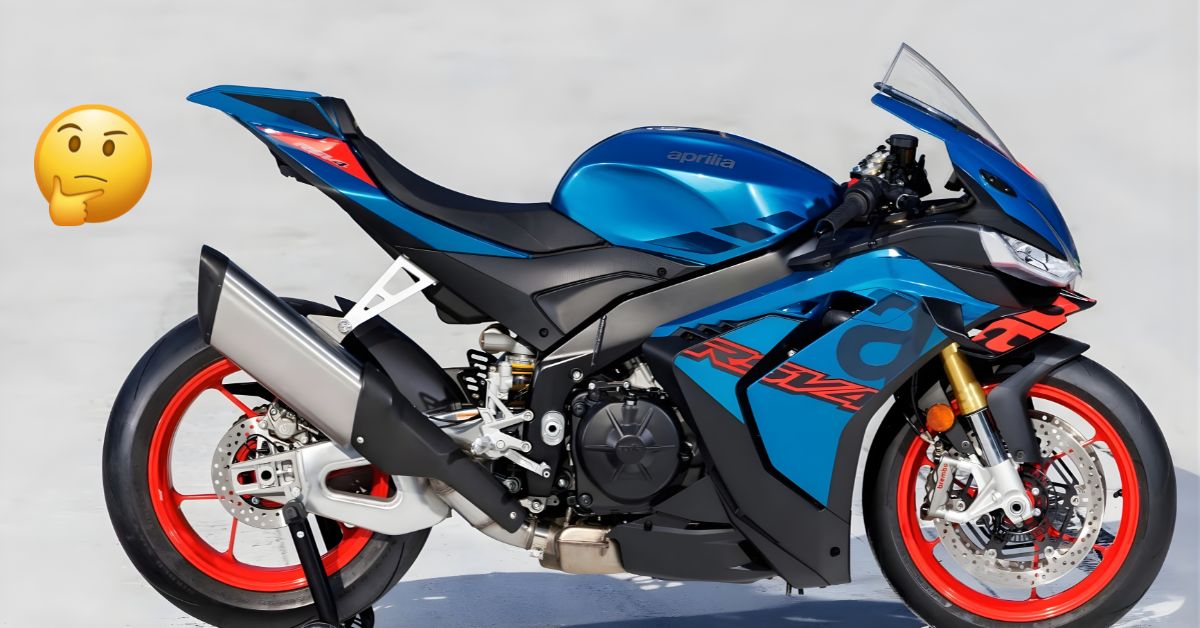
The Aprilia RSV4 Review is an examination of one of motorcycling’s most profound and intense engineering achievements. This machine is not just a superbike; it is a direct result of decades of dedication by the legendary Italian manufacturer, translating its fierce racing success in MotoGP and World Superbike into a street-legal package. The RSV4, particularly in its top-tier $1100\text{ Factory}$ guise, is revered globally for its astonishingly compact design, its incredibly potent V4 engine, and the revolutionary complexity of its rider aid electronics. It is a motorcycle that appeals to the rider who seeks the ultimate connection between man and machine, valuing surgical precision and an auditory experience that few rivals can match. This extensive analysis breaks down the unique performance metrics of its V4 heart, explains the essential technology that keeps its $213\text{ horsepower}$ manageable, details the benefits of its highly adjustable racing chassis, and outlines the substantial financial commitment required to own this piece of Italian artistry in India.
The Engine of Emotion: Performance and the V4 Sound Legacy
The heart of the Aprilia RSV4 Review subject is its defining specialization: the $1099\text{cc}$ V4 engine. Unlike the inline-four (I4) configuration favored by Japanese and German rivals, Aprilia pioneered the $65^\circ$ V4 engine in a factory superbike, a layout that provides several critical performance advantages. The V4 configuration allows the engine to be incredibly narrow and compact, which is essential for maximizing lean angles and centralizing the bike’s mass, thereby greatly improving handling agility. This $1099\text{cc}$ powerhouse delivers a monumental $213.89\text{ bhp}$ (horsepower) at $13,000\text{ rpm}$ and a peak torque of $125\text{ Nm}$ at $10,500\text{ rpm}$. This power ensures scorching acceleration, with the bike capable of launching from $0\text{ to } 100\text{ km/h}$ in approximately $3.3$ seconds and reaching a top speed exceeding $305\text{ kmph}$.
However, the greatest emotional specialty of the RSV4 is its unmistakable exhaust note. The V4 engine’s firing order produces a unique, deep, visceral roar that is often described by enthusiasts as sounding more like a high-performance racing car than a traditional motorcycle, easily distinguishing it from the smooth, often high-pitched howl of inline-four superbikes. This raw, thunderous sound provides a direct, unfiltered connection to the engine’s intense power, transforming every ride into a sensational acoustic event, which is a major factor in the bike’s high emotional appeal and prestige. This engine is a masterpiece of modern engineering, featuring a precise $13.6:1$ compression ratio and fully liquid-cooled architecture to ensure that while it is brutal in its power delivery, it remains thermally stable and mechanically robust under extreme track conditions, adhering to the latest BS6 Phase 2 emission standards.
Digital Control: The APRC Electronics Suite Explained Simply
Managing over $213\text{ horsepower}$ in a lightweight $202\text{ kg}$ package requires more than just skill; it demands the most sophisticated electronic control available, and this is where the Aprilia RSV4 Review subject truly shines. Its control system is the renowned a-PRC (Aprilia Performance Ride Control) suite, a comprehensive electronic brain derived directly from Aprilia’s championship-winning racing experience. This system relies on a central Six-Axis Inertial Measurement Unit (IMU), which is a highly sophisticated gyroscope that constantly monitors the bike’s position—its lean angle in a corner, its pitch under acceleration or braking, and its yaw—thousands of times per second.
The APRC suite simplifies extreme performance for the rider by managing five essential areas:
- Aprilia Traction Control (ATC): This prevents the rear wheel from spinning excessively during hard acceleration, especially on slippery surfaces or when exiting corners while heavily leaned over. The system detects rear wheel slip and subtly cuts power just enough to restore grip, preventing dangerous high-side crashes and allowing the rider to maintain maximum acceleration. It can be adjusted across multiple levels to suit track, sport, or street riding.
- Aprilia Wheelie Control (AWC): This ensures the front wheel does not lift too high off the ground under the V4’s massive acceleration. It doesn’t cut power entirely, but rather modulates it just enough to keep the front wheel skimming the asphalt at an optimal height, maximizing forward drive without risking loss of control.
- Aprilia Quick Shift (AQS): This allows for seamless, clutchless gear changes, both up and down. This is critical for track use, as it saves precious time and ensures the chassis remains completely stable without the jarring movement associated with using the clutch, allowing the rider to maintain continuous throttle input.
- Aprilia Engine Brake (AEB): This system manages the deceleration force when the throttle is closed. By controlling the amount of engine drag, it prevents the rear wheel from hopping or sliding during aggressive downshifts before entering a corner, enhancing stability and ensuring smoother braking transitions.
- Cornering ABS and Riding Modes: The system integrates a sophisticated Bosch 9.1 MP ABS unit with a cornering function, meaning the bike can brake safely even when leaned over, a monumental safety improvement. All these features are preset across six selectable riding modes—three for the road (Street, Sport, User) and three for the track (Race, Track 1, Track 2)—allowing the rider to select their entire electronic safety net with a simple toggle on the handlebar.
Chassis Mastery: Engineering for the Track and Aerodynamics
The chassis of the Aprilia RSV4 Review subject is the epitome of racing-derived engineering, providing the tactile feedback and adjustability essential for world-class track performance. The bike features a highly specialized aluminium dual-beam chassis that allows the factory or specialist mechanics to make unprecedented adjustments. The headstock position, the rake angle, the swingarm pivot height, and even the engine height can be physically altered, enabling the geometry to be precisely tuned to the rider’s style and the specific demands of any racetrack—a level of adjustability typically found only in competitive racing machines.
The suspension setup on the Factory model is equally specialized, utilizing Öhlins Smart EC 2.0 semi-active electronic suspension. This system uses the electronic input from the IMU to continuously and automatically adjust the compression and rebound damping of the $43\text{ mm}$ fork and the rear monoshock in real-time. This means the bike provides a plush, comfortable setting for normal street riding and instantly firms up to a rock-solid, race-ready setting the moment the rider begins aggressive braking or high-speed cornering. Furthermore, the aerodynamic winglets are fully integrated into the fairing design, a direct transfer of MotoGP technology, generating measurable downforce on the front wheel at high speeds, which enhances stability, prevents wheelieing under hard acceleration, and improves braking performance.
Ownership Economics: Price in India and Maintenance Reality
The Aprilia RSV4 Review must conclude with a pragmatic look at the economics of owning such a specialized exotic machine in the Indian context. The bike’s pedigree and top-tier components come with a substantial price tag. The current ex-showroom price for the Aprilia RSV4 $1100\text{ Factory}$ is around $\text{₹}31.26\text{ Lakh}$ in major cities like New Delhi, making it one of the more expensive superbikes in the market, often priced above its German and Japanese rivals. When RTO charges, insurance, and local taxes are added, the final On-Road Price in India for the top variant typically ranges between $\text{₹}34\text{ Lakh}$ and $\text{₹}35.7\text{ Lakh}$, depending on the state’s tax structure.
The secondary cost is maintenance. Being a completely built unit (CBU) import with a complex V4 engine architecture and specialized electronic Öhlins suspension, the Aprilia RSV4 requires highly specialized tools and trained technicians for servicing. While Aprilia has made strides in supporting its new, locally-made models, servicing the flagship RSV4 remains a high-cost endeavor. Regular service intervals, though manageable, will involve importing specialized consumables and fluids, and major services, particularly valve clearance checks, are notoriously labour-intensive due to the compact V4 design. This ensures that the long-term cost of ownership is high, a necessary reality for maintaining a $213\text{ horsepower}$ race bike that has been granted street legality. The owner must budget not just for the purchase price, but for a continuing financial commitment to specialized care and premium parts.
Read More : Panigale S1000RR Review
The Investment Verdict: Benefits, Rivals, and Legacy
The ultimate rationale for investing in the Aprilia RSV4 Review subject is the pursuit of uncompromising, pure track performance and exclusivity. The bike’s benefits are clear: the unparalleled Emotional V4 Sound, the precision of its Adjustable Racing Chassis, and the confidence instilled by the Advanced APRC Electronics and semi-active Öhlins suspension. It directly competes with the track aggression of the Ducati Panigale V4 and the high-tech supremacy of the BMW S 1000 RR. While the BMW might be more forgiving for street use and the Ducati offers raw Italian flair, the Aprilia holds a unique position as the most focused, adjustable, and sonically thrilling pure-bred racing machine currently available for road use, guaranteeing an intense and rewarding ownership experience that few rivals can match.
The automotive industry is currently navigating its most profound transformation in over a century, moving beyond simple iterations of engine technology to establish a new paradigm defined by digitalization, sustainable energy, and intelligence. The specialization of vehicles emerging from $2026$ onwards is not merely about incremental improvements in horsepower or leather quality; it is a fundamental shift toward the Software-Defined Vehicle (SDV), where the car’s primary function is to serve as an evolving, intelligent, and interconnected node within a massive mobility ecosystem. This comprehensive analysis leverages current trends and projected technological milestones to define the specialized features and capabilities that will dictate value, safety, and desire in the vehicles of the future.
The Specialization of Intelligence: AI and the Evolving Digital Architecture
The core specialty of the future car is its reliance on Artificial Intelligence (AI) and its status as a mobile computing device, capable of continuous evolution. This is powered by the Software-Defined Vehicle (SDV) architecture, which replaces complex, decentralized electronic control units (ECUs) with centralized, high-speed computing platforms. This centralized architecture enables the most critical specialized function: Over-The-Air (OTA) Updates. OTA capability ensures that the vehicle can receive significant functional upgrades—such as performance enhancements, cybersecurity patches, and entirely new ADAS features—remotely, maintaining its technological relevance long after the purchase date, a feature that profoundly protects its long-term asset value.
This intelligence extends to hyper-personalization within the cabin. Future cars utilize biometric sensors to instantly recognize the driver, automatically configuring seating positions, steering feedback, climate control settings, and even curating personalized media playlists based on biofeedback indicators of stress or fatigue. Furthermore, Conversational AI assistants are moving beyond basic commands, using predictive analytics to offer proactive assistance—suggesting the next route based on historical traffic patterns, recommending charging stops, or preemptively diagnosing maintenance issues. This specialized use of AI in manufacturing is also leading to smart factories where AI agents optimize production lines, predict supply chain disruptions, and ensure consistent quality through autonomous inspection, accelerating the pace at which innovation reaches the consumer.
The Specialization of Energy: Solid-State Batteries and V2X Utility
The most critical mechanical specialization of the future automotive fleet is the shift in its power source, driven by the race to commercialize Solid-State Batteries (SSBs). Projected to enter commercial production around $2026$, SSBs represent a monumental leap over current lithium-ion technology. Their specialty lies in their higher energy density, allowing vehicles to store significantly more energy in less space, which directly translates into driving ranges exceeding $800\text{ km}$ on a single charge for high-end models. Crucially, SSBs promise ultra-fast charging times, potentially shrinking the charging process from hours to mere minutes, eliminating the primary barrier to mass EV adoption and fundamentally changing the long-distance travel experience.
Beyond performance, the future car specializes in Energy Ecosystem Integration. Through Vehicle-to-Everything (V2X) technology, cars communicate not only with each other for traffic and safety alerts but also with smart infrastructure and the electrical grid. This enables Vehicle-to-Grid (V2G) services, where the car’s high-capacity battery can intelligently sell stored energy back to the grid during peak demand times, transforming the vehicle into a mobile power asset and creating new revenue streams for the owner. This dual specialization in cleaner power and energy management ensures the future car is both sustainable and financially integrated into the owner’s energy consumption model.
The Specialization of Experience: Autonomous Driving and Luxury Reimagined
The pinnacle of future specialization is the vehicle’s capacity for Autonomous Driving (AD) and the subsequent transformation of the luxury experience. While mass market adoption will focus on advanced Level 2 ADAS, the ultra-luxury segment is rapidly moving toward Level 3 and Level 4 autonomy, allowing the driver to completely disengage under specific, controlled conditions. This is made possible by sophisticated sensor fusion, which blends data from cameras, radars, and high-resolution LiDAR systems to create a reliable $360$-degree perception of the environment, even in adverse weather. The specialization here is the liberation of the driver’s time, transforming the act of commuting into an opportunity for personal activities, work, or relaxation.
This liberated time is spent in a cabin specialized for holistic wellness and immersion. Luxury is being redefined as Conscious Luxury, prioritizing sustainability, digital integration, and bespoke wellness features. Future luxury cars will feature Augmented Reality (AR) Dashboards, projecting critical information onto the windshield in the driver’s view. Furthermore, luxury brands are implementing direct-to-consumer (DTC) models and highly immersive concierge-led personalization experiences, where customization extends not just to bespoke leather and unique materials, but to the software itself, allowing owners to tailor performance maps, suspension characteristics, and exhaust sounds. The vehicle’s specialization is no longer in its engine size, but in its ability to adapt, evolve, and function as a highly personalized, intelligent, and sustainable companion throughout its entire lifecycle.