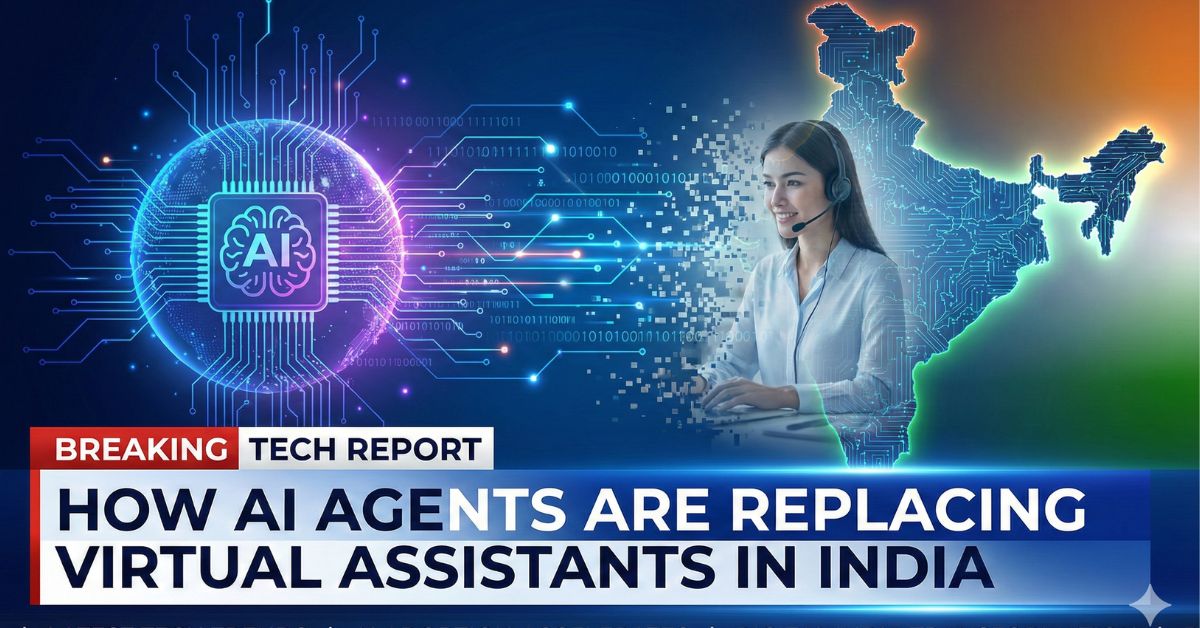
The technology world is witnessing a massive upgrade in how we interact with software. For years, we have relied on standard virtual assistants to answer simple queries, set alarms, or guide us through basic customer service menus. However, a major shift is currently happening across the global and Indian digital sectors. We are now entering the era of agentic AI, where AI agents replacing virtual assistants is quickly becoming the new industry standard. Instead of just chatting or retrieving information, these new advanced systems are taking action, making autonomous decisions, and managing complex daily workflows from start to finish.
What Exactly is Happening?
In recent months, enterprise companies, IT service providers, and startups have aggressively started deploying autonomous AI agents to replace traditional conversational bots. Standard virtual assistants—like early smartphone helpers or basic website chatbots—are fundamentally reactive. They sit idle until a user gives them a specific command, and then they provide a pre-programmed response.
Today, businesses are realizing that waiting for prompts is inefficient. They are upgrading to smart AI agents that do not just talk back, but actually perform the work. For example, if a customer reports a missing e-commerce order, a traditional virtual assistant might only provide a tracking link. An AI agent, however, can proactively check the warehouse inventory, contact the delivery partner, initiate a replacement order, and draft a personalized apology email to the customer—all without needing a human worker to guide it through each step.
The Background: Why is the Shift Happening Now?
This rapid transformation stems from recent breakthroughs in large language models and multi-step reasoning technology. The core difference between the two technologies comes down to autonomy, memory, and tool integration. Virtual assistants generally require constant human hand-holding. If a process requires logging into a system, pulling data, and sending a message, a human has to prompt the assistant at almost every stage.
AI agents operate entirely differently because they are goal-oriented. You give an AI agent a single, broad objective, such as resolving a technical support ticket or researching a market trend. The agent independently breaks that large goal into smaller tasks. It decides which software tools or databases to access, remembers the context of past user interactions, and dynamically reasons its way through roadblocks until the job is done.
The Impact on India’s Business and IT Sectors
For India, which stands as a global powerhouse for IT services, tech startups, and customer support outsourcing, this technological shift carries a massive impact. Indian IT leaders and digital enterprises are rapidly adopting AI agents to handle high volumes of customer interactions, sales operations, and internal human resources queries.
Rather than relying on large teams of support staff to read from scripted responses, Indian companies are building a modern hybrid workforce. In this new model, AI agents take over the repetitive, time-consuming tasks that previously caused employee burnout. This evolution allows human workers in India to step away from data entry and focus on higher-level tasks like creative problem-solving, strategic planning, and managing complex client relationships that require genuine empathy. It also enables local businesses to scale their operations globally, offering instant, round-the-clock service in multiple languages without heavily increasing their operational costs.
What Happens Next in the Agentic Era?
As we move forward, the capabilities of these autonomous systems will only continue to grow. We will soon see AI agents seamlessly collaborating alongside human teams in virtual workspaces, functioning much like dedicated digital coworkers. Future software updates will bring enhanced emotional intelligence, allowing these agents to detect user frustration through text or voice and adjust their communication style instantly. While simple virtual assistants will likely remain in our homes for basic tasks like playing music, the corporate and enterprise world is fully embracing the agentic era. Organizations that integrate these proactive agents will be able to operate faster and smarter, leaving behind competitors who still rely on older, reactive technologies.
Frequently Asked Questions
What is the main difference between an AI agent and a virtual assistant?
A virtual assistant is reactive and needs a human to give it step-by-step commands to complete a task. An AI agent is proactive and autonomous; you give it a final goal, and it figures out the necessary steps and completes them on its own.
Are AI agents going to replace human jobs in India?
While AI agents will replace many repetitive and manual tasks, they are not entirely replacing human workers. Instead, they are shifting the nature of work. AI agents act as digital coworkers, handling the heavy lifting so humans can focus on complex, creative, and emotional tasks that machines cannot do.
Which industries are adopting AI agents the fastest?
Industries that handle large amounts of data and customer interactions are leading the way. This includes customer service, banking and finance, healthcare, e-commerce, and IT support sectors.
Can AI agents make decisions without human permission?
Yes, AI agents can make independent decisions based on the rules and boundaries set by their developers. They can analyze a situation, choose the best software tool to use, and execute an action without waiting for a human to click an approval button.