Driving on Indian roads is full of surprises. From stray animals suddenly crossing the highway to unexpected potholes and heavy monsoon rains, you often have to hit the brakes hard and fast. In these heart-pounding moments, a special safety feature called ABS comes to your rescue. But what exactly is this feature, and how does it protect you and your family? Let us understand everything you need to know about the Anti-lock Braking System in simple terms.
What is an Anti-Lock Braking System (ABS)?
ABS stands for Anti-lock Braking System. It is an advanced safety feature installed in modern vehicles to help you keep control of your steering during an emergency stop.
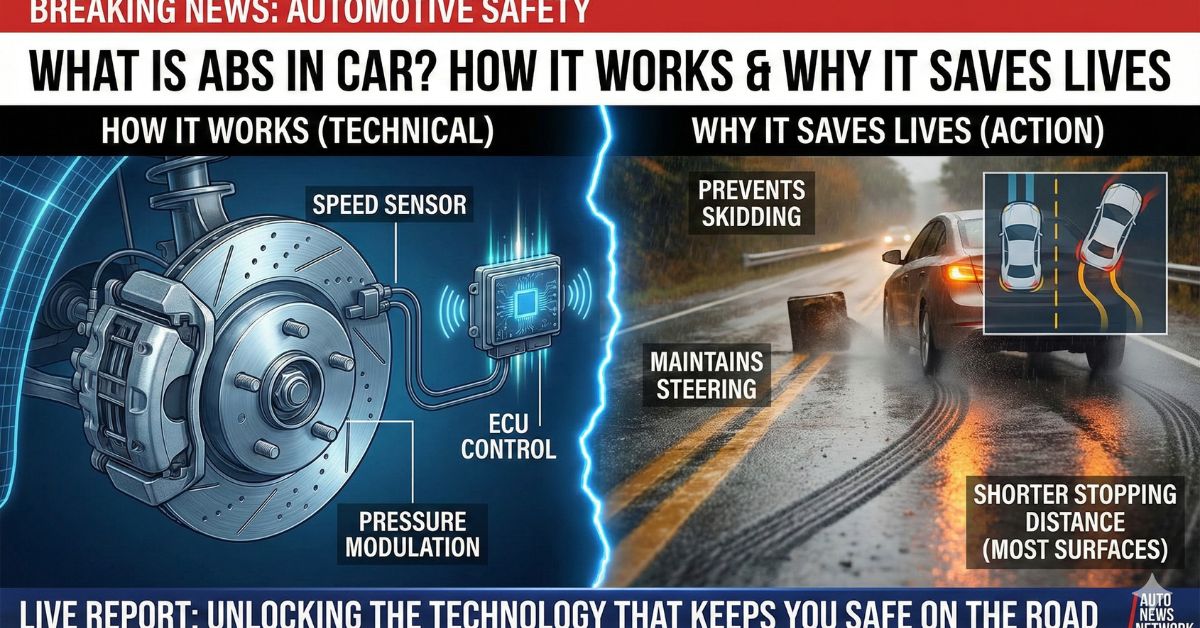
When you press the brake pedal very hard in a car without ABS, the wheels stop turning completely and lock up. Once the wheels lock, the tyres lose their grip on the road, causing the car to skid. When a car is skidding, turning the steering wheel does nothing, and the vehicle moves helplessly in a straight line. ABS prevents the wheels from locking up, allowing the tyres to maintain their grip so you can steer the car away from danger while slowing down.
How Does ABS Work?
The magic of ABS lies in a combination of smart sensors and quick mechanical actions. The system constantly monitors how fast each wheel is spinning.
If you slam on the brakes, the computer detects that a wheel is about to stop rotating and lock up. Instantly, the system reduces the brake pressure on that specific wheel to let it spin slightly, and then applies the pressure again. It pumps the brakes rapidly, sometimes up to 40 times a second. This rapid pumping action is much faster than any human foot could manage.
Because the wheels never fully lock, the car does not skid. As a driver, you might feel a rapid pulsing or vibrating sensation in the brake pedal when ABS activates. This is completely normal and simply means the system is working hard to keep you safe.
Why ABS is Crucial for Indian Road Conditions
The impact of ABS in India cannot be overstated. Indian driving conditions are highly unpredictable. During the monsoon season, roads become incredibly slippery due to water, mud, and oil spills.
Read More : How to Buy a Car Online
If a truck suddenly stops ahead of you on a wet highway, braking hard without ABS would likely cause your car to slide directly into the back of it. With ABS, your car slows down efficiently, and more importantly, you retain the ability to steer your car into the next lane to avoid a crash. It acts as an invisible shield that gives you precious seconds to maneuver around obstacles, which is a daily necessity on Indian streets.
Official Updates: Is ABS Mandatory in India?
Realizing the life-saving potential of this technology, the Ministry of Road Transport and Highways (MoRTH) in India took strict official steps to improve road safety. Since April 2019, the Indian government made it mandatory for all new cars manufactured and sold in the country to be equipped with ABS as a standard feature.
The safety push does not stop at cars. Recently, the government announced a new mandate stating that ABS will become compulsory for all new two-wheelers, regardless of engine size, starting from April 2026. This upcoming rule shows a massive nationwide shift towards making roads safer for everyone, significantly reducing accident rates linked to skidding.
Frequently Asked Questions (FAQs)
Does ABS help a car stop faster?
Not always. The primary job of ABS is to give you steering control during heavy braking, not necessarily to shorten the stopping distance. On wet or slippery roads, ABS can help you stop in a shorter distance. However, on dry roads or loose gravel, a car with ABS might take slightly longer to stop, but you will still have complete steering control.
How do I know if my car has ABS?
When you turn your car key to the ignition stage before starting the engine, look at the dashboard. A small warning light with the letters “ABS” inside a circle should light up for a few seconds and then turn off. If you see this light, your car has the system.
What should I do if the ABS dashboard light stays on?
If the ABS light remains turned on while you are driving, it means the system has detected a fault and turned itself off. Your normal brakes will still work, but the anti-lock safety feature will not. You should take your car to a mechanic for a check-up as soon as possible.
Should I pump the brakes if my car has ABS?
No. In older cars without ABS, drivers were taught to manually pump the brakes to avoid skidding. If your car has ABS, you should press the brake pedal down firmly and hold it there. Let the computer do the rapid pumping for you.