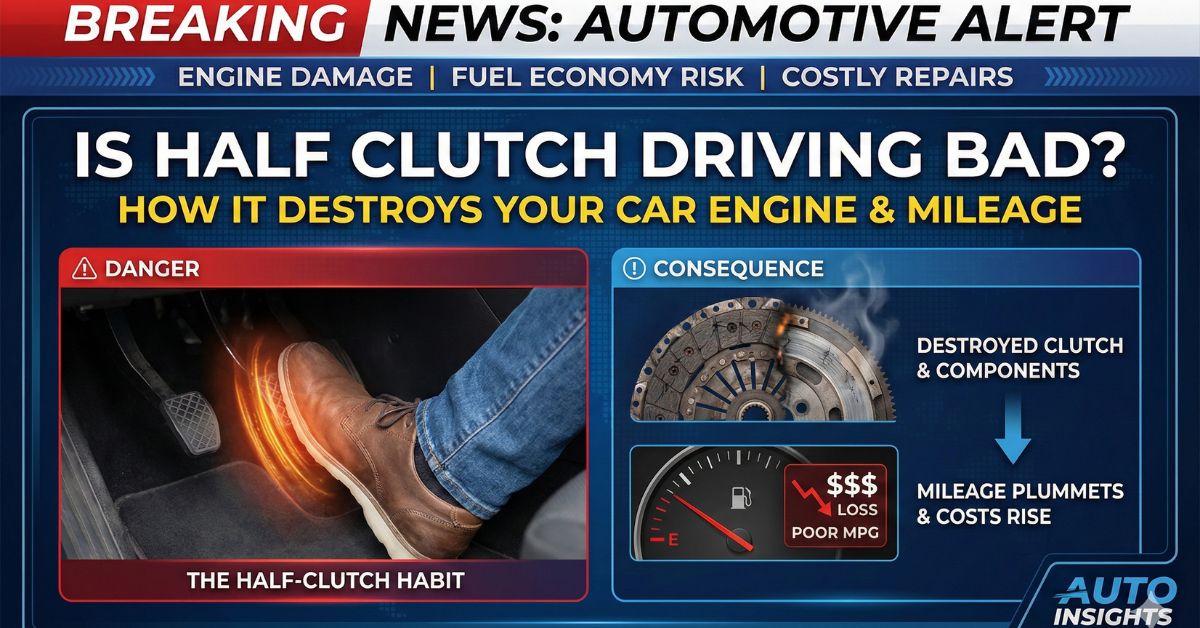
Driving in India often means navigating bumper-to-bumper traffic, narrow lanes, and steep flyovers. To manage this, many drivers—both new and experienced—use a technique called “Half Clutch” (or riding the clutch).
You might do it unconsciously: keeping your foot slightly pressed on the clutch pedal to stop the engine from stalling or to prevent the car from rolling back on a slope. While this trick seems helpful in slow traffic, experts warn that it acts as a “silent killer” for your car’s engine and gearbox.
Here is a simple breakdown of what half clutch driving does to your vehicle, why it is dangerous, and how you can save thousands of rupees on repairs.
What is Half Clutch Driving?
A car’s clutch acts as a bridge between the engine and the wheels.
- Full Clutch (Pedal Pressed): The bridge is open. The engine spins, but the wheels do not move.
- No Clutch (Pedal Released): The bridge is closed. The engine sends full power to the wheels.
- Half Clutch (Pedal Partially Pressed): The bridge is only half-closed. The engine and wheels are grinding against each other.
Drivers often use this position to “creep” forward in traffic without using the accelerator. While it gives you control, it creates massive amounts of friction inside the car’s machinery.
The Serious Effects on Your Car
Using the half-clutch technique occasionally (like during a hill start) is fine. However, making it a daily habit causes severe damage.
1. Burnt Clutch Plates
This is the most common issue. When you hold the clutch halfway, the clutch plates rub against the flywheel instead of locking into place. This friction creates intense heat. Over time, the material on the plates burns off, similar to using an eraser until it is finished.
2. Major Drop in Mileage
In India, fuel efficiency (Kitna deti hai?) is a top priority. When you drive on a half clutch, the engine produces power, but it isn’t fully transferred to the wheels. A lot of energy is wasted as heat. This forces the engine to work harder, drinking more petrol or diesel than necessary.
3. Engine Overheating
The heat generated from the slipping clutch can transfer to the engine and transmission box. In hot Indian summers, this extra heat adds stress to the car’s cooling system, potentially leading to overheating.
4. Pressure Plate Failure
It is not just the clutch plate that suffers. The “pressure plate” (which clamps the clutch disc) and the “release bearing” (which helps move the pedal) stay under constant heavy stress. If these parts fail, you cannot change gears at all, leaving you stranded on the road.
Signs Your Clutch is Already Damaged
If you have been driving on a half clutch for months, look out for these warning signs:
- Burning Smell: A smell like burnt rubber or toast coming from the bonnet, especially after driving uphill or in traffic.
- Slippage: You press the accelerator, and the engine revs (makes noise), but the car does not speed up quickly.
- Hard Gear Shifts: Changing gears becomes difficult or feels “sticky.”
- Vibrations: You feel a shudder or vibration in the clutch pedal when you lift your foot.
How to Drive Correctly in Indian Traffic
Traffic jams in cities like Delhi, Mumbai, and Bangalore are unavoidable. Here is how to handle them without destroying your clutch:
1. Use Neutral at Signals: Never keep the clutch pressed while waiting at a red light. Shift to Neutral (N) and release the clutch pedal completely. This gives the mechanical parts a rest.
2. The Handbrake Trick: On a flyover or slope, do not use the half clutch to hold the car steady. Pull the handbrake instead. When you need to move, gently press the accelerator and release the handbrake. This is the correct way to prevent rollback.
3. Use the “Dead Pedal”: Many modern cars have a small resting space to the left of the clutch pedal. Keep your foot there when you are not changing gears. Do not rest your foot on the clutch pedal, even lightly.
4. Crawl in First Gear: In very slow traffic, shift to 1st gear and fully release the clutch if possible. Let the car crawl at its own minimum speed. If you must stop, press the clutch fully and brake. Avoid hovering in the middle zone.
Conclusion: Is It Worth It?
Replacing a clutch assembly in India can cost anywhere from ₹6,000 to ₹45,000 depending on your car model (Maruti vs. SUVs). Driving with a “heavy foot” on the clutch might feel easier today, but it guarantees a heavy repair bill tomorrow.
Read More : EV Cars in Winter vs Summer: Real Truth About Range in India
Change your habit today: Press it fully, or don’t touch it at all.
Frequently Asked Questions (FAQs)
Q1: Is half clutch bad for diesel cars too?
Ans: Yes, it damages both petrol and diesel cars. However, diesel cars have more torque (pulling power), so they can often crawl in traffic without needing the accelerator, which tempts drivers to use half clutch even more.
Q2: Can I use half clutch for parking?
Ans: Yes. Using half clutch for a few seconds to park carefully in a tight spot is acceptable and necessary. The damage happens when you do it continuously while driving on roads.
Q3: Why does my car smell like burning rubber?
Ans: This is the biggest sign of a “burnt clutch.” It means the friction material inside is overheating because you are riding the clutch. Stop immediately and let the car cool down.
Q4: Will an automatic car have this problem?
Ans: No. Traditional Automatic (AMT, CVT, Torque Converter) cars handle the clutch work for you. However, in AMT cars, you should still shift to Neutral at long traffic stops to protect the system.
Q5: How long should a car clutch last in India?
Ans: With good driving habits, a clutch can last 80,000 to 1,00,000 km. With bad half-clutch habits, it can fail in just 20,000 km.