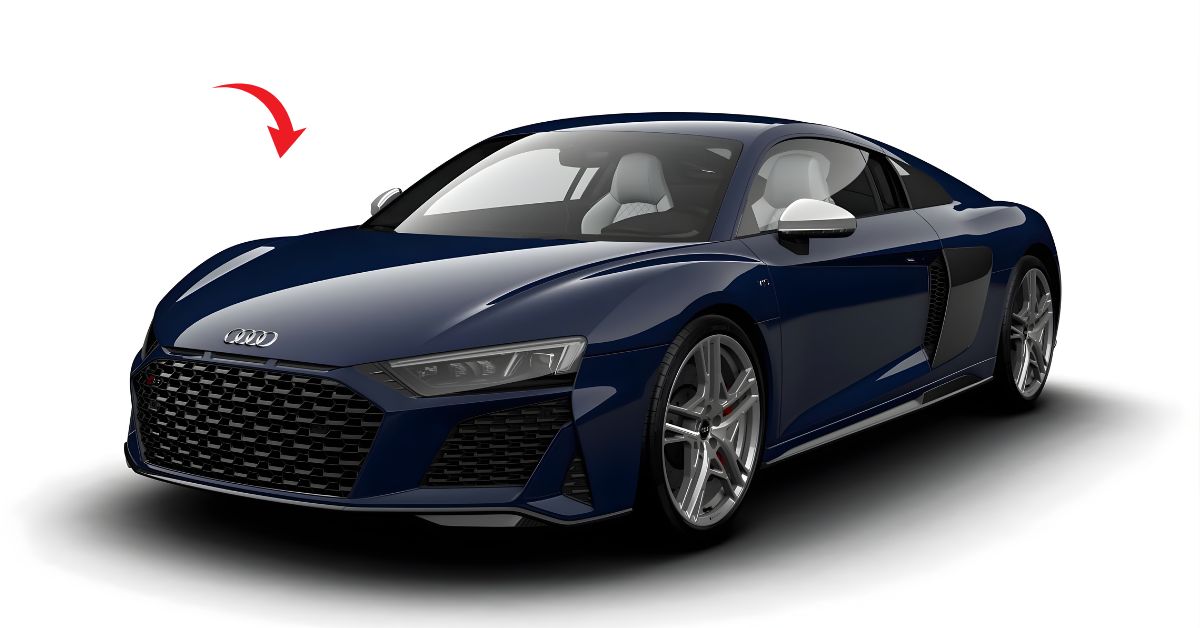
The Audi R8 Spyder V10 stands not merely as a high-performance machine, but as an enduring icon of the modern supercar era, representing a near-perfect blend of dramatic styling, everyday usability, and mechanical brilliance. For enthusiasts in India and across the globe, the R8, particularly in its convertible Spyder form, is less a car and more a definitive statement—a final, glorious salute to the naturally aspirated engine before the inevitable silence of electrification fully takes hold. Its engineering is rooted directly in motorsport, sharing a significant portion of its architecture and V10 powerplant with the formidable Lamborghini Huracán, yet the R8 maintains a distinctly sophisticated, almost understated, German persona. This in-depth review dissects the ferocious performance capabilities of the Audi R8 Spyder V10, analyses its sophisticated technological features, explores the sonic masterpiece generated by its exhaust, weighs the critical pros and cons of ownership, and examines its premium price and residual legacy in the demanding Indian luxury market.
The Heart of the Beast: Unadulterated V10 Performance and Top Speed
Nestled directly behind the driver’s seat, separated only by a glass panel and the folding roof mechanism, lies the beating heart of the Audi R8 Spyder V10: the magnificent $5.2\text{-litre}$ FSI naturally aspirated V10 engine. This powerplant is the single most defining characteristic of the R8 experience, offering an analogue purity that is increasingly absent in a world dominated by turbocharged efficiency. In its later, more powerful iterations—often badged as the V10 Plus or V10 Performance—this motor delivered a formidable output of $602\text{ bhp}$ of maximum power developed at a screaming $8250\text{ rpm}$, accompanied by a peak torque figure of $560\text{ Nm}$. The absence of turbochargers means the power delivery is intensely linear, building in a relentless, intoxicating wave that crests only when the needle is nearly kissing the $9000\text{ rpm}$ redline, demanding full driver commitment to extract its peak potential.
This phenomenal power is channeled through Audi’s lightning-quick 7-speed S tronic dual-clutch transmission (DCT), a gearbox renowned for its razor-sharp shift speed and precision, capable of executing gear changes in mere fractions of a second. This combination allows the Audi R8 Spyder V10 to achieve truly electrifying acceleration figures. Despite the Spyder’s slightly increased weight due to the necessary chassis reinforcement and the folding roof mechanism, the V10 Performance model is capable of rocketing from $0\text{ to } 100\text{ km/h}$ in a breathtaking $3.2$ to $3.3$ seconds, a figure that places it squarely among the world’s most elite supercars. The mid-engine layout and the sophisticated quattro all-wheel-drive system ensure that this explosive power is deployed efficiently, maximizing traction off the line and providing immense stability under hard acceleration. The ultimate proof of its engineering prowess is its stratospheric top speed, which officially peaks at an incendiary $328\text{ km/h}$ to $329\text{ km/h}$ (around $204\text{ mph}$), positioning the Audi R8 Spyder V10 as a serious, high-velocity machine built for the world’s fastest roads and tracks.
A Symphony of Speed: The Unforgettable V10 Exhaust Sound
For many enthusiasts, the true essence of the Audi R8 Spyder V10 is not the performance figures themselves, but the raw, visceral noise that accompanies them, a specialization that makes the open-top Spyder version the definitive choice. The naturally aspirated $5.2\text{-litre}$ V10 engine produces a spectacular, high-pitched F1-style wail that is unmatched by its turbocharged rivals. Unlike turbocharged engines which muffle the sound through their complex plumbing, the R8’s V10 is engineered to scream, letting out a glorious, spine-tingling howl that truly comes into its own as the revs climb past $4000\text{ rpm}$ and accelerates towards the $8000\text{ rpm}$ redline.
The auditory experience in the Spyder is profoundly enhanced by the retractable folding fabric roof, which opens in seconds to fully immerse the occupants in the engine’s symphony, making every tunnel or aggressive downshift an event. The optional sports exhaust system, highly recommended by owners and critics alike, features active baffles that open fully in Dynamic mode, amplifying the V10 shriek and creating a cascade of dramatic crackles and pops on the overrun, turning every drive, even a mundane trip to the grocery store, into a sensational acoustic event. This unadulterated, naturally aspirated V10 exhaust sound is the car’s ultimate emotional selling point, providing a direct, unfiltered connection to the mechanical masterpiece working just inches behind the passengers, an experience that future electric supercars, no matter how fast, can never truly replicate.
Chassis, Handling, and Features: The Usable Supercar Formula
The Audi R8 Spyder V10 is frequently lauded as the “everyday supercar,” a designation earned through its balanced chassis, advanced features, and user-friendly driving characteristics. The vehicle’s architecture utilizes an advanced Audi Space Frame (ASF) structure, which blends lightweight carbon fibre and aluminium components to ensure high torsional rigidity, crucial for maintaining precise handling especially in the roofless Spyder variant, where structural integrity is key to avoiding body flex. The mid-engine layout provides inherent balance, while the signature quattro all-wheel-drive system gives the driver immense confidence, ensuring superb grip in various driving conditions, from dry mountain passes to wet city streets, a factor that makes it less intimidating and significantly more practical for varied driving environments than its strictly rear-wheel-drive competitors.
Inside the cabin, the Audi R8 Spyder V10 maintains a minimalist, driver-focused approach. The most notable feature is the 12.3-inch Audi Virtual Cockpit, which replaces traditional gauges and the central infotainment screen entirely, placing all navigation, media, and performance data directly in the driver’s line of sight behind the steering wheel. This focus on the driver eliminates the distraction of a co-driver screen, prioritizing the driving experience. Premium materials abound, with seating typically finished in luxurious quilted leather or Alcantara, offering high lateral support essential for hard cornering. For safety and performance, the R8 V10 Plus/Performance models came standard with carbon ceramic brakes, providing incredible, fade-free stopping power necessary to haul the $602\text{ bhp}$ machine down from triple-digit speeds repeatedly.
Pros, Cons, and the Practicality Verdict
The Audi R8 Spyder V10 offers a unique combination of advantages and disadvantages that prospective owners must consider, particularly in the context of Indian road conditions.
Advantages (Pros)
The primary Pro is its Daily Usability and Reliability; for an exotic supercar, the R8 is renowned for its surprisingly reliable nature, benefiting from Audi’s robust engineering and making it practical for daily commutes or long journeys. The Naturally Aspirated V10 Engine is an overwhelming Pro, delivering a pure, linear power delivery and an emotional sound that is a highly collectible attribute. The Quattro AWD System provides confidence and traction that is superior to many rivals, making it a viable car for the wet season and patchy road surfaces.
Disadvantages (Cons)
The R8 does have notable Cons, particularly its Vague Steering Feedback; critics often point out that the steering, while light and easy for city use, lacks the raw, communicative feel of rivals like the Porsche 911. Ride Comfort can be compromised, as the sporty suspension modes, even with optional magnetic dampers, can feel overly firm and uncomfortable on poorly maintained Indian roads. Furthermore, the Fixed Seating Position in some variants and the tight packaging of the Spyder version mean very tall individuals might find the cabin cramped. Finally, the $6.71\text{ kmpl}$ Thirsty Engine means frequent fuel stops are inevitable.
Price in India, Final Verdict, and Enduring Legacy
The Audi R8 Spyder V10 was officially discontinued, making any current purchase an entry into the high-end used exotic market. The last recorded ex-showroom price for the top-tier R8 V10 Plus Coupe was approximately $\text{₹}2.72\text{ Crore}$, with the Spyder version typically commanding a premium. Factoring in registration, taxes, and insurance, the final on-road price for a new model was well in excess of $\text{₹}3.2$ to $\text{₹}3.4\text{ Crore}$.
Today, the Audi R8 Spyder V10 holds its value well as a collectible machine, with used models from 2016-2018 typically fetching prices starting from $\text{₹}1.8\text{ Crore}$ to over $\text{₹}2.5\text{ Crore}$, depending on year, mileage, and specification. The purchase of an Audi R8 Spyder V10 is not a financial decision based on practicality or efficiency; it is an emotional investment in a vanishing era of automotive engineering. It is a vehicle that offers blistering performance, a spectacular open-top V10 soundtrack, and genuine daily usability, earning its place as one of the most beloved and future-legendary supercars ever produced.
The Audi R8 Spyder V10 occupies a sacred space in modern automotive lore, standing as the ultimate tribute to the naturally aspirated mid-engine supercar—a legacy now drawing to a close. While the V10-powered R8 delivered an analog driving purity and a sensational exhaust note that defined an era, the future of this iconic nameplate is being forged in absolute silence and extreme electric power. The imminent 2026 Audi R8 is not an evolution but a complete, radical revolution, preparing to shed its glorious $5.2\text{-litre}$ V10 heart for a monstrous, 1000+ horsepower all-electric powertrain, a change that fundamentally redefines its performance, its experience, and its mission in the hypercar segment. This transition marks Audi’s aggressive entry into the top echelon of electric performance, positioning the new R8 as a direct rival to emerging electric hypercars from Tesla and Mercedes-AMG.
The performance differential between the legacy Audi R8 Spyder V10 and its electric successor is nothing short of mind-melting. The final iteration of the V10 Performance engine delivered a formidable $602\text{ bhp}$ and achieved the $0\text{ to } 100\text{ km/h}$ sprint in a breathtaking $3.2$ seconds, relying on its high-revving, linear power delivery and the traction of the Quattro all-wheel-drive system. In stark contrast, the rumored 2026 R8 EV will utilize a tri-motor electric setup, projecting a combined output well in excess of 1000 horsepower. This massive, instantly available torque is expected to propel the R8 EV from $0\text{ to } 100\text{ km/h}$ in a physics-defying time of approximately $2.0$ to $2.3$ seconds, making it one of the quickest accelerating road cars ever conceived. The new architecture, based on a high-performance EV platform, will utilize advanced torque vectoring from its independent motors, promising cornering precision and track stability that surpasses the mechanical limitations of the V10’s drivetrain, while still aiming for a top speed exceeding $330\text{ km/h}$.
Beyond the sheer speed, the transition affects the core emotional appeal of the car. The original Audi R8 Spyder V10 was celebrated globally for its high-pitched, shrieking exhaust sound, a sonic masterpiece that enhanced every downshift and full-throttle run, which the convertible Spyder body maximized for the driver. The 2026 successor will swap this raw, visceral auditory feedback for near-silent, brutal acceleration, a necessary trade-off for its technological supremacy. However, the new R8 will gain its own specialized set of features, including a projected $100\text{ kWh}$ solid-state battery pack delivering over $500\text{ km}$ of range, active aerodynamic elements like adaptive rear wings and front air curtains, and an entirely new digital cockpit featuring curved OLED screens and augmented-reality performance overlays. The interior will shift from the current model’s analogue-centric Virtual Cockpit to a fully digitized, futuristic environment tailored for EV telemetry and extreme performance tracking, showcasing a new era of luxury and technology integration.
Ultimately, the choice facing the collector involves a philosophical divide: the last Audi R8 Spyder V10 now stands as a highly valued collector’s item, a tribute to internal combustion engine purity whose last recorded price was around $\text{₹}2.5\text{ Crore}$ and whose used prices are fiercely defended by enthusiasts. The 2026 Audi R8 EV, however, is the definitive technological statement, a vehicle whose expected global price equivalent of $\text{₹}2.2\text{ crore}$ to $\text{₹}3.5\text{ crore}$ buys the absolute pinnacle of electric performance and futuristic engineering, offering a new, silent kind of power that guarantees its relevance in the electrified future.