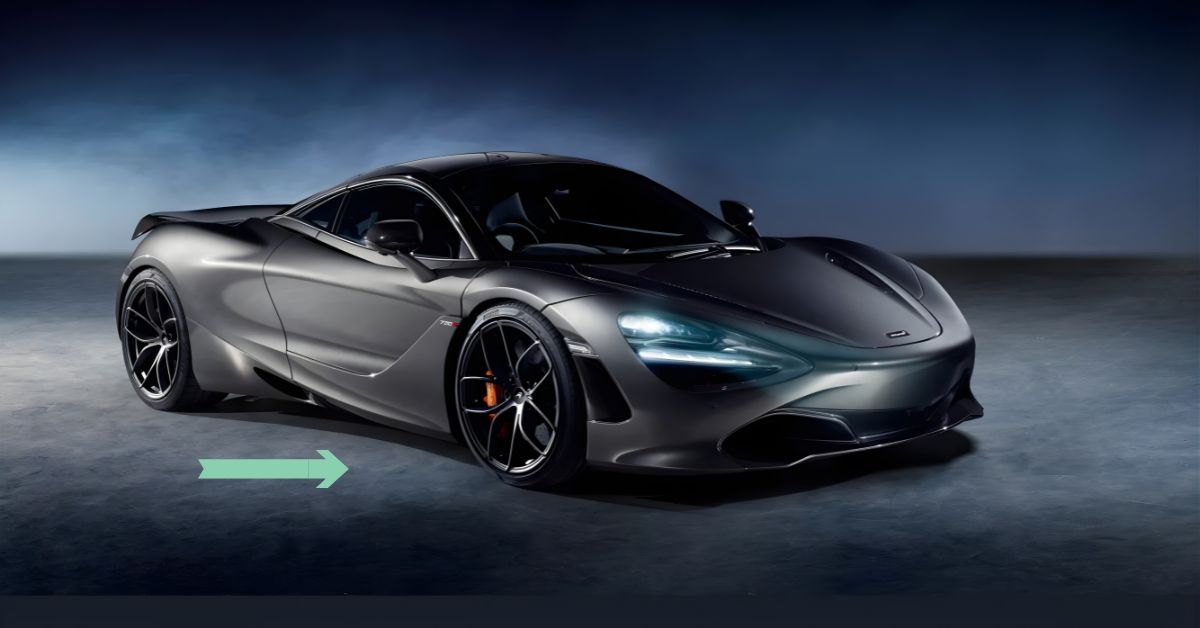
The McLaren 720S Review India is not simply an examination of a high-performance vehicle; it is a deep dive into a philosophy—the relentless, clinical pursuit of perfection through Formula 1-derived engineering. The 720S, the centerpiece of McLaren’s Super Series, represents a transformative moment for the brand, embodying a design ethos where every curve, vent, and component exists solely to enhance aerodynamic efficiency and maximize driver engagement. Although the 720S has been technically succeeded by the 750S, its legacy as the model that perfected the hydraulic suspension and carbon fibre architecture remains paramount, making it a highly desirable used and collectors’ hypercar in the exclusive Indian market. This extensive analysis details the specialized M840T V8 engine, the revolutionary Proactive Chassis Control II (PCC II) system, the uncompromising performance figures, and the considerable financial commitment required for ownership of this aerodynamic masterpiece today.
The Core: M840T V8 Engine Specs and Unrelenting Performance
The raw, focused intensity of the McLaren 720S Review India subject is entirely generated by its heart: the specialized $4.0\text{-litre}$ Twin-Turbo V8 engine, known internally as the M840T. This engine is an evolution of McLaren’s racing unit, engineered in collaboration with Ricardo, featuring a unique flat-plane crankshaft configuration which is typically reserved for high-revving racing cars. This design, combined with bespoke, low-inertia twin-scroll turbochargers that are electrically actuated for minimal lag, allows the engine to be incredibly compact, light, and highly responsive.
In its 720S application, the M840T engine delivers a phenomenal $720\text{ PS}$ ($710\text{ bhp}$) of power at $7,500\text{ rpm}$ and a robust $770\text{ Nm}$ of peak torque across the $5,500\text{ rpm}$ to $6,500\text{ rpm}$ band. This performance is managed by a rapid-fire 7-speed Seamless Shift Gearbox (SSG) dual-clutch transmission, which ensures instant gear changes without interrupting the power flow. The combination of this brutal power output and the car’s extreme lightweight construction gives it a power-to-weight ratio that rivals dedicated racing cars. This translates to performance statistics that are truly staggering: the McLaren 720S is capable of rocketing from $0\text{ to } 100\text{ km/h}$ in a verified time of just $2.9$ seconds, hitting $200\text{ km/h}$ in a mere $7.8$ seconds, and achieving an uncompromising Top Speed of $341\text{ km/h}$ ($212\text{ mph}$). This level of clinical, accessible speed is the 720S’s core specialization.
Engineering Mastery: Monocage II and Proactive Chassis Control II
The true technological supremacy of the McLaren 720S Review India subject lies in its structural and suspension specialization, derived directly from Formula 1 technology.
The Monocage II Carbon Fibre Tub
The entire passenger cell and upper structure of the 720S are built around the Monocage II carbon fibre tub, which is a single-piece chassis design evolved from the architecture first seen in the P1 hypercar. This carbon fibre construction provides exceptional structural rigidity, which is essential for precise handling, while dramatically reducing weight. The Monocage II is astonishingly light, enabling the 720S to achieve a dry weight of just $1,283\text{ kg}$, making it the lightest car in its class. Furthermore, the tub’s design allows for slimmer pillars and large cutouts in the dihedral doors, giving the 720S best-in-class all-round visibility, a highly valued safety and convenience feature often sacrificed in rival mid-engine supercars.
Proactive Chassis Control II (PCC II)
The suspension system is the 720S’s most complex and celebrated feature: Proactive Chassis Control II (PCC II). This hydraulic system eliminates the need for conventional mechanical anti-roll bars entirely. Instead, the dampers at each corner are hydraulically interlinked, and sensors—including accelerometers and pressure sensors—constantly monitor the driving conditions. A complex algorithm, originally developed from a PhD thesis at the University of Cambridge, uses this data to instantly apply or release pressure within the dampers. This allows the system to achieve two contradictory goals simultaneously: maintaining a remarkably flat, neutral stance during hard cornering (like a track car) while relaxing the pressure during straight-line driving over bumps, providing a surprisingly serene ride comfort (like a luxury car). The result is an extraordinary balance of body control and ride compliance that is unmatched in the segment.
Features: Active Aerodynamics and Driver-Focused Cockpit
The aerodynamic and interior features of the McLaren 720S Review India subject are dictated by the brand’s philosophy that “everything is for a reason.”
Active Aero and Folding Display
The car’s iconic “teardrop” shape is designed for optimal airflow management. The most dramatic feature is the massive, active rear wing, which constantly adjusts its angle. In high-speed braking scenarios, the wing instantly flips up to act as a powerful air brake, stabilizing the vehicle and significantly reducing stopping distances. Airflow is managed meticulously across the body, with innovative channels built into the headlight recesses and door skins to guide air to cool the engine and brakes without the need for large, unsightly side scoops. Inside, the cabin is driver-focused, defined by the innovative Folding Driver Display. In Comfort and Sport modes, the full digital display is visible, but in Track mode, the screen physically retracts and folds to a slim display showing only the most vital information (RPM, gear, speed), minimizing distraction and maximizing the driver’s focus on the road ahead.
Read More : Rolls-Royce Cullinan Black Badge
Control and Customization
The 720S deepens driver connection with Variable Drift Control (VDC), which utilizes the stability control system to allow the driver to intentionally select the amount of rear-wheel oversteer they desire before the electronic safety net intervenes. This allows the driver to explore the limits of the chassis and their own skills in a safe, controlled manner. The interior itself is a blend of carbon fibre, Alcantara, and high-quality Nappa leather, emphasizing contemporary luxury while ensuring essential controls, such as the Active Dynamics Panel (ADP) for selecting drive modes (Comfort, Sport, Track), are always within immediate reach.
Benefits and Price in India: The Collectible Exotic
The primary benefits of acquiring a McLaren 720S Review India subject today are its unmatched power-to-weight ratio, its proven mechanical reliability (relative to other exotics), and its status as a collector’s item now that production has ceased and the new 750S is launched. The 720S is a piece of automotive history, representing the moment McLaren perfected its carbon tub and hydraulic suspension formula.
The price of the McLaren 720S Review India subject is defined by its scarcity and the luxury import tax structure. While the final recorded ex-showroom price was approximately $\text{₹}4.40\text{ Crore}$ to $\text{₹}5.04\text{ Crore}$ (for the Coupe and Spider variants), the current market reality for a well-maintained, used model is highly competitive. Used prices often start around $\text{₹}4.10\text{ Crore}$ and go upwards depending on the specification, mileage, and optional carbon fibre packs. The final On-Road Price in India for an imported or pre-owned 720S, factoring in high RTO charges and insurance, typically ranges from $\text{₹}5.0\text{ Crore}$ to $\text{₹}5.8\text{ Crore}$ in major metropolitan areas like Mumbai and Delhi. This price confirms the 720S’s position as a highly valuable, highly exclusive hypercar that offers a purer, more surgical driving experience than many of its rivals
The contemporary automotive industry is undergoing a metamorphosis, shifting its focus from solely mechanical engineering to a synthesis of digital architecture, advanced materials science, and personalized human-machine interaction. The cars emerging in 2026 are not just newer models; they represent a fundamental change in philosophy, embracing sophisticated technologies that enhance safety, redefine luxury, and simplify ownership maintenance. This comprehensive overview analyzes the critical trends defining future vehicle design, the deepening integration of the digital cockpit, and the necessary evolution of specialized car care and protection technologies.
The Digital Cockpit: HMI and the Rise of AI Assistants
The most immediate change in the vehicles of 2026 is the complete transformation of the interior into a Software-Defined Vehicle (SDV) cockpit. The traditional array of fixed buttons and gauges is giving way to a unified digital platform that stretches across the dashboard. This specialization is epitomized by features like the Mercedes-Benz MBUX Hyperscreen or the BMW Curved Display, which integrate instrument clusters, infotainment, and climate control into seamless, high-definition curved screens. This not only enhances aesthetic appeal but allows manufacturers to deliver Over-The-Air (OTA) software updates, meaning the car you buy today can have its features expanded, refined, or optimized years after purchase, mirroring the flexibility of a modern smartphone.
Crucially, the primary means of interaction is shifting to intelligent AI-led voice assistants. These advanced systems, powered by superior natural language processing, are becoming context-aware companions. They move beyond simple commands to understand user intent, tone, and environment. For instance, a driver might casually say, “I’m stressed and it’s hot,” and the AI assistant will proactively dim the ambient lighting, lower the cabin temperature, and suggest a quieter navigation route, demonstrating a specialized capability in cognitive comfort and emotional personalization. This multi-modal interface also incorporates gesture control and augmented reality (AR), where navigation arrows and hazard warnings are projected directly onto the windshield in the driver’s field of view, keeping eyes on the road while seamlessly integrating digital information with the real world.
Design Aesthetics and Materials: Light as Communication
Exterior and interior design in 2026 is specializing in communication and material innovation. The use of advanced, high-definition lighting technologies is shifting from mere illumination to a critical safety and aesthetic feature. New matrix LED and laser systems can selectively darken segments of the beam to avoid dazzling oncoming drivers while maintaining maximum road visibility. Internally, dynamic ambient lighting is gaining massive traction, transforming the car cabin into a polymorphic, customizable space.
This lighting is no longer static; it is communicative. For instance, ambient lights embedded in the door panels might pulse red to warn a passenger of approaching traffic before they open the door, or the steering wheel might light up green to indicate successful autonomous driving engagement. Materials are also specializing, with high-end brands using sophisticated processes like Technical Carbon Veneer (seen in the Rolls-Royce Cullinan Black Badge) and unique perforation patterns in leather upholstery to create bespoke, personalized textures. The overall exterior design trend favors bolder, aerodynamic aesthetics that often incorporate integrated winglets and sculpting, as demonstrated by the McLaren 720S, where every design element is primarily functional, enhancing downforce and efficiency.
Advanced Protection: Nanotechnology and Sustainable Preservation
Given the high cost and complexity of modern car paint and finish, the market for vehicle protection is specializing in long-term, high-tech solutions.
The Coating Evolution: Graphene and Ceramics
The most prominent trend is the widespread adoption of third-generation ceramic and graphene coatings. These specialized liquids, applied by professionals, chemically bond with the vehicle’s paint, creating a hard, durable, hydrophobic shell. The specialization of Graphene oxide in the newest coatings enhances strength and provides superior anti-static properties, meaning the surface actively repels dust and dirt, a massive benefit for vehicle preservation in dusty climates. This protective layer guards against UV damage, chemical etching from contaminants like bird droppings, and greatly simplifies the cleaning process by allowing dirt to slide off easily.
Paint Protection Films (PPF) and Custom Aesthetics
For physical damage protection, Paint Protection Film (PPF) has become a non-negotiable specialty for premium vehicle owners. Modern PPF is made from highly resilient Thermoplastic Polyurethane (TPU) and possesses self-healing capability, allowing minor scratches and swirl marks to disappear when exposed to heat, maintaining a flawless finish for years. The specialization now extends into aesthetics, with a surge in demand for Color PPF, allowing owners to completely change their vehicle’s color to unique finishes like satin warm neutrals or muted liquid metallics, all while adding a protective, thick physical shield over the original paint.
Sustainable Car Care
Accompanying these material advancements is a massive shift toward sustainable detailing practices. Services are increasingly utilizing low-water or waterless washing systems that employ specialized biodegradable polymer formulas to safely encapsulate dirt for removal, conserving thousands of liters of water annually. This focus on green chemistry and sustainable practices ensures that the high-end vehicle is not only protected by cutting-edge technology but is maintained with an environmentally responsible philosophy, aligning with the global move towards cleaner mobility.