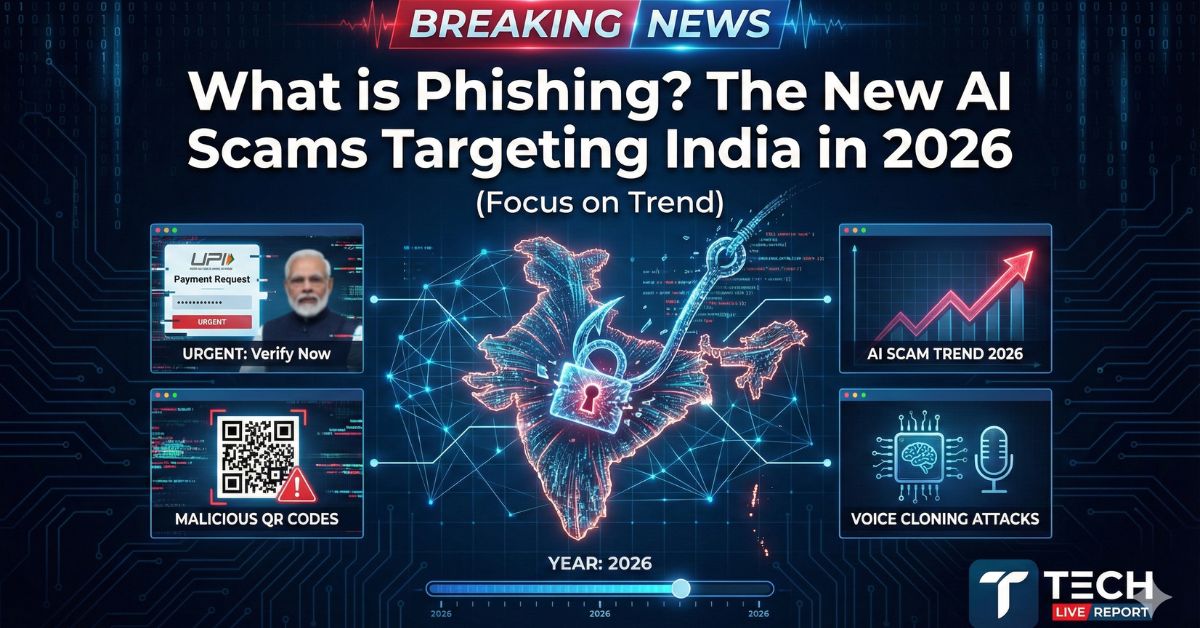
Imagine receiving a WhatsApp message from your “boss” asking for an urgent money transfer, or a call from the “police” saying your child is in trouble. You panic and pay, only to realize later that the voice was fake and the message was a lie. This is Phishing—and in 2026, it has become India’s biggest cyber headache.
While phishing started as simple fake emails, it has now evolved into a sophisticated trap using Artificial Intelligence (AI) and deepfakes. From “Digital Arrests” to fake “8th Pay Commission” links, scammers are finding new ways to steal hard-earned money.
Here is everything you need to know about what phishing is, the latest scams trending in India, and how to protect your bank account.
What is Phishing? (In Simple Words)
Phishing (pronounced “fishing”) is a type of cybercrime where scammers pretend to be a trustworthy entity—like your bank, the Income Tax Department, or even a family member—to trick you into revealing sensitive information.
Think of it like fishing in a lake. The scammer puts “bait” (a fake promise or threat) on a “hook” (a malicious link or call) and waits for a victim to bite.
Their main goal is to steal:
- Login details (Usernames and Passwords)
- Financial data (Credit Card numbers, OTPs, UPI PINs)
- Personal Identity (Aadhaar, PAN details)
The New Wave: Top Phishing Scams Trending in India (2025-2026)
The days of poorly written “You won a lottery” emails are fading. Indian cybercriminals are now using highly local and terrifying tactics.
1. The “Digital Arrest” Scam (The Fear Trap)
This is currently the most dangerous form of phishing in India. You receive a video call from someone dressed in a police or CBI uniform. They claim a parcel addressed to you was found with drugs, or your Aadhaar is linked to money laundering.
- The Trap: They keep you on a “video call interrogation” for hours (digital arrest) and force you to transfer money to a “safe government account” for verification.
- Fact: No Indian police agency conducts arrests or interrogations via video call.
2. The Malicious APK Scam (WhatsApp Phishing)
Recently, government employees have been targeted with messages about the “8th Pay Commission” or “Salary Calculator.” The message asks you to download a file (usually an .apk file) to check your new salary.
- The Trap: Once installed, this app takes total control of your phone, reading your OTPs and stealing banking data in the background.
3. AI Voice Cloning (Vishing)
“Vishing” stands for Voice Phishing. With AI, scammers can now clone voices from just 3 seconds of audio found on social media (Instagram Reels/Stories).
- The Trap: You get a call that sounds exactly like your son or daughter crying, claiming they have been in an accident or arrested. The panic makes you transfer money immediately without verifying.
4. The “Panic” SMS (KYC and Electricity)
- Electricity: “Your power will be cut tonight at 9:30 PM because your previous month’s bill was not updated. Call this number immediately.”
- KYC: “Your SBI/HDFC account is blocked due to incomplete KYC. Click here to update.”
- The Trap: Clicking the link takes you to a fake website that looks exactly like the real bank portal.
Government & RBI Updates: The Fight Back
The Government of India and the Reserve Bank of India (RBI) have introduced strict measures to combat these scams.
- Chakshu Portal: The Department of Telecommunications (DoT) has launched the Chakshu facility on the Sanchar Saathi portal. This allows citizens to report suspected fraud communications (calls, SMS, WhatsApp) before they lose money.
- Financial Fraud Risk Indicator (FRI): The RBI has advised banks to use the FRI tool. This system alerts banks if a transaction is being made to a mobile number that has a history of fraud or “high-risk” behavior.
- 1930 Helpline: This is the “Golden Hour” helpline. If you report a financial scam within minutes of it happening, the police can freeze the money in the scammer’s bank account before they withdraw it.
How to Spot a Phishing Attack
You don’t need to be a tech expert to spot a fake. Just look for these red flags:
- Check the URL (Link): Real websites have clean names (e.g.,
incometax.gov.in). Fake ones look messy (e.g.,incometax-gov-update.xyzorbit.ly/update-pan). - Urgency and Threats: Scammers always want you to act FAST. Phrases like “Immediate Action Required,” “Account Blocked,” or “24 Hours Left” are classic signs.
- Generic Greetings: Banks know your name. A scam email usually says “Dear Customer” or “Dear User.”
- Suspicious Sender Address: If an email claims to be from Amazon but the email address is
amazon-support@gmail.com, it is a scam. Official companies use their own domain names.
What to Do If You Clicked a Phishing Link?
If you accidentally clicked a link or shared details, do not panic. Act quickly:
Read More : Android 17 Beta 1 Released
- Call 1930 Immediately: Dial 1930 to report the fraud to the National Cyber Crime Reporting Portal.
- Disconnect the Internet: If you downloaded a file, turn off your Wi-Fi and mobile data to stop the malware from sending data.
- Change Passwords: Use a different device (like a laptop or another phone) to change your banking and email passwords instantly.
- Block the Card: Call your bank to block your debit/credit card and freeze your UPI access.
Frequently Asked Questions (FAQs)
Q1: Will my bank ever ask for my OTP or Password over the phone?
A: No. No bank, police officer, or government official will ever ask for your OTP, PIN, or Password. If someone asks, it is 100% a scam.
Q2: What is the difference between Phishing and Smishing?
A: Phishing is a general term usually done via email. Smishing is phishing done via SMS (text messages). Vishing is phishing done via Voice calls.
Q3: Is it safe to open PDFs sent by unknown numbers on WhatsApp?
A: No. Hackers often hide viruses inside PDF or APK files. Never download files from strangers, especially if they claim to be “wedding invitations” or “job offers.”
Q4: Can I get my money back if I was scammed?
A: It is possible if you act fast. Reporting within the “Golden Hour” (the first hour after the fraud) increases the chances of freezing the funds. Dial 1930 immediately.
Q5: How do I report a fake number?
A: You can report the number on the Chakshu facility at the Sanchar Saathi website (sancharsaathi.gov.in).