Imagine watching your favorite TV channels without a dish antenna on your roof or a cable wire hanging from your balcony. That is the reality of IPTV (Internet Protocol Television), a technology that is rapidly replacing old-school cable TV in Indian homes.
However, there is a serious twist to this story. While big companies like Jio and Airtel are offering legal, high-tech IPTV services, a shadow market of “illegal set-top boxes” is causing trouble. Recently, the Indian government and police have launched a massive crackdown on these illegal services due to scams and security risks.
This article explains what IPTV is, why it is trending in 2026, and how to stay safe from illegal apps that could steal your data.
What is IPTV and How Does it Work?
In simple words, IPTV means TV delivered through your internet connection.
- Old Way (Cable/DTH): Signals come from a satellite to a dish or through a cable wire. You watch what they broadcast at a specific time.
- New Way (IPTV): Video is sent as “data packets” over your broadband (Wi-Fi) connection. It works just like streaming YouTube or Netflix, but for live TV channels.
Because it uses the internet, it is “smart.” You can pause live TV, watch shows you missed yesterday (Catch-Up TV), and choose movies whenever you want (Video on Demand).
The Big News: Government Crackdown on Illegal IPTV
In early 2026, news broke about a massive ₹700 Crore IPTV scam investigated by the Gujarat Police and central agencies. Authorities found that illegal operators were selling unauthorized set-top boxes that streamed premium channels (like Star, Sony, and Zee) and even foreign content without paying any fees to the broadcasters.
Why is the Government Banning Them?
The Ministry of Information and Broadcasting (MIB) and cyber police are taking strict action for three main reasons:
- Money Laundering: Money collected from these illegal subscriptions was allegedly being sent out of India through hawala channels.
- National Security: Some illegal boxes were streaming unverified channels from neighboring countries that carried anti-India propaganda.
- Consumer Risk: These illegal boxes often contain malware (viruses) that can steal personal data from your home Wi-Fi network.
As a result, several illegal websites and apps have been blocked, and raids are continuing across the country.
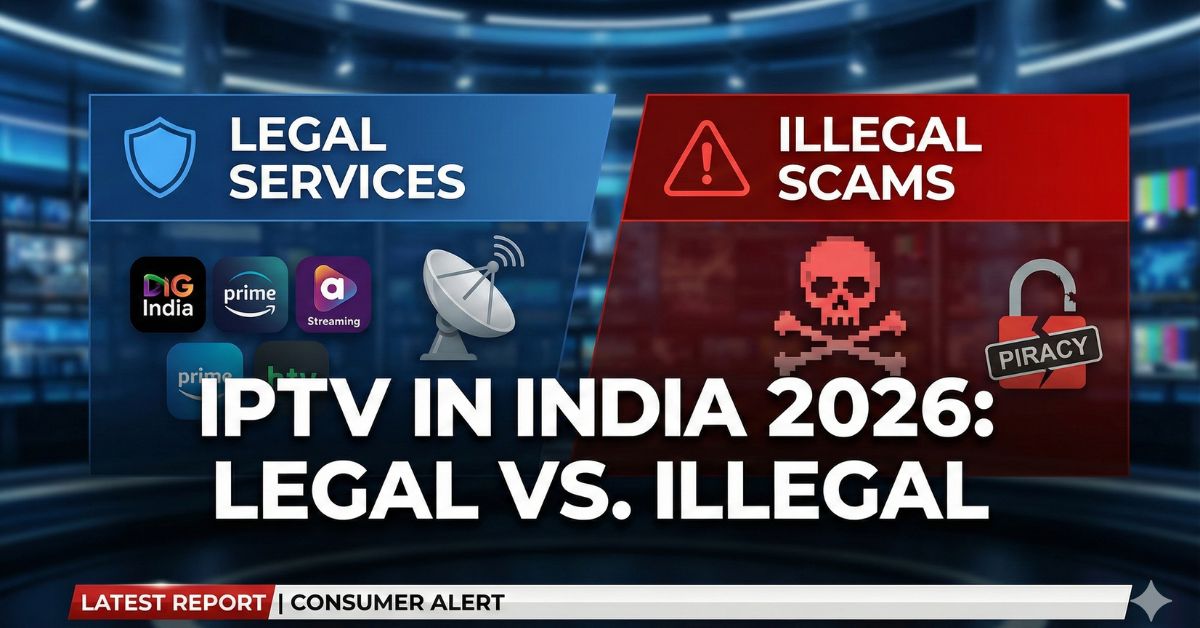
Legal vs. Illegal IPTV: Know the Difference
It is vital for every Indian user to know if their connection is safe.
1. Legal IPTV (Safe & Approved)
These are services provided by licensed telecom operators. They are 100% legal, safe, and offer high-quality 4K streaming.
- Reliance Jio (JioAirFiber / JioTV+): Bundles high-speed internet with hundreds of live TV channels. It uses a small smart box.
- Airtel (Xstream TV): Offers a similar hybrid box that allows you to watch satellite TV and internet content together.
- BSNL: Has partnered with providers like Ulka TV to offer IPTV solutions.
2. Illegal IPTV (Unsafe)
These are often sold as “Android Boxes” or “Magic Sticks” on social media or local electronic markets.
- The Trap: They promise “5000+ channels for free” or a very cheap lifetime fee (e.g., ₹2000 one-time).
- The Risk: The streams buffer constantly, the service can stop anytime (when raided), and your personal data is at risk. Using these services to access pirated content can also lead to legal trouble.
Why India is Switching to Legal IPTV
Despite the crackdown on the bad players, the good version of IPTV is booming. Here is why millions of Indians are switching to services like JioAirFiber and Airtel Xstream in 2026:
No More “Rain Fade”
We all hate it when the DTH signal goes away during heavy rain. Since IPTV comes through fiber-optic cables (internet), weather usually does not affect the signal.
Interactive Features
Legal IPTV boxes are smart.
- Catch-Up: Missed the 9 PM news? You can scroll back and watch it at 10 PM.
- Voice Search: You can just speak into the remote (“Play IPL match”) and it finds the channel.
- One Bill: You pay one bill for your Wi-Fi, TV, and OTT apps (like Hotstar or Netflix).
What Happens Next?
The future of TV in India is 100% digital. Experts predict that by the end of 2026, traditional cable setups will become rare in metro cities. The government is also working on new broadcasting policies to make sure all IPTV providers follow strict quality and security standards.
For consumers, the advice is simple: Stick to trusted brands. If a deal sounds too good to be true (like “Free Premium Channels forever”), it is likely a scam that could cost you much more than a monthly subscription.
Frequently Asked Questions (FAQs)
Q1: Is IPTV legal in India?
Yes, IPTV is completely legal if you use a licensed provider like Jio, Airtel, or BSNL. It is illegal to use unauthorized apps or boxes that stream pirated content.
Q2: Do I need a Smart TV for IPTV?
Not necessarily. Most IPTV services (like JioFiber or Airtel Xstream) come with a “Set-Top Box” that connects to any TV (even older LED/LCD models) via an HDMI cable.
Q3: How much internet speed do I need for IPTV?
For a smooth experience without buffering, you generally need a speed of at least 30 Mbps. For 4K quality channels, 100 Mbps or higher is recommended.
Q4: Can I watch IPTV on my mobile phone?
Yes. Legal providers usually have apps (like JioTV or Airtel Xstream Play) that let you watch your subscribed channels on your smartphone anywhere.
Q5: Why is my local cable operator offering an Android box?
Many local cable operators are upgrading to IPTV technology legally. Ask them if they are licensed or partnered with a major ISP. If they offer “unlimited free paid channels,” be cautious.